


Syrians in government-held areas of the war-torn country yesterday headed to polling stations to vote in a presidential election set to give Syrian President Bashar al-Assad a fourth seven-year term.
The vote is the second presidential election since the country’s conflict began 10 years ago and has been dismissed as a sham by the opposition and Western countries.
Two other candidates are running for the country’s top post, which has been held by members of the al-Assad family for five decades.
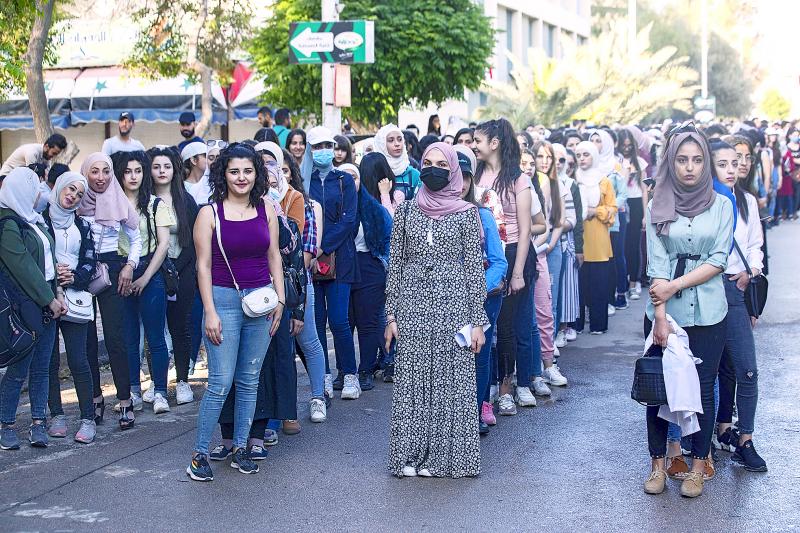
Photo: AP
They are little known figures, Abdullah Salloum Abdullah and Mahmoud Ahmad Marie.
However, competition with al-Assad is largely seen as symbolic.
Starting at 7am, thousands began arriving at polling stations in Damascus, where streets have been decorated with giant posters of al-Assad and banners praising his rule. Few posters of the two other candidates appeared in the streets.
“We choose the future. We choose Bashar al-Assad,” read one of many banners raised in the capital, Damascus.
No vote was to be held in northeast Syria, which is controlled by US-backed Kurdish-led fighters, or in the northwestern province of Idlib, which is the last major rebel stronghold in the country.
In some parts of government-held areas, including the southern provinces of Daraa and Sweida, many have rejected the vote, calling it “illegitimate.”
The Syrian Democratic Council, which runs daily affairs in northeast Syria, said in a statement that it would not take part in the vote “before political solutions in accordance with UN Security Council resolutions, release of detainees, return of displaced and putting the basis for a political structure far away from tyranny.”
On Sunday, Syrian Prime Minister Hussein Arnous traveled to Sweida along with a dozen Cabinet ministers in the first such visit in years to meet local officials.
There has reportedly been widespread anger against the vote and overspending on pro-al-Assad campaigns in the city at a time when much of the region’s population lives in poverty.
The vote comes as Syria’s economy is in free fall as a result of Western sanctions, government corruption and infighting, the COVID-19 pandemic and the financial crisis in Lebanon, Syria’s main link with the outside world.
Some of the voters waiting at polling stations were wearing masks.
Over the past three months, intensive care units in public hospitals in Damascus reached full capacity due to a sharp rise in COVID-19 infections, leading doctors to transfer patients to hospitals in other provinces.
In March, al-Assad and his wife, Asma, tested positive for the novel coronavirus.
The administration of US President Joe Biden has said it will not recognize the result of the Syrian election unless the voting is free, fair, supervised by the UN and represents all of Syrian society.
“We are not involved in these elections ... in any way, and we, of course, have no mandate to be,” UN secretary-general’s spokesman Stephane Dujarric told reporters at the UN on Tuesday.
“We are, of course, aware that the elections are taking place. It’s important to remind you in answering the question that ... these are being called under the auspices of the current constitution and not part of the political process that was established under resolution 2254,” Dujarric said.
Syrian Minister of the Interior Mohammad Rahmoun said that 12,102 polling stations were set up in all if Syria’s governorates.
He said there are more than 18 million eligible voters in Syria and abroad.
Syrians living abroad voted last week.
Syria had a population of 23 million before the conflict broke out a decade ago. The fighting has left nearly 500,000 dead and half the country’s population displaced, more than 5 million of them refugees outside Syria.
The civil war broke out in 2011 when Arab Spring-inspired protests against al-Assad family rule turned into an armed insurgency in response to a brutal military crackdown.
Al-Assad has been in power since 2000, when he took over from his father, former Syrian president Hafez al-Assad, who ruled before that for 30 years.
Despite the war, which seemed at one point to threaten his rule, Bashar al-Assad remained in power supported by regional powerhouse Iran and Russia, which sent in military advisers and air power to push back the armed opposition.
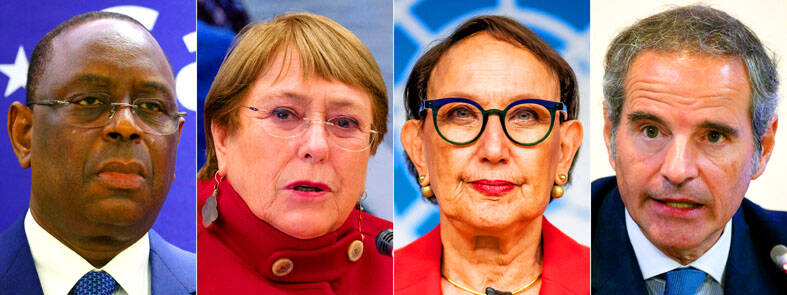
Four contenders are squaring up to succeed Antonio Guterres as secretary-general of the UN, which faces unprecedented global instability, wars and its own crushing budget crisis. Chile’s Michelle Bachelet, Argentina’s Rafael Grossi, Costa Rica’s Rebeca Grynspan and Senegal’s Macky Sall are each to face grillings by 193 member states and non-governmental organizations for three hours today and tomorrow. It is only the second time the UN has held a public question-and-answer, a format created in 2016 to boost transparency. Ultimately the five permanent members of the UN’s top body, the Security Council, hold the power, wielding vetoes over who leads the
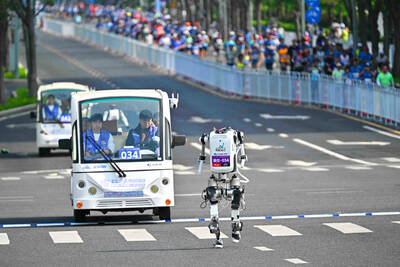
A humanoid robot that won a half-marathon race for robots in Beijing on Sunday ran faster than the human world record in a show of China’s technological leaps. The winner from Honor, a Chinese smartphone maker, completed the 21km race in 50 minutes and 26 seconds, said a WeChat post by the Beijing Economic-Technological Development Area, also known as Beijing E-Town, where the race began. That was faster than the human world record holder, Ugandan Jacob Kiplimo, who finished the same distance in about 57 minutes in March at the Lisbon road race. The performance by the robot marked a significant step forward

An earthquake registering a preliminary magnitude of 7.7 off northern Japan on Monday prompted a short-lived tsunami alert and the advisory of a higher risk of a possible mega-quake for coastal areas there. The Cabinet Office and the Japan Meteorological Agency said there was a 1% chance for a mega-quake, compared to a 0.1% chance during normal times, in the next week or so following the powerful quake near the Chishima and Japan trenches. Officials said the advisory was not a quake prediction but urged residents in 182 towns along the northeastern coasts to raise their preparedness while continuing their daily lives. Prime
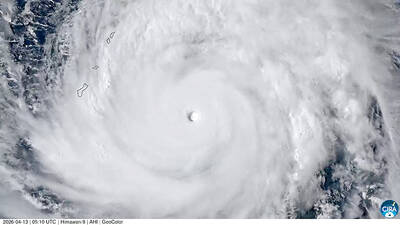
HAZARDOUS CONDITION: The typhoon’s sheer size, with winds extending 443km from its center, slowed down the ability of responders to help communities, an official said The US Coast Guard was searching for six people after losing contact with their disabled boat off the coast of Guam following Typhoon Sinlaku. The crew of the 44m dry cargo vessel, the US-registered Mariana, on Wednesday notified the coast guard that the boat had lost its starboard engine and needed assistance, Petty Officer 3rd Class Avery Tibbets said yesterday. The coast guard set up a one-hour communication schedule with the vessel, but lost contact on Thursday. A Coast Guard HC-130 Hercules aircraft was launched to search for the six people on board, but it had to return to Guam because of


 RSS
RSS