


Once the winter residence of sultans from illustrious Islamic dynasties, the ruins of a thousand-year-old royal city in southern Afghanistan have become home to hundreds of people who have fled Taliban clashes.
The astonishing ocher clay complex juts from the cliffs along the Helmand River, threatened by decay and encroaching urban sprawl, as well as the makeshift constructions that have grown within it.
Thousands of people have been displaced across Helmand Province since October last year following a surge in Taliban attacks, and while many have resettled in the capital, Lashkar Gah — one of the few areas in the province still under government control — some have joined other refugees in the ruins.
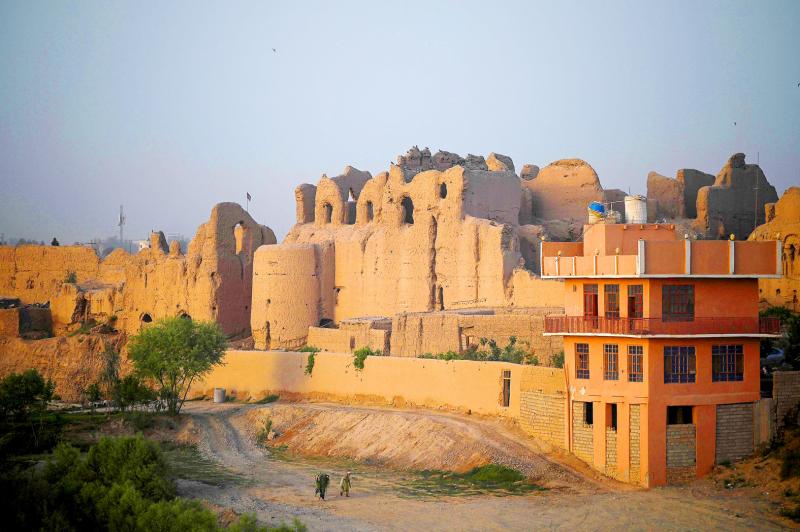
Photo: AFP
Qala-e-Kohna, as it is known locally, or Lashkari Bazar to archeologists, has garnered international attention for its scale, remarkable architecture and murals.
Spread over 10km, the site is the only known winter residence of the Ghaznavid and Ghurid sultans — two dynasties that ruled a region covering present-day Afghanistan between the 10th and 13th centuries who were responsible for spreading Islamic art as far as north India.
“There is no place in the Islamic world where we have something like it — a site as coherent, elaborate and, despite everything, still relatively well preserved,” said Philippe Marquis, the director of the French Archaeological Delegation in Afghanistan (DAFA). “It is important to preserve it because we are sure that it will teach us a lot about this period.”
Among the ancient towers, doors and windows have been added, and crumbling walls coated with a clay and straw mixture to strengthen them and plug gaps.
A blue wrought-iron door leads into Agha Mohammad’s cramped two-room quarters that house 11 people, a makeshift cradle for his infant son hanging from a bamboo roof.
“I want the government to give me a place to live. Look at the cracks in the roof. I’m afraid one night it will fall,” said Mohammad, a 33-year-old police officer whose district fell to a resurgent Taliban.
Southern Afghanistan has seen renewed fighting as talks between the Afghan government and Taliban leaders have stalled, and the US prepares to withdraw the last of its troops from the nation by September.
“I should have the support of the government, because I lost three sons serving it,” 48-year-old mother Bibi Halima said from within the palace walls.
“Every house is full of widows,” a neighbor added.
Many of the residents are families of police officers who cannot afford to live elsewhere and have no access to electricity or running water.
An official from the country’s archeology department in Kabul said that there had been reports of land-grabbing at the site, with some families forced to pay rent to local mafia.
For residents, life within the ornate arches and adobe walls of the former royal city is a constant reminder of how the nation has yet to emerge from a cycle of battles against invasion and civil war.
“It is a place for ghosts, not humans,” Khudai Nazar, 54, said.
First explored by the DAFA in the 1950s, the site has seen no conservation work since then.
At that time, archeologists identified the palaces, mosque and other buildings, such as the pottery and craft workshops, as well as ice boxes used for the preservation of fresh food.
One of the most striking excavations was a series of paintings depicting court scenes, extremely rare for an era in which the realistic representation of living beings was already frowned upon in Islamic societies.
Moved to the Kabul museum, the paintings were destroyed or stolen during the Afghan civil war in the 1990s and only photographs remain.
Marquis is now concerned about the impact looters and displaced families would have at the site — as well as the effects of climate change, which could cause the river to flood. On the flip side, reinforcements made from clay and straw that have been added to the partly collapsed towers might have also resulted in their temporary preservation.
“The paradox is that in their own way people are protecting the place, because it is their home,” Marquis said.
He proposed building an “archeological park” that involves displaced people in the conservation process so they can earn a living and settle outside the palace walls, but for author Shah Mahmud Haseat, who has written a book about the citadel, the future of the largely unexplored ruins remains bleak.
“I tried to convince the government to protect the site, but they did nothing. We are really afraid that our history will be destroyed,” he said.

‘CROSSING THE LINE’: China’s embassy in Seoul criticized US Forces Korea Commander General Xavier Brunson, asking if his ‘hostile’ remarks were authorized by Washington South Korea and the US are in talks over recent public remarks by the commander of US Forces Korea, Seoul’s presidential office said yesterday, after the comments drew sharp criticism from China. In a recent podcast interview, US Forces Korea Commander General Xavier Brunson described South Korea as “the dagger in the heart of Asia” from China’s east coast, prompting the Chinese embassy in Seoul to say that he had “truly crossed the line.” The interview came amid growing speculation that Washington might seek to expand the role of US Forces Korea in countering the growing regional influence of China, a key

Through the noise of rushing papers and whirring belts at a print factory in Kyoto, two creators watch their photo essay come to life in broadsheet form — part of an effort to win new audiences in the age of artificial intelligence (AI). Despite the decline of the publishing industry, self-publication and handmade “zine” magazines are growing in popularity in Japan, reflecting the nation’s enduring love of paper in the digital era. While speaking to Agence France-Presse at the plant, his hands black with ink, one of the creators, Kazuma Obara, said: “I think [paper] is a medium that engages all five

Australian researchers have trained lab-grown brain cells on a silicon computer chip to play the 1990s shooter game Doom and said they are just scratching the surface of what the neurons could be capable of doing. It is the science-fiction work of biotech boffins at Cortical Labs, who researched and developed the technology that harnesses the workings of the brain’s networking system. Each so-called “biological computer” contains about 200,000 living human brain cells, grown from stem cells that were harvested from blood donations. Having mastered the simple computer game Pong, where a paddle is moved up and down to send a ball

A surprising gut feeling may help pigeons find their way home. Animals use various techniques to navigate, including following the stars and remembering key landmarks. Birds, fish and turtles orient themselves using Earth’s magnetic field as a compass, but it is not yet clear how exactly they do this. Pigeons are a well-known group of frequent flyers that can traverse hundreds of kilometers in a single day. For thousands of years, humans have used them to carry news, notes and military messages. Scientists have long tried to untangle how pigeons travel without getting lost. Some think the birds detect magnetic cues using light-sensitive


 RSS
RSS