


Japan yesterday began COVID-19 vaccinations for its sizeable elderly population, with imported doses still in short supply and the pace unlikely to stop a fourth wave of infections.
Shots for people aged 65 and above began at about 120 sites across the nation, using Pfizer Inc’s vaccine made in Europe and delivered to the regions in the past week.
Just 2,810 people in Tokyo are expected to get a shot from the first batch, while most regions are to receive 1,000 doses or fewer, a Japanese Ministry of Health, Labour and Welfare schedule showed.
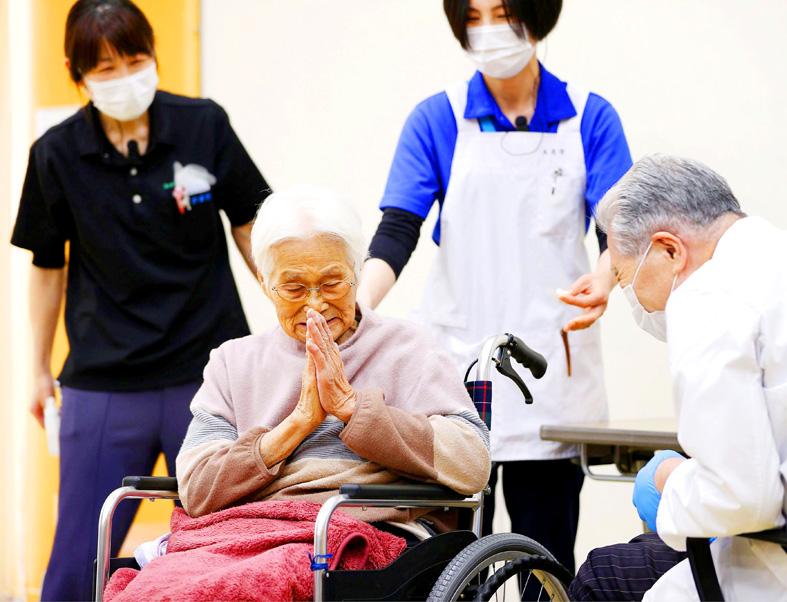
Photo: Reuters / Kyodo
Japan has a rapidly aging population totaling 126 million.
Touring a vaccination center in Hachioji, west of Tokyo, Japanese Prime Minister Yoshihide Suga said that he expected to secure about 100 million vaccine doses by the end of June, more than enough to give two doses to the elderly population of 36 million.
“We would like to deliver [the vaccine] to as many people as possible, as soon as possible,” Suga said.
Tokyo yesterday implemented a month-long period of quasi-emergency disease prevention measures to blunt a fourth wave driven by virulent mutant strains, and with the planned start of the Summer Olympic Games just over 100 days away.
Shots for most of the population are not likely to be available until late summer or even winter, too late to stem a resurgence of cases that appears to be focused on people in their 30s and 40s, said Haruka Sakamoto, a physician and researcher at Keio University in Tokyo.
“The currently available vaccination cannot prevent the fourth wave of the pandemic,” Sakamoto said. “I think the younger generation is now going to be more greatly affected compared with the previous waves.”
Japan was among the last major economies to begin COVID-19 inoculations when it started in mid-February, after domestic trials to ensure safety. Japan is dependent on Pfizer’s vaccine as the only COVID-19 shot approved by domestic regulators.
About 1.1 million people in Japan, mostly frontline healthcare workers, have received at least one dose of the Pfizer vaccine’s two-shot regimen so far.
Japanese Minister for Administrative Reform and Regulatory Reform Taro Kono, who is in charge of vaccinations, has defended the pace, saying local governments wanted time to prepare.
“After tomorrow, we will inform the prefectures how much we can distribute and they will decide how much to allocate to each municipality,” Kono told national broadcaster NHK on Sunday.

The pitch is a classic: A young celebrity with no climbing experience spends a year in hard training and scales Mount Everest, succeeding against some — if not all — odds. French YouTuber Ines Benazzouz, known as Inoxtag, brought the story to life with a two-hour-plus documentary about his year preparing for the ultimate challenge. The film, titled Kaizen, proved a smash hit on its release last weekend. Young fans queued around the block to get into a preview screening in Paris, with Inoxtag’s management on Monday saying the film had smashed the box office record for a special cinema

CRITICISM: ‘One has to choose the lesser of two evils,’ Pope Francis said, as he criticized Trump’s anti-immigrant policies and Harris’ pro-choice position Pope Francis on Friday accused both former US president Donald Trump and US Vice President Kamala Harris of being “against life” as he returned to Rome from a 12-day tour of the Asia-Pacific region. The 87-year-old pontiff’s comments on the US presidential hopefuls came as he defied health concerns to connect with believers from the jungle of Papua New Guinea to the skyscrapers of Singapore. It was Francis’ longest trip in duration and distance since becoming head of the world’s nearly 1.4 billion Roman Catholics more than 11 years ago. Despite the marathon visit, he held a long and spirited

‘DISAPPEARED COMPLETELY’: The melting of thousands of glaciers is a major threat to people in the landlocked region that already suffers from a water shortage Near a wooden hut high up in the Kyrgyz mountains, scientist Gulbara Omorova walked to a pile of gray rocks, reminiscing how the same spot was a glacier just a few years ago. At an altitude of 4,000m, the 35-year-old researcher is surrounded by the giant peaks of the towering Tian Shan range that also stretches into China, Kazakhstan and Uzbekistan. The area is home to thousands of glaciers that are melting at an alarming rate in Central Asia, already hard-hit by climate change. A glaciologist, Omarova is recording that process — worried about the future. She hiked six hours to get to

The number of people in Japan aged 100 or older has hit a record high of more than 95,000, almost 90 percent of whom are women, government data showed yesterday. The figures further highlight the slow-burning demographic crisis gripping the world’s fourth-biggest economy as its population ages and shrinks. As of Sept. 1, Japan had 95,119 centenarians, up 2,980 year-on-year, with 83,958 of them women and 11,161 men, the Japanese Ministry of Health said in a statement. On Sunday, separate government data showed that the number of over-65s has hit a record high of 36.25 million, accounting for 29.3 percent of


 RSS
RSS