


Fresh lockdowns and curfews were imposed on tens of millions of people from India to Argentina yesterday, as COVID-19 infections surged again, and vaccine rollouts were hampered by shortages and scares over side effects.
In India, the worst-hit state of Maharashtra was running out of vaccines as the health system buckled under the weight of the contagion, which has killed 2.9 million people worldwide.
Having let its guard down with mass religious festivals, political rallies and spectators at cricket matches, the world’s second-most populous nation has added more than 1 million new infections since late last month.
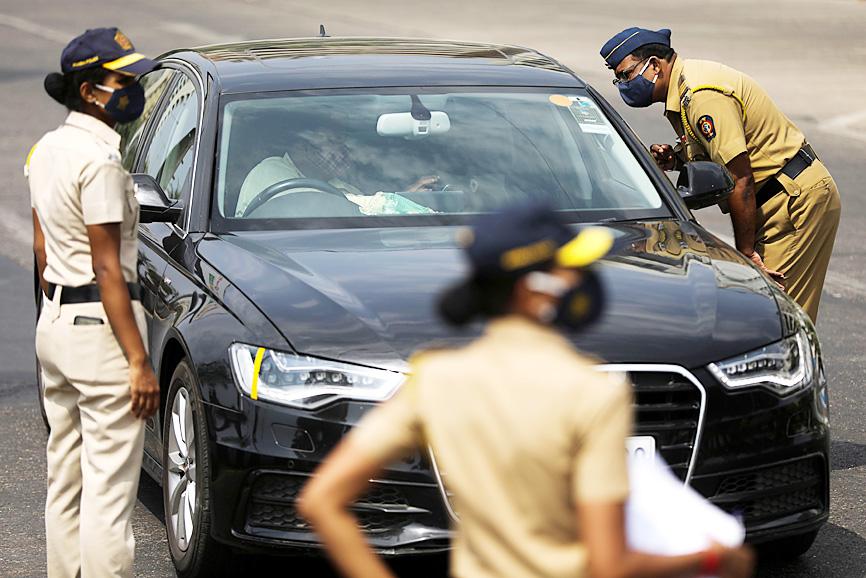
Photo: Reuters
Every weekend from yesterday until the end of this month, Maharashtra’s 125 million people are to be confined to their homes unless traveling or shopping for food or medicine.
“I’m not for the lockdown at all, but I don’t think the government has any other choice,” media professional Neha Tyagi, 27, told reporters in Maharashtra’s megacity, Mumbai. “This lockdown could have been totally avoided if people would take the virus seriously.”
The crisis is being exacerbated by a shortage of vaccines.
India has inoculated 94 million of its 1.3 billion people, but The Times of India on Friday reported that states on average had just more than five days of stock left, citing Indian Ministry of Health data, with some regions already grappling with severe shortages.
Stay-at-home orders were also set to come into force for the 8 million inhabitants of Bogota, as the Colombian capital battled a third wave of infections, adding to curfews already covering 7 million across four other major cities.
Elsewhere in South America, Argentina on Friday entered a nighttime curfew running from midnight to 6am every day until the end of this month.
It would be in force in the country’s highest-risk areas, mainly urban centers, where bars and restaurants are to close at 11pm.
Both Argentina and Colombia have recorded about 2.5 million COVID-19 cases, numbers surpassed only by Brazil in the region.
All of France is subject to restrictions of some form, while the German government’s attempts to curb movement and commerce have been stymied by several states refusing to go along with the proposals.
Berlin is changing the rules to centralize power, adjustments likely to usher in nighttime curfews and some school closures in especially hard-hit areas.
However, some countries were in the process of opening up.
Italy was set to end lockdowns from next week for Lombardy, the epicenter of its COVID-19 outbreak, and several other regions with improving contagion statistics.
Neighboring Slovenia announced that it would ease coronavirus restrictions and suspend a six-month-long curfew starting tomorrow.
As in India, Europe’s stuttering vaccine rollout faced multiple hurdles on Friday as EU regulators said they were reviewing side effects of the Johnson & Johnson shot and France further limited its use of the AstraZeneca jab.
France has repeatedly changed the rules on AstraZeneca’s vaccine, first over doubts about its efficacy, then over fears that it could be linked to blood clots.
On Friday, it did so again, with French Minister of Health Olivier Veran saying under-55s who had been given a first shot with AstraZeneca would be given a different vaccine for their second dose.
However, shortly after he spoke, the WHO said there was “no adequate data” to support switching COVID-19 vaccines between doses.
As for the Johnson & Johnson shot, the European Medicines Agency said four “serious cases” of unusual blood clots had been reported — one of them fatal — with the vaccine, which uses similar technology to the AstraZeneca one.
The US Food and Drug Administration said it had found no causal link between the jab and clots, but said “a few individuals” in the country had clots and low levels of platelets in the blood after receiving the vaccine, and its investigation was continuing.
Both jabs are approved for use in the EU, but the Johnson & Johnson vaccine has not yet been rolled out, and various EU countries have stopped or limited the use of AstraZeneca’s.
An AstraZeneca spokesman said half of its vaccine shipments to the EU would be delayed this week.
In the US, deliveries of the Johnson & Johnson vaccine were set to drop off sharply next week, US health authorities said on Friday.

Chinese President Xi Jinping (習近平) is to visit Russia next month for a summit of the BRICS bloc of developing economies, Chinese Minister of Foreign Affairs Wang Yi (王毅) said on Thursday, a move that comes as Moscow and Beijing seek to counter the West’s global influence. Xi’s visit to Russia would be his second since the Kremlin sent troops into Ukraine in February 2022. China claims to take a neutral position in the conflict, but it has backed the Kremlin’s contentions that Russia’s action was provoked by the West, and it continues to supply key components needed by Moscow for

Japan scrambled fighter jets after Russian aircraft flew around the archipelago for the first time in five years, Tokyo said yesterday. From Thursday morning to afternoon, the Russian Tu-142 aircraft flew from the sea between Japan and South Korea toward the southern Okinawa region, the Japanese Ministry of Defense said in a statement. They then traveled north over the Pacific Ocean and finished their journey off the northern island of Hokkaido, it added. The planes did not enter Japanese airspace, but flew over an area subject to a territorial dispute between Japan and Russia, a ministry official said. “In response, we mobilized Air Self-Defense

CRITICISM: ‘One has to choose the lesser of two evils,’ Pope Francis said, as he criticized Trump’s anti-immigrant policies and Harris’ pro-choice position Pope Francis on Friday accused both former US president Donald Trump and US Vice President Kamala Harris of being “against life” as he returned to Rome from a 12-day tour of the Asia-Pacific region. The 87-year-old pontiff’s comments on the US presidential hopefuls came as he defied health concerns to connect with believers from the jungle of Papua New Guinea to the skyscrapers of Singapore. It was Francis’ longest trip in duration and distance since becoming head of the world’s nearly 1.4 billion Roman Catholics more than 11 years ago. Despite the marathon visit, he held a long and spirited

China would train thousands of foreign law enforcement officers to see the world order “develop in a more fair, reasonable and efficient direction,” its minister for public security has said. “We will [also] send police consultants to countries in need to conduct training to help them quickly and effectively improve their law enforcement capabilities,” Chinese Minister of Public Security Wang Xiaohong (王小洪) told an annual global security forum. Wang made the announcement in the eastern city of Lianyungang on Monday in front of law enforcement representatives from 122 countries, regions and international organizations such as Interpol. The forum is part of ongoing


 RSS
RSS