


Accusations that officials at South Korea’s state housing corporation tried to use insider information to cash in on runaway property prices has thrown new fuel on an issue that is draining support from the ruling party ahead of key elections.
Police yesterday said they were serving search and seizure warrants at the headquarters of Korea Land and Housing Corp in Jinju, south of Seoul, to gather evidence of illegal property speculation by employees.
The police raids came one day after South Korean President Moon Jae-in called for an investigation into allegations that at least 13 employees at Korea Land and Housing had acted on insider information and bought undeveloped land near Seoul before the government unveiled a new town development project in the area.
Median apartment prices in Seoul — where about a fifth of South Koreans live — have soared nearly 60 percent since May 2017 when Moon came into office, despite repeated government interventions to try to cool down the market.
Housing affordability has become a political headache for Moon, whose historically high levels of support have been eroded by scandals, high unemployment and slow economic growth.
The property speculation furor comes a month before a by-election that is to decide several key offices, including the mayors of the nation’s two largest cities, Seoul and Busan.
Polls show Moon’s Democratic Party is likely to lose control of Seoul’s municipal government for the first time in a decade, and would struggle to retain power in Busan after the incumbent mayor resigned amid a sexual harassment scandal.
With a year to go until the next national presidential election, polls also suggest the housing scandal is boosting the conservative opposition, which has been in disarray since the impeachment of former South Korean president Park Geun-hye in 2017.
“The soaring house prices, already causing pain to the public, combined with the scandals in the Moon administration will result in public resentment,” said Kwon Huck-ju, a professor of public policy at Seoul National University.
The insider-trading allegations surfaced last week after civic groups accused more than a dozen current and former employees of Korea Land and Housing of speculating in land in two satellite cities of Gwangmyeong and Siheung in Gyeonggi Province, less than 20km southwest of Seoul.
One of the groups, the human rights lawyers’ collective Minbyun, said that from April 2018 to June last year, land corporation employees and their spouses had purchased 10 plots for a total of about 10 billion won (US$8.8 million).
The state-run corporation has subsequently confirmed the purchase of 12 plots by 13 employees over three years, according to a document provided to a ruling party lawmaker.
The aim of the new development project is to decentralize Seoul by turning farmland into a self-sufficient town powered by an industrial complex and full infrastructure, said Yeo Kyoung-hui, a property market analyst at Real Estate 114 Inc.
“Since these new towns have a full renewable capacity of their own with residential and work areas and the infrastructure that connects to Seoul, those who couldn’t afford housing in Seoul would move away and drive up the price,” Yeo said.
Since its launch in 2009, the state housing corporation has developed residential areas, new towns and industrial complexes, including the inter-Korean Kaesong industrial park in North Korea, with the aim to improve quality of life and develop the national economy by creating stable housing.

Crowds in Bangladesh are flocking to snap photographs with an unlikely social media star — an albino buffalo with flowing blond hair nicknamed “Donald Trump” that is due to be sacrificed within days. Owner Zia Uddin Mridha, 38, said his brother named the 700kg bull over its flowing helmet of hair resembling the signature look of the US president. “My younger brother picked this name because of the buffalo’s extraordinary hair,” he said at his farm in Narayanganj, just outside the capital, Dhaka. Mridha said that a constant stream of curious visitors — social media fans, onlookers and children — have come throughout
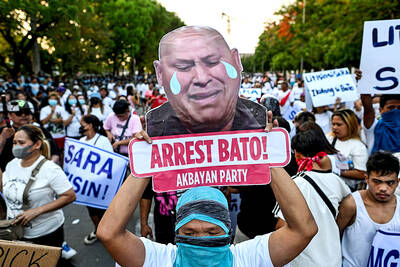
The Philippines said it has asked the country’s Supreme Court to allow it to arrest former Philippine president Rodrigo Duterte’s chief drug war enforcer to stand trial in an international tribunal. The International Criminal Court (ICC) last week unsealed an arrest warrant against Philippine Senator Ronald dela Rosa, accusing him along with Duterte and other “coperpetrators” of the “crime against humanity of murder.” Dela Rosa briefly sought refuge in the Philippine Senate last week while asking the Philippine Supreme Court to stop an ongoing attempt by government agents to arrest him. “By his own conduct, he has placed himself outside the protection of

The researchers in Ireland looked at their computer screen, marveling at a medieval book tracked down in a Roman library. They flipped through its digitized pages and found their sought-after treasure: the oldest surviving English poem. “We were extremely surprised. We were speechless. We couldn’t believe our eyes when we first saw that,” said Elisabetta Magnanti, a visiting research fellow at Trinity College Dublin’s school of English. The poem was also within the main body of Latin text, she said, calling it “extraordinary.” Composed in Old English by a Northumbrian agricultural worker in the 7th century, Caedmon’s Hymn appears within some copies of

It began as a satirical online project. Now millions of young people in India are flocking to it as an outlet for their frustration. A parody political party called the Cockroach Janta Party, with the insect as its symbol, has exploded across India’s social media by turning absurdist humor into protest. Memes and short videos mocking corruption, joblessness and political dysfunction have flooded social media sites, where millions of users are embracing the cockroach — known for its ability to survive harsh conditions — as a tongue-in-cheek symbol of endurance. The online movement’s rise has been unusually rapid. The Cockroach Janta Party (CJP)


 RSS
RSS