


An endangered turtle bred in captivity laid eggs for the first time in Cambodia, conservationists said on Tuesday, in a massive win for animal protection in the kingdom.
The animal was among five royal turtles — once feared extinct in the country — that laid dozens of eggs.
Cambodia is home to several populations of endangered turtles, whose numbers have dwindled due to demand for them in Vietnam and China as delicacies, and for use in traditional medicine.
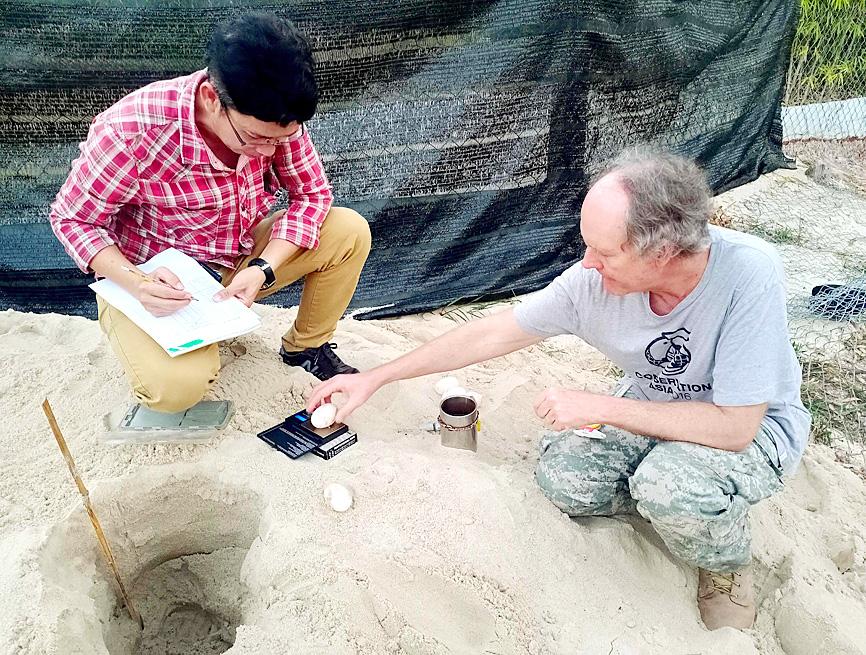
Photo: AFP / Wildlife Conservation Society
Royal turtles, formally classified as southern river terrapins, were pushed to the brink of extinction by hunting and sand mining, which destroys the banks where they lay their eggs.
The damage was so severe that in 2000 they were feared wiped out in Cambodia, before nests were found and a careful conservation effort began.
Wildlife Conservation Society (WCS) Cambodia announced that four royal turtles bred in captivity — and one that was handed to its conservation center in Cambodia’s southwestern Koh Kong Province — had successfully laid 71 eggs.
“It’s the first time that the captive female royal turtles have ever laid eggs since they were head-started at the center in 2006,” WCS project manager Som Sitha said. “The team will make artificial nests for incubation purposes or leave them as they are.”
Given the rarity of the species in the wild, the successful egg laying is considered a massive win for Cambodia.
“We anticipate soon being able to produce large numbers of royal turtles in captivity and releasing them back into the wild,” said Steven Platt, a herpetologist with the WCS.
Since conservation efforts started, scores of royal turtles have been released back into the wild.
They come from eggs laid in the wild and taken into captivity, to protect them from the dangers that threaten the species’ numbers.
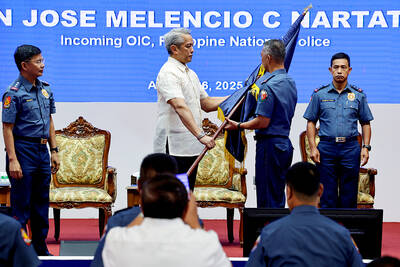
Philippine President Ferdinand Marcos Jr has fired his national police chief, who gained attention for leading the separate arrests of former Philippine president Rodrigo Duterte on orders of the International Criminal Court and televangelist Apollo Carreon Quiboloy, who is on the FBI’s most-wanted list for alleged child sex trafficking. Philippine Executive Secretary Lucas Bersamin did not cite a reason for the removal of General Nicolas Torre as head of the 232,000-member national police force, a position he was appointed to by Marcos in May and which he would have held until 2027. He was replaced by another senior police general, Jose

POWER CONFLICT: The US president threatened to deploy National Guards in Baltimore. US media reports said he is also planning to station troops in Chicago US President Donald Trump on Sunday threatened to deploy National Guard troops to yet another Democratic stronghold, the Maryland city of Baltimore, as he seeks to expand his crackdown on crime and immigration. The Republican’s latest online rant about an “out of control, crime-ridden” city comes as Democratic state leaders — including Maryland Governor Wes Moore — line up to berate Trump on a high-profile political stage. Trump this month deployed the National Guard to the streets of Washington, in a widely criticized show of force the president said amounts to a federal takeover of US capital policing. The Guard began carrying

Ukrainian drone attacks overnight on several Russian power and energy facilities forced capacity reduction at the Kursk Nuclear Power Plant and set a fuel export terminal in Ust-Luga on fire, Russian officials said yesterday. A drone attack on the Kursk nuclear plant, not far from the border with Ukraine, damaged an auxiliary transformer and led to 50 percent reduction in the operating capacity at unit three of the plant, the plant’s press service said. There were no injuries and a fire sparked by the attack was promptly extinguished, the plant said. Radiation levels at the site and in the surrounding
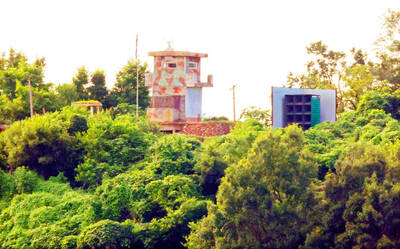
‘DELIBERATE PROVOCATION’: Pyongyang said that Seoul had used a machine gun to fire at North Korean troops who were working to permanently seal the southern border South Korea fired warning shots at North Korean soldiers that briefly crossed the heavily fortified border earlier this week, Seoul said yesterday after Pyongyang accused it of risking “uncontrollable” tensions. South Korean President Lee Jae-myung has sought warmer ties with the nuclear-armed North and vowed to build “military trust,” but Pyongyang has said it has no interest in improving relations with Seoul. Seoul’s military said several North Korean soldiers crossed the border on Tuesday while working in the heavily mined demilitarized zone (DMZ) separating the two Koreas. The incursion prompted “our military to fire warning shots,” South Korea’s Joint Chiefs of Staff


 RSS
RSS