

Ahead of the 10th anniversary of Arab Spring demonstrations in Bahrain, the authorities have increasingly sought to erase memories of the mass protests that threatened the Sunni monarchy’s grip on power.
Dissent persists in the tiny kingdom with a majority-Shiite population off the eastern coast of Saudi Arabia. Police have been out in force in city streets over the past week, residents said, taking no chances on renewed demonstration.
A Web site for the Bahrain Independent Commission of Inquiry, commissioned by King Hamad bin Isa Al Khalifa, that had hosted an independent report on the 2011 protests and the government crackdown that ended them, went mysteriously offline before it was restored on Thursday.
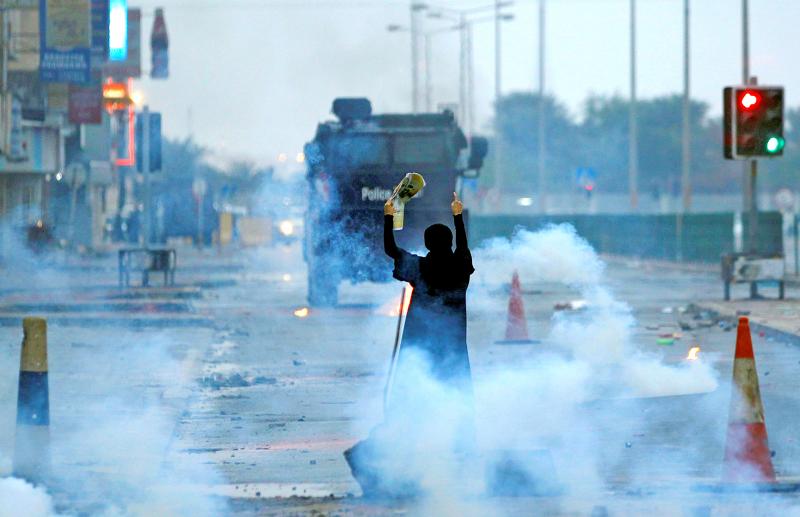
Photo: Reuters
The government described it as a “technical glitch,” without elaborating.
For weeks starting on Feb. 14, 2011, thousands thronged streets across Bahrain, emboldened and energized by pro-democracy protests roiling Egypt, Syria, Tunisia and Yemen. Bahrain’s protests were organized primarily by the nation’s Shiites seeking greater political rights in the Persian Gulf state, which is a key Western ally and home to the US Navy’s 5th Fleet.
“It was overwhelming,” said Nazeeha Saeed, a reporter at the time for a French TV news channel, describing the heady days in Pearl Roundabout, the symbolic center of the capital, Manama, later bulldozed by authorities.
“I’d never seen anything like it. People forgot we were a Persian Gulf kingdom supported by powerful monarchies,” she said.
Then, everything went horribly wrong, Saeed said.
Security forces tried to disperse the sit-in, responding to protests with torrents of tear gas, rubber bullets and in some cases live fire. Police shot a protester in the head just 20m in front of her.
She said she was detained and beaten for telling foreign journalists what she saw.
Now in exile in Berlin, Saeed said she cannot return home.
Bahrain in 2017 fined her US$2,650 for working with a government-issued press card.
The government at the same time refused to accredit two Associated Press journalists and since then has tightly controlled visas to report on the island.
As violence escalated over the weeks in February 2011, demonstrations snowballed into a popular movement crossing sectarian divides. Calls for constitutional reform turned into demands for the dismantling of the country’s political structure.
The monarchy turned to Saudi Arabia and the United Arab Emirates for help, inviting in foreign troops to crush the protests.
In the time since 2011, authorities have targeted not only Shiite political groups and religious leaders, but also human rights activists, journalists and online opponents. Mass trials have become commonplace. Political parties have been dismantled. Independent news gathering on the island has become increasingly difficult.
Meanwhile, there have been sporadic, low-level attacks on police and other targets by Shiite militant groups.

Japan has started its first nationwide survey of animal cafes amid concerns over animal welfare, hygiene and public health, a government official said, bringing greater scrutiny to the popular but lightly regulated sector. The desktop survey, which began this month, will examine the number of facilities, the types of animals they house and the conditions they are held in, and how visitors interact with the animals. Exotic animal cafes, where visitors can interact with species ranging from otters to owls and marmots, have become popular attractions for Japanese and foreign tourists. However, researchers say some facilities keep threatened species, raising
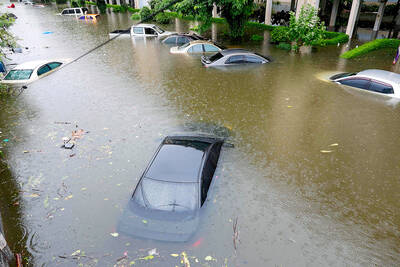
Several areas of Thailand’s capital city Bangkok were inundated by continuous rain from Thursday afternoon to yesterday morning that has disrupted traffic and forced some residents to evacuate. Major canals in Bangkok filled with accumulated rainfall exceeding 20cm, officials said yesterday. Floodwaters spread across the city, particularly in the central and eastern parts, blocking roads and stopping traffic. The Thai Meteorological Department warned that the heavy rain would continue in most parts of the country through today, citing a strong low-pressure system over the central region and strengthening southwest monsoon conditions. More than 84,000 people in 21 provinces nationwide were

Yemen’s Saudi-led coalition early yesterday said it had intercepted two ballistic missiles and two drones launched by the Iran-backed Houthis toward the kingdom. The coalition said in posts on social media that the missiles were headed towards Khamis Mushait and the drones toward the capital, Riyadh, adding that it was monitoring the missile threat and drones launched at the kingdom, without providing further details. The Saudi Civil Defense had sent alerts overnight for Khamis Mushait and Abha, but not for Riyadh. The Houthis, who control the most populous parts of Yemen and much of the north, have been launching attacks
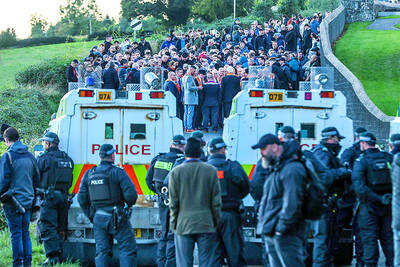
OLD WOUNDS: Protestant marchers seized on an overturned injunction to stage a march, which drew thousands of counterprotesters to block the road in Portadown UK leaders called for calm as a tense standoff with residents seeking to halt a pro-British Protestant march through a primarily Catholic area stretched into the night on Sunday, in one of the worst crises for Northern Ireland in the past few years. The tensions were triggered after a Belfast appeal court overturned a High Court injunction in the early hours of Sunday to clear the march by the Orange Order to go ahead for the first time since 1997. The Parades Commission, Northern Ireland’s independent body regulating contentious processions, had authorized 35 Orangemen to march silently along Garvaghy Road in Portadown,


 RSS
RSS