


A citizen journalist detained for more than six months after reporting on the Wuhan COVID-19 outbreak has had a feeding tube forcibly inserted and her arms restrained to stop her from pulling it out, her lawyer has said.
Zhang Zhan (張展), a 37-year-old former lawyer, has been on a hunger strike at a detention facility near Shanghai.
Zhang was arrested in May and accused of “picking quarrels and stirring up trouble,” an accusation frequently used against critics and rights advocates inside China, after reporting on social media and streaming accounts.
Last month, she was formally indicted on charges of spreading false information.
In a blog post on Wednesday, Zhang’s lawyer, Zhang Keke (張科科), said that he visited his client on Tuesday afternoon, and found her unwell and exhausted.
“She was wearing thick pajamas with a girdle around the waist, her left hand pinned in front and right hand pinned behind,” he wrote. “She said she had a stomach tube inserted recently and because she wanted to pull it out, she was restrained.”
Zhang Keke said that she was in “constant torment” from around-the-clock restraints and needed assistance to go to the bathroom.
“In addition to headache, dizziness and stomach pain, there was also pain in her mouth and throat. She said this might be inflammation due to the insertion of a gastric tube,” he added.
Zhang Keke told her that her family, friends and lawyers urged her to stop her hunger strike, but she refused, he said.
She said that she had expected a court hearing in December, but it appeared that there were no plans to hold one, he said, adding that she did not know if she could survive.
In 2018, Zhang Zhan was detained on similar accusations by Chinese authorities, and again last year, for expressing support for Hong Kong pro-democracy advocates.
She denies the charge of falsifying information, telling her lawyer that all of the information was gathered firsthand through interviews with Wuhan residents.
Zhang Zhan is among several Chinese journalists to have been arrested this year after traveling to Wuhan to report on the city’s response to the COVID-19 pandemic.
Chen Qiushi (陳秋實), a former lawyer turned journalist, was detained in January. Li Zehua (李澤華), who traveled to Wuhan to report after Chen’s disappearance, went missing in early February, but was released in April.
Wuhan resident Fang Bin (方斌), who reportedly posted footage of overwhelmed hospitals and filmed police knocking on his door, went missing at the same time, and has not been seen since.
This year, Beijing’s crackdown on human rights advocates and dissidents appears to have worsened.
Yesterday, Chinese Human Rights Defenders (CHRD) said that authorities this week detained lawyer Tang Jitian (唐吉田), and placed under apparent house arrest lawyers Xie Yanyi (謝燕益), Li Heping (李和平) and his family, Wang Quanzhang (王全璋) and his family, and the wife of lawyer Yu Wensheng (余文生).
Posting videos of some of the police action at the lawyers’ homes, CHRD accused authorities of turning International Human Rights Day “into a field day for attacking human rights defenders.”
Additional reporting by Lillian Yang
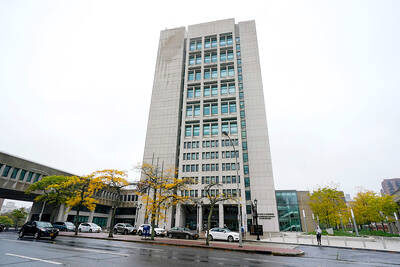
A coalition of civil rights groups on Tuesday asked a New York State judge to order one of its largest suburban counties to stop its deployment of nearly 600 license plate readers, calling it a warrantless and “indiscriminate surveillance system” that violates the state constitution. The class action lawsuit also alleged that Westchester County never got proper authorization to launch the program, which has amassed a database of 1.6 billion plate scans that has been shared with more than 50 outside law enforcement agencies. The complaint said the network “records the long-term travel patterns, daily habits, and intimate information of millions of
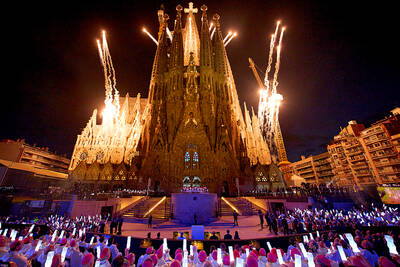
Pope Leo XIV on Wednesday blessed a giant new tower at Barcelona’s famed Sagrada Familia Basilica after celebrating mass inside what is now the world’s tallest church. A fireworks and light show illuminated the exterior of the temple at the end of the ceremony, bathing the unfinished basilica in shifting colours that highlighted its towering spires. A choir of 600 singers performed at the service which lasted around 90 minutes and was attended by Spanish Prime Minister Pedro Sanchez as well as King Felipe VI and Queen Letizia. The stained-glass windows in various colours shone brightly in between the tree-like
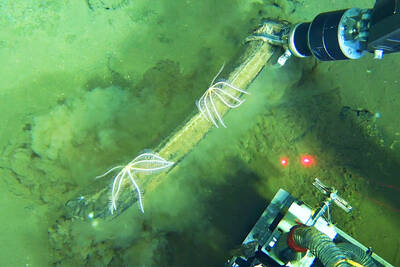
Scientists have discovered communities of marine life — including jellyfish, tubeworms and brittle stars — thriving on a whale graveyard. The graveyards form when whale carcasses fall to the sea floor, becoming a sustaining snack for nearby critters. This one, which is up to 7km below the surface of the southeastern Indian Ocean, spans the largest area, and is so far the deepest found. A whale’s sheer size and the unique chemistry of its bones are the keys to forming these unique underwater neighborhoods, said Song Xikun (宋希坤), a biologist with the Chinese Academy of Sciences’ Institute of Deep-sea Science and Engineering
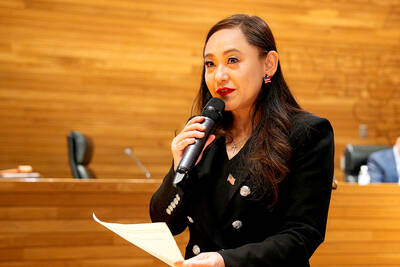
IMAGE ‘DAMAGED’? Ted Tseng, who emigrated to the US from Taiwan, was concerned the espionage case would deepen animosity against Asian Americans In 2024, voters in the Southern California city of Arcadia elected the first all-Asian city council in the city’s history. Now, one of those politicians has pleaded guilty to being an illegal agent of the Chinese government. Former Arcadia mayor Eileen Wang’s (王愛琳) plea, entered in federal court on Friday last year, continues a saga that some residents of the area worry could bring unfair scrutiny on the broader Chinese and Asian American community. Arcadia has gone under rapid demographic change in the past two decades as immigrants from Taiwan, China and Hong Kong flocked to the San Gabriel Valley


 RSS
RSS