


The vast underground cellars of Moldova’s Cricova winery used to echo with the sounds of hundreds of visitors. Now just a handful of guests wander past the huge barrels and endless rows of bottles holding its vintages.
“We used to have 300 to 450 people a day, but with the pandemic ... there are days when there are literally 15 people,” winery tour guide Vita Viznyuk told reporters in the cellars, her face covered by a black mask.
Impoverished Moldova, a tiny country wedged between Romania and Ukraine, has struggled to build a solid economy since gaining independence with the 1991 collapse of the Soviet Union.

Photo: AFP
One of the few bright spots has been its long-established wine industry, well-known in eastern Europe, with significant exports to Russia, Romania, Poland and other countries.
Vineyards have been trying for a decade to expand their business into tourism, offering wine tours and wine-themed resorts.
They were making some headway, but the COVID-19 pandemic has halted progress in its tracks.
In 2018, the country of only 3.5 million people welcomed 1.5 million foreign tourists — and almost half of them came to Moldova specifically for wine tours, Kristina Frolov, the head of Moldova’s National Office of Vine and Wine, told reporters.
Most came from Romania and Ukraine, but also from Russia and Germany, she said.
Barely larger than Belgium, the country has about 110,000 hectares of vines and has ranked in the past few years as the world’s 20th-largest wine producer.
The Cricova winery alone produces 11 million bottles per year of red, white and rose, and is best known for its sparkling wines.
Its cellars contain bottles that belonged to Nazi leader Hermann Goering and were seized by Red Army troops in World War II, as well as collections awarded to visiting world leaders such as Russian President Vladimir Putin, who celebrated his 50th birthday in Cricova.
At his vineyard not far away in the village of Cojusna, Georgy Cissa, 75, has spent 53 years in the business.
“Half of the people in Moldova are winemakers,” said Cissa, whose bottles feature a label showing his winemaker grandfather with a glass of wine in hand.
About 30km from Cricova, Milestii Mici is an old lime mine that is now the biggest wine cellar in the world, its tunnels running for about 200km.
Its collection of 1.5 million bottles is recognized by Guinness World Records as the world’s biggest.
The pandemic has hit the industry’s core business, with Moldovan wine sales falling by 10 to 30 percent, Frolov said.
However, it is the fall in wine tourism that has hit the industry hardest. Stays in Moldovan tourism establishments were down 78 percent in the first nine months of this year, compared with last year, according to the state statistics service.
The elegant Castel Mimi Wine Resort, founded in the 19th century, has lost 70 percent of its tourist flow and is trying to find creative ways to stay afloat. Visitors can participate in designing labels, attend wine blending workshops, or even try wine spa treatments.
The company also relaunched production of spirits to meet a growing demand for alcohol disinfectants, employing waiters after its restaurant was closed for four months of lockdown.
These efforts made it possible to “at least pay salaries and maintain the complex,” manager Olga Ovchinnikova told reporters
Like everyone else, “we are waiting for the vaccine,” she said.
Frolov was optimistic and believed that Moldovan wine tourism has “a good chance” of recovering quickly.
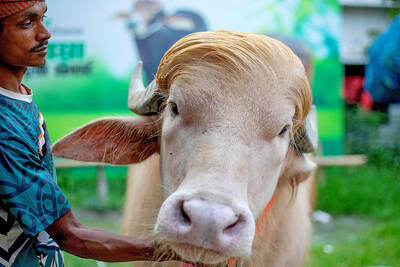
Crowds in Bangladesh are flocking to snap photographs with an unlikely social media star — an albino buffalo with flowing blond hair nicknamed “Donald Trump” that is due to be sacrificed within days. Owner Zia Uddin Mridha, 38, said his brother named the 700kg bull over its flowing helmet of hair resembling the signature look of the US president. “My younger brother picked this name because of the buffalo’s extraordinary hair,” he said at his farm in Narayanganj, just outside the capital, Dhaka. Mridha said that a constant stream of curious visitors — social media fans, onlookers and children — have come throughout

It began as a satirical online project. Now millions of young people in India are flocking to it as an outlet for their frustration. A parody political party called the Cockroach Janta Party, with the insect as its symbol, has exploded across India’s social media by turning absurdist humor into protest. Memes and short videos mocking corruption, joblessness and political dysfunction have flooded social media sites, where millions of users are embracing the cockroach — known for its ability to survive harsh conditions — as a tongue-in-cheek symbol of endurance. The online movement’s rise has been unusually rapid. The Cockroach Janta Party (CJP)
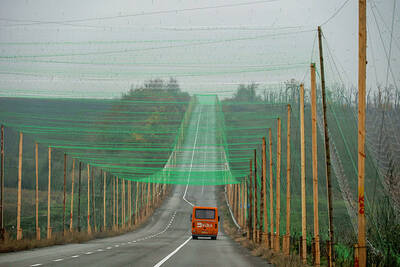
BIGGER ROLE: Beijing has said it maintains an impartial stance on the war in Ukraine, but by training Russian troops, China is far more involved than previously known China’s armed forces secretly trained about 200 Russian military personnel in China late last year, and some have since returned to fight in Ukraine, according to three European intelligence agencies and documents seen by Reuters. While China and Russia have held a number of joint military exercises since Moscow’s full-scale invasion of Ukraine in 2022, Beijing has repeatedly said that it is neutral in the conflict and presents itself as a peace mediator. The covert training sessions, which predominantly focused on the use of drones, were outlined in a dual-language Russian-Chinese agreement signed by senior Russian and Chinese officers in Beijing on
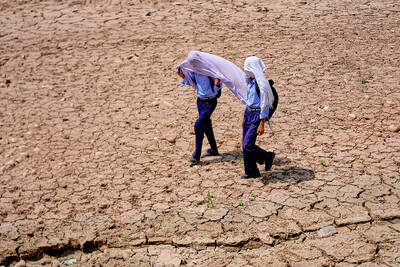
HOTTER: While Indians are accustomed to summer heat, climate change has caused northwestern India to warm faster than other parts of the country, an academic said Roads and markets have emptied during afternoons and some farmers have switched to nighttime work to avoid scorching temperatures as a heat wave grips large parts of India. The India Meteorological Department forecast maximum temperatures for yesterday of about 45°C in the capital, New Delhi, where authorities have opened temporary “cooling zones” to help people cope. The weather department warned that conditions would likely persist across several northern regions in the coming days, with temperatures staying well above seasonal averages. Authorities urged people to stay indoors during the hottest hours and take precautions against heat-related illnesses. India declares a heat wave whenever maximum temperatures


 RSS
RSS