


Abdelaziz al-Hassan did not want to live in an overcrowded camp after fleeing war in northwestern Syria, so instead his family pitched a tent in the ruins of a Roman temple.
He, his wife and three children are among almost 1 million Syrians who fled their homes last winter during a Russia-backed offensive on Syria’s last rebel stronghold of Idlib.
In the UNESCO-listed site of Baqirha, near the Turkish border, they are now among dozens of Syrians uprooted by war who have settled among centuries-old Roman and Byzantine ruins.
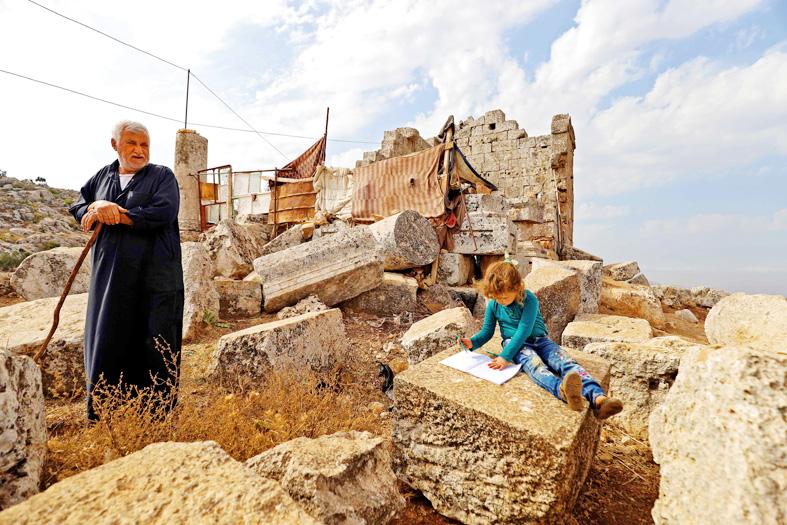
Photo: AFP
Hassan and his family have set up a tunnel-shaped tent between the three surviving walls of a 2nd century temple to the Greek god Zeus, on a site strewn with broken columns and a plinth.
Behind their tent, laundry hung on a rope strung between the ancient walls. Propped up over the centuries-old stones, solar panels soaked in the sun near a blackened pot on a small wood-burning stove.
Hassan said the site is a far better option than living in one of the numerous informal displacement camps that have sprouted up along the frontier, especially amid the COVID-19 pandemic.
“I chose this place because it provides peace of mind, far from overcrowded places and those riddled with disease,” he said.
Syria is filled with archeological sites — from Roman temples and Crusader castles to Ottoman-era caravanserais.
Many have been damaged, bombarded or plundered throughout a nine-year-old conflict that has killed more than 380,000 people and displaced millions.
Northwest Syria is home to 40 UNESCO-listed villages from the 1st to the 7th centuries that, the UN cultural body says, provide insight into “rural life in late Antiquity and during the Byzantine period.”
Dotted with the remains of temples and churches, the sites illustrate “the transition from the ancient pagan world of the Roman Empire to Byzantine Christianity,” it says.
In Baqirha, Zeus Bomos, or Zeus of the Altar, was built almost two millennia ago, historians say, in a wider area that later prospered from olive oil production.
Maamoun Abdel Karim, head of Syria’s Directorate-General for Antiquities and Museums, said Baqirha was exceptional for its well-preserved buildings, also including two churches from the 6th century.
However, for all the grand architecture, Hassan admitted there were a few inconveniences to living where he does, including a long walk for his children to the village school.
He also said the area is crawling with poisonous snakes and insects.
“Two days ago, near the tent’s opening, I killed a viper,” he said. And “every other day, we have to kill a scorpion.”
“But we haven’t found anywhere better than here yet,” he said.
Hassan’s brother-in-law, Saleh Jaour, and his dozen children have also made the ancient ruins of Baqirha their new home, after fleeing bombardment last winter that killed his wife and a son.
“I chose this region because it’s close to the Turkish border. If anything happens, we can flee to Turkey on foot,” the 64-year-old said.
As the crow flies, the Turkish border lies just 4km away.
“This place is far from the crowds and the noise,” he said, adding that he too was taken aback by how many people were living at close proximity in the camps.
Hassan’s and Jaour’s families escaped their homes further south during a government-led offensive between December last year and March on the jihadist-dominated stronghold of Idlib.
Local officials have asked families living on the archeological site in Baqirha to leave, but they have refused until they are provided with alternative shelter.
“We’ve gotten used to this place,” Jaour said, reluctant to uproot the family again at the start of the rainy winter season.
“Where else can we go?” he said.

Chinese President Xi Jinping (習近平) is to visit Russia next month for a summit of the BRICS bloc of developing economies, Chinese Minister of Foreign Affairs Wang Yi (王毅) said on Thursday, a move that comes as Moscow and Beijing seek to counter the West’s global influence. Xi’s visit to Russia would be his second since the Kremlin sent troops into Ukraine in February 2022. China claims to take a neutral position in the conflict, but it has backed the Kremlin’s contentions that Russia’s action was provoked by the West, and it continues to supply key components needed by Moscow for

Japan scrambled fighter jets after Russian aircraft flew around the archipelago for the first time in five years, Tokyo said yesterday. From Thursday morning to afternoon, the Russian Tu-142 aircraft flew from the sea between Japan and South Korea toward the southern Okinawa region, the Japanese Ministry of Defense said in a statement. They then traveled north over the Pacific Ocean and finished their journey off the northern island of Hokkaido, it added. The planes did not enter Japanese airspace, but flew over an area subject to a territorial dispute between Japan and Russia, a ministry official said. “In response, we mobilized Air Self-Defense

CRITICISM: ‘One has to choose the lesser of two evils,’ Pope Francis said, as he criticized Trump’s anti-immigrant policies and Harris’ pro-choice position Pope Francis on Friday accused both former US president Donald Trump and US Vice President Kamala Harris of being “against life” as he returned to Rome from a 12-day tour of the Asia-Pacific region. The 87-year-old pontiff’s comments on the US presidential hopefuls came as he defied health concerns to connect with believers from the jungle of Papua New Guinea to the skyscrapers of Singapore. It was Francis’ longest trip in duration and distance since becoming head of the world’s nearly 1.4 billion Roman Catholics more than 11 years ago. Despite the marathon visit, he held a long and spirited

China would train thousands of foreign law enforcement officers to see the world order “develop in a more fair, reasonable and efficient direction,” its minister for public security has said. “We will [also] send police consultants to countries in need to conduct training to help them quickly and effectively improve their law enforcement capabilities,” Chinese Minister of Public Security Wang Xiaohong (王小洪) told an annual global security forum. Wang made the announcement in the eastern city of Lianyungang on Monday in front of law enforcement representatives from 122 countries, regions and international organizations such as Interpol. The forum is part of ongoing


 RSS
RSS