


The annual Muslim pilgrimage to Mecca is a time for celebration, not least among Somalia’s livestock herders and traders who export millions of livestock to feed pilgrims.
This year, COVID-19 restrictions mean the hajj is a small, largely Saudi affair, and Somalia’s economy is suffering.
“Business is bad,” said Yahye Hassan, who works in Mogadishu’s largest livestock market where the pandemic has suppressed trade.
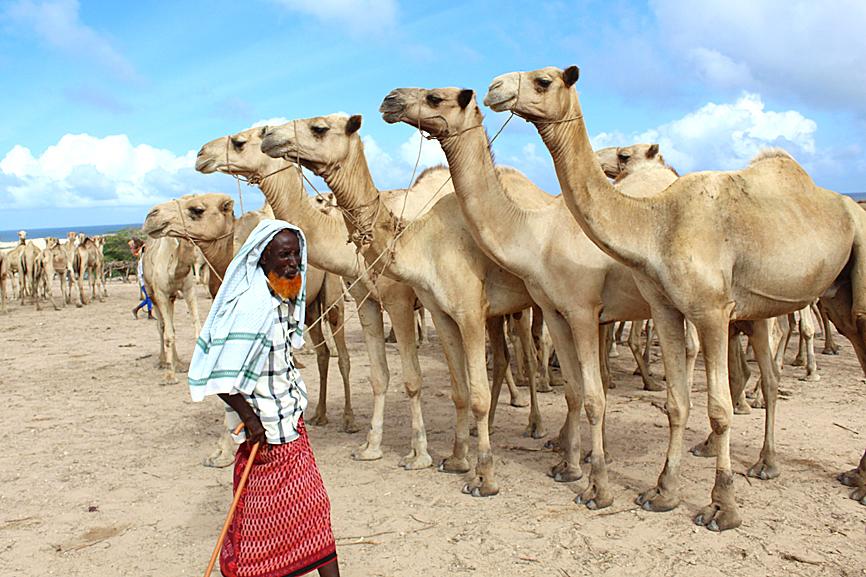
Photo: AFP
“The effect of coronavirus is apparent,” Hassan said. “The Arab countries are not in need of animals from Somalia, and the nomadic people who would bring the livestock to town for trading are reluctant due to the fear of infection.”
“There is a major decrease in demand,” said Nur Hassan, another Mogadishu-based livestock trader, who said the shortage of domestic and foreign buyers was catastrophic, while supply had also seen a dip as herders stay away.
The hajj, which began last week, is mandatory for all Muslims who are physically and financially able to undertake at least once in their lifetime and involves pilgrimage to the holy city of Mecca and its Grand Mosque.
Saudi authorities this year have restricted the hajj to those already inside the country — fewer than 10,000 domestic pilgrims are expected, compared with the 2 million mostly foreign visitors who attended last year — effectively canceling the annual ceremony for most.
Saudi demand accounts for nearly two-thirds of Somalia’s annual livestock exports, according to the World Bank, which reports that in 2015 more than 5 million sheep, goats, camels and cattle were shipped northwards from Somalian ports through the Gulf of Aden and the Red Sea to Saudi Arabia.
Exports are predicted to be sliced in half this year, primarily due to COVID-19 travel restrictions.
“The hajj cancelation has massive implications on the lives and livelihoods of the Somalian population,” said Ahmed Khalif, Somalia country director at the Action Against Hunger charity, adding that livestock accounts for about 60 percent of household income in the largely rural country.
“It is a blow to the Somalian pastoralist households particularly, who heavily survive on livestock exports to Saudi,” Khalif said.
Up to three-quarters of Somalia’s export earnings come from livestock, making the foreign sale of animals a crucial lifeline for Somalia’s economy, Khalif added.
The annual hajj is normally a reliable boom time for herders, but not this year.
“The livestock exports happen all through the year, but the majority — 70 percent of live animals — happen during this hajj season,” Khalif said.
The evaporation of exports has meant an oversupply in local markets, where prices have dropped dramatically, with camels going for US$500, half their usual price, Khalif said.
This might be good news for a relatively small number of well-off consumers, but it is a disaster for the majority of livestock-keepers who rely on sales to buy food, pay back debts and cover basics such as school fees.
Making matters even worse, keeping animals for longer than expected is a drain on limited resources, said Isse Muse Mohamed, a livestock trader in the port town of Eyl, who warned of “widespread effects” for the economy.
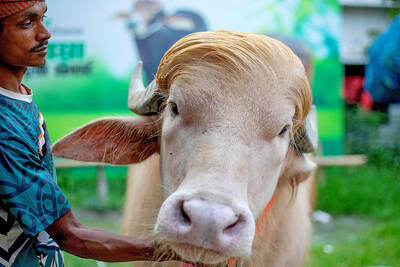
Crowds in Bangladesh are flocking to snap photographs with an unlikely social media star — an albino buffalo with flowing blond hair nicknamed “Donald Trump” that is due to be sacrificed within days. Owner Zia Uddin Mridha, 38, said his brother named the 700kg bull over its flowing helmet of hair resembling the signature look of the US president. “My younger brother picked this name because of the buffalo’s extraordinary hair,” he said at his farm in Narayanganj, just outside the capital, Dhaka. Mridha said that a constant stream of curious visitors — social media fans, onlookers and children — have come throughout

It began as a satirical online project. Now millions of young people in India are flocking to it as an outlet for their frustration. A parody political party called the Cockroach Janta Party, with the insect as its symbol, has exploded across India’s social media by turning absurdist humor into protest. Memes and short videos mocking corruption, joblessness and political dysfunction have flooded social media sites, where millions of users are embracing the cockroach — known for its ability to survive harsh conditions — as a tongue-in-cheek symbol of endurance. The online movement’s rise has been unusually rapid. The Cockroach Janta Party (CJP)
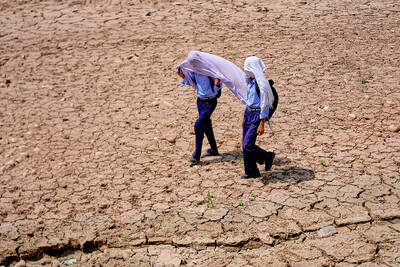
HOTTER: While Indians are accustomed to summer heat, climate change has caused northwestern India to warm faster than other parts of the country, an academic said Roads and markets have emptied during afternoons and some farmers have switched to nighttime work to avoid scorching temperatures as a heat wave grips large parts of India. The India Meteorological Department forecast maximum temperatures for yesterday of about 45°C in the capital, New Delhi, where authorities have opened temporary “cooling zones” to help people cope. The weather department warned that conditions would likely persist across several northern regions in the coming days, with temperatures staying well above seasonal averages. Authorities urged people to stay indoors during the hottest hours and take precautions against heat-related illnesses. India declares a heat wave whenever maximum temperatures
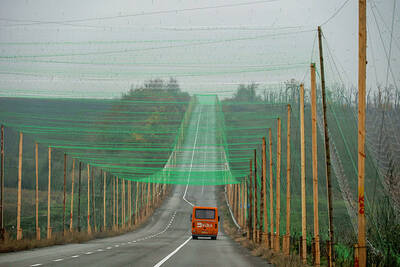
BIGGER ROLE: Beijing has said it maintains an impartial stance on the war in Ukraine, but by training Russian troops, China is far more involved than previously known China’s armed forces secretly trained about 200 Russian military personnel in China late last year, and some have since returned to fight in Ukraine, according to three European intelligence agencies and documents seen by Reuters. While China and Russia have held a number of joint military exercises since Moscow’s full-scale invasion of Ukraine in 2022, Beijing has repeatedly said that it is neutral in the conflict and presents itself as a peace mediator. The covert training sessions, which predominantly focused on the use of drones, were outlined in a dual-language Russian-Chinese agreement signed by senior Russian and Chinese officers in Beijing on


 RSS
RSS