


The village of Banka in Azerbaijan should have plentiful supplies of water as it lies beside one of the country’s mightiest rivers, the Kura.
However, the river has shallowed dramatically this summer and has become contaminated with salty seawater, in what experts warn is an unfolding ecological disaster.
“Our animals are dying. We don’t get water in time,” said farmer Maryam Hasanova, as she waited for a truck to deliver water.
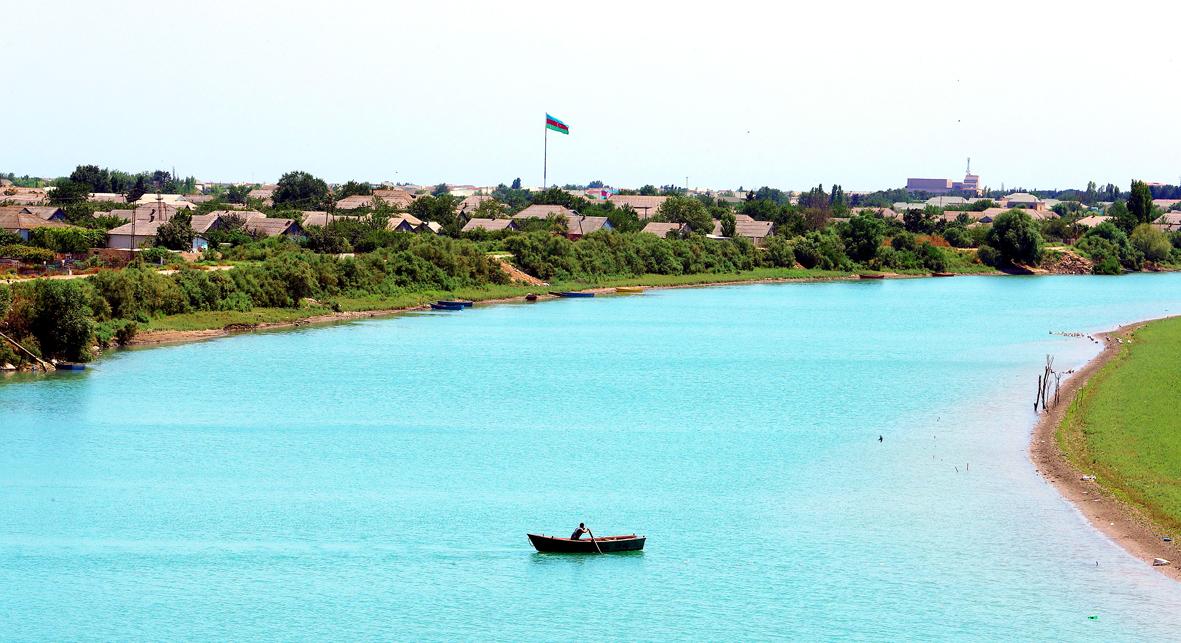
Photo: AFP
Residents in two southern regions have suffered acute water shortages for months, and people like Hasanova — who have small holdings with crops and cattle — have been particularly affected.
Wide expanses of cracked gray silt can be seen above the waterline of the river near the village.
“The drop in water levels in the Kura this summer is unprecedented,” reaching nearly 2 meters in some regions, Institute of Geology Director Ramiz Mammadov said in Baku, the capital.
“Kura’s riverbed is a frightening sight,” he said.
“This is an ecological disaster,” said Telman Zeynalov, the head of Azerbaijan’s Centre for Ecological Forecasting.
Originating in northeastern Turkey, the 1,515km river flows through Georgia and Azerbaijan into the Caspian Sea, playing a major role in the ecosystem of the entire Caucasus region.
Close to the delta where Banka is located, the river’s current has slowed down so much that saltwater from the Caspian is flowing upstream.
“We can’t use it, nor can we use it for animals to drink,” said Famil Akhmedov, a local pensioner in his 80s. “We’re in a terrible state.”
A communal water tank stands in the village street of one-story houses waiting to be filled by deliveries from a truck.
However, Hasanova complained that the amount of water delivered by the authorities was far less than the villagers’ real needs.
Some villagers were filling plastic bottles with murky water directly from the river, despite the saltwater contamination.
Residents are angry about the government’s apparent indifference to their plight.
People are “suffering from water shortages and the local authorities are refusing to listen to our complaints,” Famil Hasanov said.
Global warming is a factor in the rapidly worsening crisis, Mammadov said, since Azerbaijan has seen a 30 percent decrease in rainfall over the last decade.
“This problem isn’t anything new. We are witnessing similar issues in arid regions around the globe,” he said.
Uncontrolled and unregulated use of water for agriculture is exacerbating the crisis, he added.
“The number of new farms and fish farms along the river is constantly growing, leading to excessive water use,” he said. “There are water pumps everywhere you look.”
Another factor might be a vast reservoir called Mingachevir dammed off in the river close to the Georgian border and used to power Azerbaijan’s largest hydroelectric plant, Zeynalov said.
More research was needed into its use of water, he said.
Mammadov said Azerbaijan’s limited water resources can only be enough for everyone if it is used prudently.
In April, Azerbaijani President Ilham Aliyev issued a decree on the “rational” use of water resources and set up a governmental commission tasked with restoring the Kura’s water levels.
Mammadov said the commission has drafted long-overdue guidelines that are essential for addressing the crisis.
“The problem can be resolved if there is political will and if we stop abusing nature,” he said.

‘CROSSING THE LINE’: China’s embassy in Seoul criticized US Forces Korea Commander General Xavier Brunson, asking if his ‘hostile’ remarks were authorized by Washington South Korea and the US are in talks over recent public remarks by the commander of US Forces Korea, Seoul’s presidential office said yesterday, after the comments drew sharp criticism from China. In a recent podcast interview, US Forces Korea Commander General Xavier Brunson described South Korea as “the dagger in the heart of Asia” from China’s east coast, prompting the Chinese embassy in Seoul to say that he had “truly crossed the line.” The interview came amid growing speculation that Washington might seek to expand the role of US Forces Korea in countering the growing regional influence of China, a key

SEEKING ORDER: Rodrigo Paz said that ‘anyone who wants to destroy the nation will have to deal with this president and the full force of the constitution’ Bolivian President Rodrigo Paz on Wednesday said that the nation was at a “breaking point” after nearly a month of protests that have caused shortages of food, fuel and medicine. Paz, who took office six months ago amid the worst economic crisis there in four decades, is battling a groundswell of fury over his policies. The political capital, La Paz, has been besieged by low-income workers and members of the indigenous majority calling for his resignation. “The country needs order and is reaching breaking point,” the 58-year-old said at a public event in La Paz, renewing his appeal for dialogue. On Tuesday, the Bolivian

Forecasters in Europe yesterday warned of exceptional heat as record temperatures driven by a “heat dome” push temperatures well above seasonal norms across the continent. The surge follows a record-breaking Monday, with France logging its hottest day in the month of May on record, its weather agency said, and the UK also posting unprecedented highs. A so-called “heat dome” of warm air from northern Africa trapped under a high-pressure system over western Europe is behind the high temperatures not usually seen until high summer. Restrictions on outdoor work were imposed in parts of Italy, beaches in southwest France filled earlier than usual and

Australian researchers have trained lab-grown brain cells on a silicon computer chip to play the 1990s shooter game Doom and said they are just scratching the surface of what the neurons could be capable of doing. It is the science-fiction work of biotech boffins at Cortical Labs, who researched and developed the technology that harnesses the workings of the brain’s networking system. Each so-called “biological computer” contains about 200,000 living human brain cells, grown from stem cells that were harvested from blood donations. Having mastered the simple computer game Pong, where a paddle is moved up and down to send a ball


 RSS
RSS