


An Australian astrophysicist has been admitted to hospital after getting four magnets stuck up his nose in an attempt to invent a device that prevents people touching their faces during the COVID-19 pandemic.
Daniel Reardon, a research fellow at Melbourne’s Swinburne University, was building a necklace that would sound an alarm on facial contact when the mishap occurred on Thursday night.
The 27 year-old astrophysicist, who studies pulsars and gravitational waves, said that he was trying to liven up the boredom of self-isolation with the four powerful neodymium magnets.
“I have some electronic equipment, but really no experience or expertise in building circuits or things,” he told the Guardian Australia.
“I had a part that detects magnetic fields. I thought that if I built a circuit that could detect the magnetic field, and we wore magnets on our wrists, then it could set off an alarm if you brought it too close to your face. A bit of boredom in isolation made me think of that,” he said.
However, the academic realized that the electronic part he had did the opposite and would only complete a circuit when there was no magnetic field present.
“I accidentally invented a necklace that buzzes continuously unless you move your hand close to your face,” Reardon said.
“After scrapping that idea, I was still a bit bored, playing with the magnets. It’s the same logic as clipping pegs to your ears — I clipped them to my earlobes and then clipped them to my nostril and things went downhill pretty quickly when I clipped the magnets to my other nostril.”
Reardon said he placed two magnets inside his nostrils, and two on the outside. When he removed the magnets from the outside of his nose, the two inside stuck together.
Unfortunately, the researcher then attempted to use his remaining magnets to remove them.
“At this point, my partner who works at a hospital was laughing at me,” he said. “I was trying to pull them out, but there is a ridge at the bottom of my nose you can’t get past.”
“After struggling for 20 minutes, I decided to Google the problem and found an article about an 11-year-old boy who had the same problem. The solution in that was more magnets to put on the outside to offset the pull from the ones inside,” Reardon said.
“As I was pulling downwards to try and remove the magnets, they clipped on to each other and I lost my grip. And those two magnets ended up in my left nostril while the other one was in my right. At this point I ran out of magnets,” he said.
Before attending the hospital, Reardon attempted to use pliers to pull them out, but they became magnetized by the magnets inside his nose.
“Every time I brought the pliers close to my nose, my entire nose would shift towards the pliers and then the pliers would stick to the magnet,” he said. “It was a little bit painful at this point.”
“My partner took me to the hospital that she works in, because she wanted all her colleagues to laugh at me. The doctors thought it was quite funny, making comments like: ‘This is an injury due to self-isolation and boredom,’” Reardon said.
At the hospital, a team of two doctors applied an anesthetic spray and manually removed the magnets from Reardon’s nose.
“When they got the three out from the left nostril, the last one fell down my throat,” he said.
“That could have been a bit of a problem if I swallowed or breathed it in, but I was thankfully able to lean forward and cough it out... Needless to say I am not going to play with the magnets any more,” he added.
Medical records from the emergency department said that Reardon did not have difficulty breathing and denied the presence of further magnets up his nose.
He said he has ruled out further experiments with the magnets and face-touching, and would find other ways to pass the time while at home.
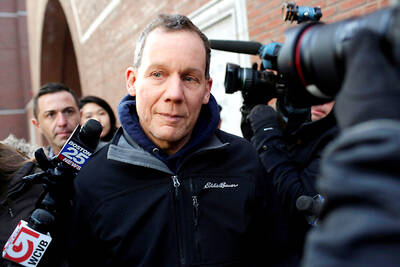
An American scientist convicted of lying to US authorities about payments from China while he was at Harvard University has rebuilt his research lab in Shenzhen, China, to pursue technology the Chinese government has identified as a national priority: embedding electronics into the human brain. Charles Lieber, 67, is among the world’s leading researchers in brain-computer interfaces. The technology has shown promise in treating conditions such as amyotrophic lateral sclerosis and restoring movement in paralyzed people. It also has potential military applications: Scientists at the Chinese People’s Liberation Army have investigated brain interfaces as a way to engineer super soldiers by boosting
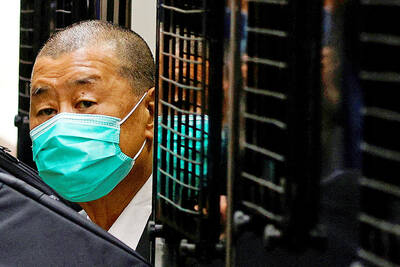
Jailed media entrepreneur Jimmy Lai (黎智英) has been awarded Deutsche Welle’s (DW) freedom of speech award for his contribution to Hong Kong’s pro-democracy movement. The German public broadcaster on Thursday said Lai would be presented in absentia with the 12th iteration of the award on June 23 at the DW Global Media Forum in Bonn. Deutsche Welle director-general Barbara Massing praised the 78-year-old founder of the now-shuttered news outlet Apple Daily for standing “unwaveringly for press freedom in Hong Kong at great personal risk.” “With Apple Daily, he gave journalists a platform for free reporting and a voice to the democracy movement in
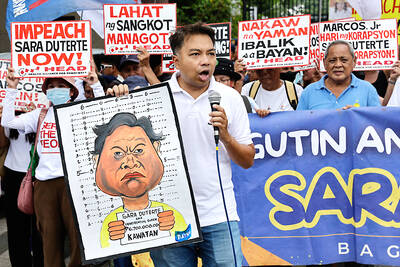
PHILIPPINE COMMITTEE: The head of the committee that made the decision said: ‘If there is nothing to hide, there is no reason to hide, there is no reason to obstruct’ A Philippine congressional committee on Wednesday ruled that there was “probable cause” to impeach Philippine Vice President Sara Duterte after hearing allegations of unexplained wealth, misuse of state funds and threats to have the president assassinated. The unanimous decision of the 53-member committee in the Philippine House of Representatives sends the two impeachment complaints to deliberations and voting by the entire lower chamber, which has more than 300 lawmakers. The complaints centered on Duterte’s alleged illegal use and mishandling of intelligence funds from the vice president’s office, and from her time as education secretary under Philippine President Ferdinand Marcos Jr. Duterte and the
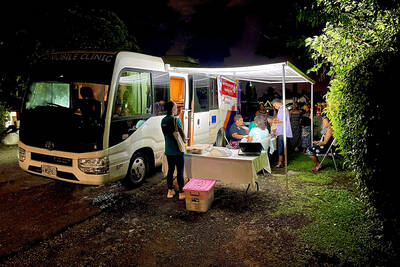
As evening falls in Fiji’s capital, a steady stream of people approaches a makeshift clinic that is a first line of defense against one of the world’s fastest-growing HIV epidemics. In the South Pacific nation — a popular tourist destination of just under a million people — more than 2,000 new HIV cases were recorded last year, a 26 percent increase from 2024. The government has declared an HIV outbreak and described it as a national crisis. “It’s spreading like wildfire,” said Siteri Dinawai, 46, who came to be tested. The Moonlight Clinic, a converted minibus parked in a suburban cul-de-sac in Suva, is


 RSS
RSS