


Japan yesterday marked the ninth anniversary of the earthquake and tsunami that triggered the Fukushima Dai-ichi nuclear meltdown, but the coronavirus outbreak forced public commemorations to be scaled back.
Japanese Prime Minister Shinzo Abe canceled the annual public ceremony at the National Theater, attended by members of the royal family and people from the northeastern region hardest-hit by the 2011 tsunami, earthquake and nuclear accident.
The cancelation was extremely regrettable, but “it’s time to take every possible measure to prevent the spread of infections in our country,” said Abe at a small wreath-laying ceremony at his office in Tokyo.
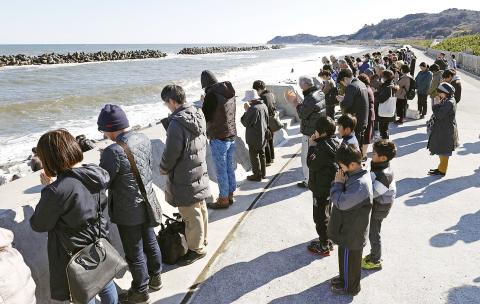
Photo: Reuters / Kyoto
He offered condolences to those who lost loved ones and renewed his pledge to rebuild the disaster-hit region.
“We should not allow precious lessons from the disaster to fade away,” Abe added.
The country fell silent for a minute at 2:46pm, the exact time a magnitude 9 earthquake struck the seabed off Miyagi Prefecture on March 11, 2011.
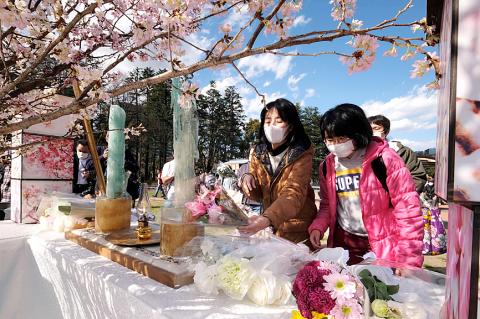
Photo: AFP
Under light drizzle in Tokyo’s Hibiya Park, mourners gathered to pray silently in front of an altar strewn with cherry blossom — most wearing protective masks.
Naoya Matsuoka, a 32-year-old staff member at a financial company, said it was important to defy the coronavirus to pay respect to the 18,500 killed or missing.
“We are now facing all different issues [like the virus] and hear lots of noise about holding events, but the disaster is something we must not forget. So I am here,” he said.
The government has urged the public to cancel or postpone major gatherings or unnecessary outings to help contain the spread of the virus, which has infected 568 people and been linked to 12 deaths.
The call has resulted in the shutdown of schools and the cancelation or rescheduling of everything from music concerts to soccer matches, while graduation ceremonies, fashion shows and a sumo tournament have taken place behind closed doors.
Japanese Chief Cabinet Secretary Yoshihide Suga yesterday lauded the recovery efforts under way in the northeast of the nation, but acknowledged the challenges that remained in providing psychological care and other services to evacuees.
Despite the many signs of recovery in the region, some residents are still unable to live in the areas closest to the Fukushima Dai-ichi plant. Radiation levels in such areas remain high, despite repeated decontamination efforts.
The final decommissioning of the crippled plant is expected to take four decades, but Abe’s government hopes to showcase reconstruction so far in the region at this year’s Olympics, with the torch relay starting from Fukushima and travelling across affected areas.
“I think the memory [of the disaster] is fading away,” said Masahiko Sano, a 47-year-old company owner, who joined the event at the park in Tokyo.
Additional reporting Reuters
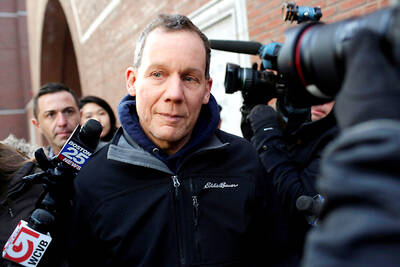
An American scientist convicted of lying to US authorities about payments from China while he was at Harvard University has rebuilt his research lab in Shenzhen, China, to pursue technology the Chinese government has identified as a national priority: embedding electronics into the human brain. Charles Lieber, 67, is among the world’s leading researchers in brain-computer interfaces. The technology has shown promise in treating conditions such as amyotrophic lateral sclerosis and restoring movement in paralyzed people. It also has potential military applications: Scientists at the Chinese People’s Liberation Army have investigated brain interfaces as a way to engineer super soldiers by boosting
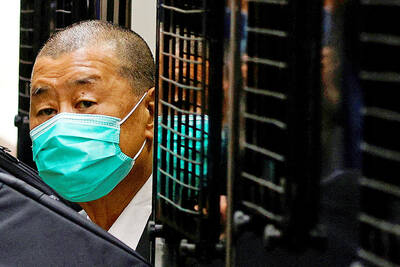
Jailed media entrepreneur Jimmy Lai (黎智英) has been awarded Deutsche Welle’s (DW) freedom of speech award for his contribution to Hong Kong’s pro-democracy movement. The German public broadcaster on Thursday said Lai would be presented in absentia with the 12th iteration of the award on June 23 at the DW Global Media Forum in Bonn. Deutsche Welle director-general Barbara Massing praised the 78-year-old founder of the now-shuttered news outlet Apple Daily for standing “unwaveringly for press freedom in Hong Kong at great personal risk.” “With Apple Daily, he gave journalists a platform for free reporting and a voice to the democracy movement in
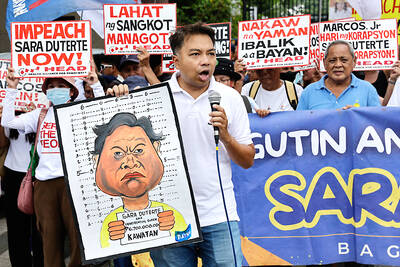
PHILIPPINE COMMITTEE: The head of the committee that made the decision said: ‘If there is nothing to hide, there is no reason to hide, there is no reason to obstruct’ A Philippine congressional committee on Wednesday ruled that there was “probable cause” to impeach Philippine Vice President Sara Duterte after hearing allegations of unexplained wealth, misuse of state funds and threats to have the president assassinated. The unanimous decision of the 53-member committee in the Philippine House of Representatives sends the two impeachment complaints to deliberations and voting by the entire lower chamber, which has more than 300 lawmakers. The complaints centered on Duterte’s alleged illegal use and mishandling of intelligence funds from the vice president’s office, and from her time as education secretary under Philippine President Ferdinand Marcos Jr. Duterte and the
Burmese President Min Aung Hlaing yesterday cut all prisoners’ sentences by one-sixth, a blanket measure that a source close to deposed leader Aung San Suu Kyi said would further shorten her detention. Aung San Suu Kyi has been sequestered since a 2021 military coup, but the senior member of her dissolved National League for Democracy (NLD) party said that while her term had been reduced, her remaining sentence is still unclear. “We also don’t know exactly how many years she has left,” the source told reporters, speaking on condition of anonymity for security reasons. The military toppled Aung San Suu Kyi’s elected government


 RSS
RSS