


When she rides alone around the streets of Caracas astride a Suzuki GS500, Ana Julia Mosquera tucks her long hair inside her helmet and wears baggy clothes.
“Sometimes I prefer to ride looking like a man, for safety,” she said.
Not just for safety, but also to avoid comments she and her fellow members of the Venezuelan all-female Ratgirls biker group suffer on a regular basis.
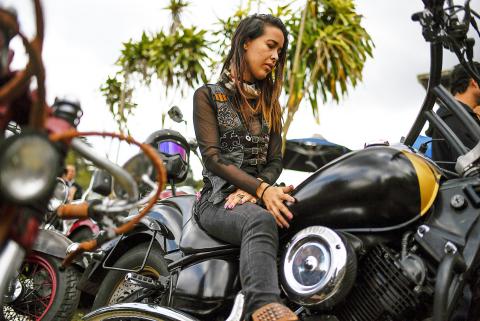
Photo: AFP
Mosquera has become immune to sexist quips like: “That’s a lot of bike for you.”
The 23 members of the Ratgirls are not looking to start a fight between the sexes, but they want respect from a biker world dominated by men.
“Crazy things always happen to us in the street,” said Mosquera, a 32-year-old audiovisual producer and Ratgirls president.
The Ratgirls, who were formed in 2014 after the mixed Rats biker club banned women, are identified by a black leather jacket with orange stripes, embroidered with the words: “Long life.”
Safety in numbers is crucial in a city such as Caracas, one of the most violent in the world.
Three times someone has tried to steal Mosquera’s bike. She even keeps its battery locked inside a cage.
Venezuela’s murder rate last year was 21 per 100,000 inhabitants, government data showed, but the Venezuelan Observatory non-governmental organization said the figure was actually 60: 10 times the global average.
The Ratgirls ride in groups to reduce the chance of being the victims of crime.
Several times they have been mistaken for notorious colectivos — civilians armed by Venezuelan President Nicolas Maduro’s regime who also ride bikes.
Oil-rich, but cash-strapped Venezuela is in the grip of five years of recession, and a chronic economic crisis that has left millions in poverty and shortfalls in basic necessities, such as food and medicine.
However, Maduro’s regime has maintained price controls on fuel — a great advantage for the Ratgirls, Mosquera said.
The Ratgirls are not just trying to show off, though, theirs is the kind of passion that leaves hands dirty.
Some, like Jennifer Rodriguez, are learning to fix their bikes themselves. She thinks nothing of tackling her Keeway Superlight 200 to mend a problem.
Half Spanish and half Venezuelan, Rodriguez joined the club just over a year ago.
“I started riding around with them and I stayed, now they’re my family,” said the single mother with a 10-year-old daughter.
Although the Rats biker club barred women from its club, the two groups still take part in events together, said Jose Gonzalez, vice president of the men’s club.
The 47-year-old, a professional photographer, acknowledges there is a “macho culture” in Venezuela that opposes women bikers.
“The Ratgirls have done better than other [male clubs], they ride more and have more activities than many [male] clubs,” Gonzalez said.
The Ratgirls “have a motto: no one is more than anyone if they don’t work harder than the other,” Mosquera said.
Maryelitza Sanchez, a 48-year-old mother of two, learned to ride a motorcycle out of necessity to get around town.
“The only thing I’d ridden before in my life was a bicycle,” the personal trainer said.
She had always been attracted to motorbikes, but her parents prevented her from riding one out of fear.
After Sanchez got married, her husband was also against the idea.
“We went around in a car,” she said.
Everything changed two years ago when she got divorced and needed to use the collapsed metro system in Caracas.
“Every day I went through a different issue in the metro. There was always a problem, I arrived late or not at all,” she said.
After falling twice from her Bera 150, she overcame her initial fears.
“It’s a unique feeling of freedom, of dominion, of control, of power. I feel powerful when I’m on the motorbike,” she said.

Through the noise of rushing papers and whirring belts at a print factory in Kyoto, two creators watch their photo essay come to life in broadsheet form — part of an effort to win new audiences in the age of artificial intelligence (AI). Despite the decline of the publishing industry, self-publication and handmade “zine” magazines are growing in popularity in Japan, reflecting the nation’s enduring love of paper in the digital era. While speaking to Agence France-Presse at the plant, his hands black with ink, one of the creators, Kazuma Obara, said: “I think [paper] is a medium that engages all five

‘ABSURD MISTAKE’: The election commission said that there had been a failure to anticipate turnout after 14 polling stations ran short of ballot papers South Korean riot police yesterday cleared protesters from a Seoul polling station after a 35-hour blockade sparked by a shortage of ballot papers during local elections earlier this week. Wednesday’s election was the first nationwide vote since South Korean President Lee Jae-myung took office following the ouster of Yoon Suk-yeol over his short-lived martial law declaration. Lee’s ruling Democratic Party swept most races, but failed to flip the crucial Seoul mayoral seat. The South Korean National Election Commission apologized, blaming a failure to anticipate turnout after 14 polling stations in Seoul ran short of ballot papers. Some polling stations stayed open until 10pm to

Australian researchers have trained lab-grown brain cells on a silicon computer chip to play the 1990s shooter game Doom and said they are just scratching the surface of what the neurons could be capable of doing. It is the science-fiction work of biotech boffins at Cortical Labs, who researched and developed the technology that harnesses the workings of the brain’s networking system. Each so-called “biological computer” contains about 200,000 living human brain cells, grown from stem cells that were harvested from blood donations. Having mastered the simple computer game Pong, where a paddle is moved up and down to send a ball

France experienced its hottest spring on record, the French weather service said on Tuesday, after an exceptional early heat wave that also broke highs for the season in England and Wales. Meteo-France said the average nationwide temperature over March to May was 13.8°C — about 1.7°C above the norm, and surpassing records set in 2011 and 2020. “The warmest spring since records began in 1900,” it said in a bulletin. All three months were warmer than average, but the onset of an “unprecedented heatwave” late last month pushed the mercury to highs typically seen at the height of the summer. “Our country had never


 RSS
RSS