


US teenager Kyle Giersdorf on Sunday won US$3 million after taking the top prize in a tournament in New York for the popular online video game Fortnite. It is believed to be the biggest winnings in e-sports history.
Giersdorf, 16, from Pennsylvania, was one of at least 100 players competing for US$30 million in total prize money, as the booming popularity of video and online games has drawn top-dollar investments and fueled the emerging professional sport.
Playing under the name “Bugha,” Giersdorf won the solo finals portion of the Fortnite World Cup by scoring 59 points, 26 more than his nearest competitor “psalm,” according to the Fortnite World Cup leaderboard on the game’s Web site.
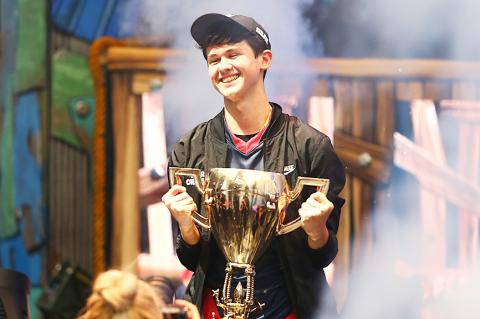
Photo: Getty Images/AFP
“Words can’t even explain it. I’m just so happy,” Giersdorf said in an interview at the event at Arthur Ashe Stadium in Queens posted by organizers on Twitter. “Everything I’ve done, the grind, it’s all paid off. It’s just insane.”
Giersdorf did not immediately respond to a request for comment.
Meanwhile, the competition has made an overnight star of a British teenager whose obsession with video games caused years of arguments with his despairing mother.
Essex schoolboy Jaden Ashman, 15, competing under the name “Wolfiez,” finished runner-up with his Dutch teammate Dave John “Rojo” in the duos event, landing a US$2.25 million prize that they must split.
Ashman was one of several UK gamers to fly to New York to take part in the tournament.
While many of those taking part were professional Fortnite gamers with legions of fans, Ashman was a relative unknown with only a few thousand followers on social media.
The teenager put his success down to the many hours he has devoted to Fortnite since the day it came out in September 2017, sometimes playing it for up to eight hours a day.
“Me and my mum, we clash quite a lot,” Ashman told the BBC. “She didn’t understand how it worked, so she thought that I was spending eight hours a day in my room just wasting my time. So now that I’ve proved to her I can do stuff, I’m really happy.”
His mother, Lisa Dallman, said she once threw out an Xbox after an argument, but now accepted his career choice as a professional e-sports player. He got into gaming watching his uncle play the shooter Gears of War, before getting his own Xbox when he was six.
Dallman told the BBC: “If I’m honest with you, I’ve been quite against him gaming. I’ve been more pushing him to do his schoolwork.”
Ashman nearly missed the tournament entirely. He had problems securing a visa for the US flight and, in a mishap that would be laughed out of a classroom, the dog ate his birth certificate.
“This is not a joke — this actually really did happen, and then my work messed up my wages, so three things went wrong before we started heading here, so I knew we were on an even keel and everything was going to go right,” Dallman said.
Asked how her son might spend the prize money, she said: “I think Jaden’s not really a materialistic person. He will have a lifetime supply of Uber Eats, and I think that will do him, to be fair. Just sitting there playing video games and eating takeaways, Jaden would be in his element.”
The duos winners, Emil Bergquist Pedersen from Norway and his Austrian partner, David W, who play as “Nyhrox” and “Aqua,” took home prize money totaling US$3 million.


Kehinde Sanni spends his days smoothing out dents and repainting scratched bumpers in a modest autobody shop in Lagos. He has never left Nigeria, yet he speaks glowingly of Burkina Faso military leader Ibrahim Traore. “Nigeria needs someone like Ibrahim Traore of Burkina Faso. He is doing well for his country,” Sanni said. His admiration is shaped by a steady stream of viral videos, memes and social media posts — many misleading or outright false — portraying Traore as a fearless reformer who defied Western powers and reclaimed his country’s dignity. The Burkinabe strongman swept into power following a coup in September 2022
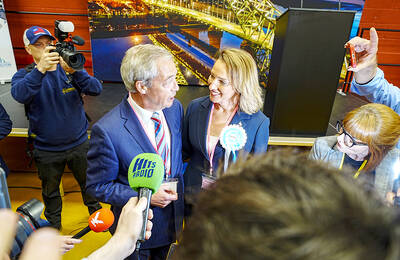
‘FRAGMENTING’: British politics have for a long time been dominated by the Labor Party and the Tories, but polls suggest that Reform now poses a significant challenge Hard-right upstarts Reform UK snatched a parliamentary seat from British Prime Minister Keir Starmer’s Labor Party yesterday in local elections that dealt a blow to the UK’s two establishment parties. Reform, led by anti-immigrant firebrand Nigel Farage, won the by-election in Runcorn and Helsby in northwest England by just six votes, as it picked up gains in other localities, including one mayoralty. The group’s strong showing continues momentum it built up at last year’s general election and appears to confirm a trend that the UK is entering an era of multi-party politics. “For the movement, for the party it’s a very, very big
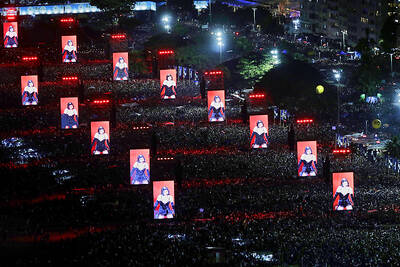
ENTERTAINMENT: Rio officials have a history of organizing massive concerts on Copacabana Beach, with Madonna’s show drawing about 1.6 million fans last year Lady Gaga on Saturday night gave a free concert in front of 2 million fans who poured onto Copacabana Beach in Rio de Janeiro for the biggest show of her career. “Tonight, we’re making history... Thank you for making history with me,” Lady Gaga told a screaming crowd. The Mother Monster, as she is known, started the show at about 10:10pm local time with her 2011 song Bloody Mary. Cries of joy rose from the tightly packed fans who sang and danced shoulder-to-shoulder on the vast stretch of sand. Concert organizers said 2.1 million people attended the show. Lady Gaga
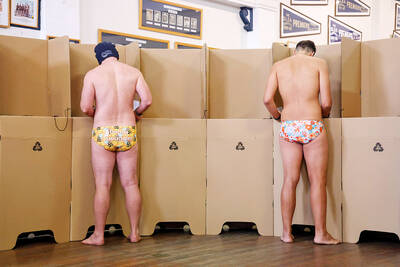
SUPPORT: The Australian prime minister promised to back Kyiv against Russia’s invasion, saying: ‘That’s my government’s position. It was yesterday. It still is’ Left-leaning Australian Prime Minister Anthony Albanese yesterday basked in his landslide election win, promising a “disciplined, orderly” government to confront cost-of-living pain and tariff turmoil. People clapped as the 62-year-old and his fiancee, Jodie Haydon, who visited his old inner Sydney haunt, Cafe Italia, surrounded by a crowd of jostling photographers and journalists. Albanese’s Labor Party is on course to win at least 83 seats in the 150-member parliament, partial results showed. Opposition leader Peter Dutton’s conservative Liberal-National coalition had just 38 seats, and other parties 12. Another 17 seats were still in doubt. “We will be a disciplined, orderly


 RSS
RSS