


Hunched over a thick book, George Zaarour uses a magnifying glass to decipher Aramaic script — the biblical language of Jesus that is starting to disappear from everyday use in his village.
The 62-year-old is one of the last in Syria to specialize in the ancient language, which has survived for 2,000 years in the village of Maalula — one of the world’s oldest Christian settlements. In the mountain village, Aramaic was once widely used, but today few people still speak the tongue.
“Aramaic is in danger,” Zaarour said. “If things continue like this, the language will disappear within five to 10 years.”
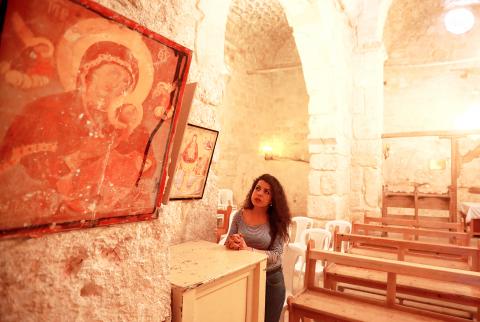
Photo: AFP
Zaarour collects books and encyclopedias on Aramaic in his small shop, where he sells religious icons, crucifixes and household products.
He spends his days studying and translating the ancient Semitic language, which was widespread in the Middle East at the beginning of the Christian era and whose origins date back to 10th century BC.
Today, “80 percent of Maalula’s inhabitants don’t speak Aramaic, and the remaining 20 percent are over 60 years old,” the expert said.
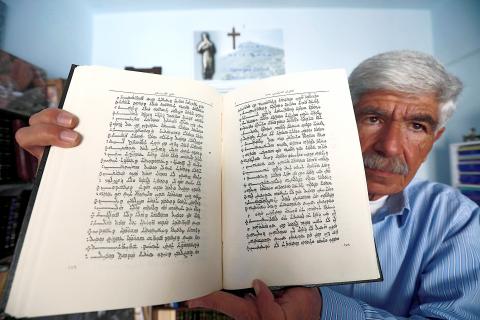
Photo: AFP
Etched out in the cliff face, and full of churches, convents and monasteries, Maalula is considered a symbol of Christian presence in the Damascus region.
Pilgrims across the world once visited the village to see its religious buildings and to hear Aramaic spoken on the streets, but the outbreak of the Syrian civil war in 2011 changed everything. Rebels and militants linked to al-Qaeda seized Maalula in late 2013, forcing most of its Christian inhabitants to flee.
Regime forces recaptured it in April 2014, seven months after the insurgents first entered the village.
However, two-thirds of its inhabitants have yet to return.
Many of Maalula’s residents have found refuge in and around Damascus, which is about 55km away, or even abroad.
“The war generation was born outside Maalula, in Damascus or in other areas, and they learned Arabic first,” Zaarour said.
An author of some 30 books on the Aramaic language and its history in Maalula, Zaarour is well-known in Syrian academic circles. He regularly supervises student dissertations in Damascus.
In 2006, he helped set up a center in Maalula to teach Aramaic, but it closed after war broke out.
Maalula Mayor Elias Thaalab hailed Zaarour as a source of true local pride.
“I think George Zaarour must be the only teacher and specialist of the Aramaic language in Syria,” the 80-year-old said.
“Some young teachers are trying to learn the language, but Mr Zaarour is the only one who knows the language in depth,” he added.
Preserving the language is of utmost importance, he said.
“For more than 2,000 years, we have kept the language of Christ in our hearts,” he said. “We are among the last people on earth who have the honor of mastering it.”
However, of the more than 6,000 people who lived in the village before the conflict, only 2,000 have returned, he said.
Maalula, which means “entrance” in Aramaic, is the most famous of three villages around Damascus where the language is still used.
In Syria’s northeast, Syriac, which is derived from Aramaic, is also still spoken. Other Aramaic dialects that have evolved from the original historic version of the language are also used across the Middle East today, especially in Turkey and northern Iraq, said Jean-Baptiste Yon, an ancient language specialist.
In Maalula today, the vast majority of houses remain empty, only chirping birds interrupting the calm.
The village has fared better than other parts of Syria, but it has not been spared completely. Several churches and monasteries were looted or damaged by artillery fire and religious icons destroyed or stolen.
Al-Nusra militants kidnapped 13 nuns from the village in December 2013, only releasing them three months later.
Today, in the monastery of Saint Sergius and Bacchus, gilded candles stand once again on the chapel’s white marble altar, but in the village’s only kindergarten, numbers have plummeted since the war started.
The number of students enrolled has dropped from more than 100 in 2010 to less than 30 this year, the administration said.
To ensure their ancient language survives, its pupils have an Aramaic class every day.
In a classroom with white-and-pink walls, children aged five to six sit behind wooden desks reciting Aramaic poems under the watchful eye of their teacher, Antoinette Mokh, 64.
“Aramaic in Maalula is inherited from generation to generation, from father to son... It’s the language of the home,” she said. “But these children were born outside Maalula during the years of exile.”
She has been teaching for more than a quarter of a century, but “I cannot give up my job and retire. There will be no replacement.”
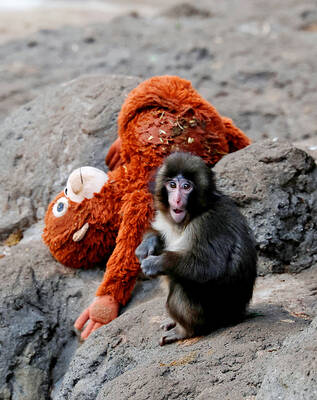
THE TRAGEDY OF PUNCH: Footage of the seven-month-old Japanese macaque has gone viral online after he was rejected by his mother and formed a bond with a soft toy A baby monkey in Japan has captured hearts around the world after videos of him being bullied by other monkeys and rejected by his mother went viral last week. Punch, a Japanese macaque, was born in July last year at Ichikawa City Zoo. He has drawn international attention after zookeepers gave him a stuffed orangutan toy after he was abandoned by his mother. Without maternal guidance to help him integrate, Punch has turned to the toy for comfort. He has been filmed multiple times being dragged and chased by older Japanese macaques inside the enclosure. Early clips showed him wandering alone with

South Korea would soon no longer be one of the few countries where Google Maps does not work properly, after its security-conscious government reversed a two-decade stance to approve the export of high-precision map data to overseas servers. The approval was made “on the condition that strict security requirements are met,” the South Korean Ministry of Land, Infrastructure and Transport said. Those conditions include blurring military and other sensitive security-related facilities, as well as restricting longitude and latitude coordinates for South Korean territory on products such as Google Maps and Google Earth, it said. The decision is expected to hurt Naver and Kakao

Australian Prime Minister Anthony Albanese yesterday said he did not take his security for granted, after he was evacuated from his residence for several hours following a bomb threat sent to a Chinese dance group. Albanese was evacuated from his Canberra residence late on Tuesday following the threat, and returned a few hours later after nothing suspicious was found. The bomb scare was among several e-mails threatening Albanese sent to a representative of Shen Yun, a classical Chinese dance troupe banned in China that is due to perform in Australia this month, a spokesperson for the group said in a statement. The e-mail
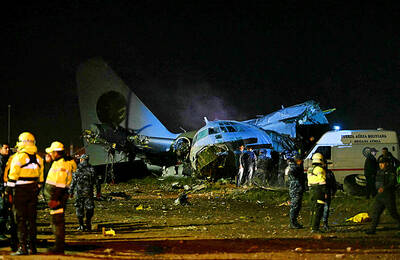
MONEY GRAB: People were rushing to collect bills scattered on the ground after the plane transporting money crashed, which an official said hindered rescue efforts A cargo plane carrying money on Friday crashed near Bolivia’s capital, damaging about a dozen vehicles on highway, scattering bills on the ground and leaving at least 15 people dead and others injured, an official said. Bolivian Minister of Defense Marcelo Salinas said the Hercules C-130 plane was transporting newly printed Bolivian currency when it “landed and veered off the runway” at an airport in El Alto, a city adjacent to La Paz, before ending up in a nearby field. Firefighters managed to put out the flames that engulfed the aircraft. Fire chief Pavel Tovar said at least 15 people died, but


 RSS
RSS