


Seeking an “authentic” experience as he backpacked through Afghanistan, Dutch tourist Ciaran Barr searched the Couchsurfing Web site for locals to stay with. He found an astonishing number of potential hosts.
Despite the nation’s decaying security, nearly 2,000 Afghans — the vast majority of them men — have signed up to host guests on the social networking platform, which connects travelers around the world with locals who are willing to put them up for free.
“You feel like you get a more authentic feel for the city so you don’t get trapped in tourist hot spots,” Barr, 24, told reporters in heavily militarized Kabul, where he spent several nights sleeping on a thin mattress on the floor of his Afghan host’s bedroom.
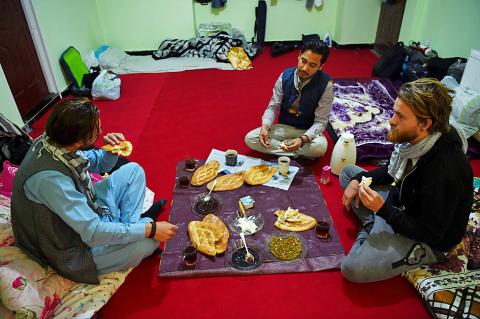
Photo: AFP
“Not that there are any in Afghanistan,” he added.
Once a popular stop on the well-worn hippie trail between Europe and South Asia in the 1970s, Afghanistan has seen the number of foreign travelers crossing its borders dwindle in the past four decades.
However, dozens still make the dangerous journey every year, ignoring clear warnings from their governments to stay away from a country that by some estimates is the world’s deadliest conflict zone.
Many take their chances by staying with Afghan strangers they find through the Couchsurfing network, rather than paying for a room in a hotel protected by armed guards and bulletproof doors.
“Staying with people and dressing to blend in a bit makes it possible to travel in Afghanistan with not too big of a risk,” said Barr, who — with his dark hair and beard, and dressed in the baggy shalwar kameez favored by most Afghan men — stands out less than most foreigners.
Couch surfing’s concept is like a modern-day version of Afghanistan’s tradition of hospitality, which obliges Afghans to provide food and shelter to strangers, but it is risky.
Couch surfers only have their host’s online profile and references to judge their character. In a country where kidnappings remain common and foreigners are highly prized targets, they have no way of knowing if their host is connected to criminals, who might see a chance to get rich by abducting them or giving them up to militants.
“You can end up with the Taliban,” a diplomat in Kabul said. “It’s naive and reckless.”
That is what happened to North American couple Caitlan Coleman and Joshua Boyle, who were kidnapped while backpacking in Afghanistan in 2012.
They were freed from the Taliban in 2017, along with their three children who were born in captivity.
However, Norwegian tourist Jorn Bjorn Augestad said that government warnings exaggerate the dangers.
“They are too careful. You have to be smart about a lot of things. Having contact with a local is the best way to stay safe,” said Augestad, who plans to visit every country in the world, including Syria, before his 30th birthday this year.
Barr and Augestad began their week-long Afghan odyssey in the northern city of Mazar-i-Sharif, famous for its ancient Blue Mosque and buzkashi, a savage version of polo played with a goat carcass.
After reaching Kabul, the deadliest place in Afghanistan for civilians, Barr and Augestad stayed with Couchsurfing host Naser Majidi, 27, who works as a technical adviser for a water utility company.
For Afghans, hosting a foreigner is a chance to travel vicariously, as more countries make it all but impossible for Afghan passport holders to obtain a visa.
“I can make it easier for them to see the beauty of this country,” said Majidi, who has hosted six guests since signing up on Couchsurfing in 2016. “It’s a good experience for me — I get more friends and I know the world better.”
However, his family worry that he is putting himself in danger.
“They have advised me many times that this is very risky for you and for them [guests],” Majidi said.
Elyas Yari, who became a host in 2017 despite the objections of loved ones, said he enjoys listening to his guests’ “experiences and their ideas.”
“It’s fun for me,” said Yari, 19, who has received visitors from Canada, Russia, Mexico and Taiwan.
Afghanistan is “not as dangerous as it looks,” he added.
Barr and Augestad are not oblivious to the potential pitfalls of traveling independently in Afghanistan.
“Things can go well nine out of 10 times,” Barr said. “It just takes that one time when things go wrong and so far nothing has gone wrong. We also have been lucky.”

Malaysia yesterday installed a motorcycle-riding billionaire sultan as its new king in lavish ceremonies for a post seen as a ballast in times of political crises. The coronation ceremony for Malaysia’s King Sultan Ibrahim, 65, at the National Palace in Kuala Lumpur followed his oath-taking in January as the country’s 17th monarch. Malaysia is a constitutional monarchy, with a unique arrangement that sees the throne change hands every five years between the rulers of nine Malaysian states headed by centuries-old Islamic royalty. While chiefly ceremonial, the position of king has in the past few years played an increasingly important role. Royal intervention was

X-37B COMPARISON: China’s spaceplane is most likely testing technology, much like US’ vehicle, said Victoria Samson, an official at the Secure World Foundation China’s shadowy, uncrewed reusable spacecraft, which launches atop a rocket booster and lands at a secretive military airfield, is most likely testing technology, but could also be used for manipulating or retrieving satellites, experts said. The spacecraft, on its third mission, was last month observed releasing an object, moving several kilometers away and then maneuvering back to within a few hundred meters of it. “It’s obvious that it has a military application, including, for example, closely inspecting objects of the enemy or disabling them, but it also has non-military applications,” said Marco Langbroek, a lecturer in optical space situational awareness at Delft

The Philippine Air Force must ramp up pilot training if it is to buy 20 or more multirole fighter jets as it modernizes and expands joint operations with its navy, a commander said yesterday. A day earlier US National Security Adviser Jake Sullivan said that the US “will do what is necessary” to see that the Philippines is able to resupply a ship on the Second Thomas Shoal (Renai Shoal, 仁愛暗沙) that Manila uses to reinforce its claims to the atoll. Sullivan said the US would prefer that the Philippines conducts the resupplies of the small crew on the warship Sierra Madre,

AIRLINES RECOVERING: Two-thirds of the flights canceled on Saturday due to the faulty CrowdStrike update that hit 8.5 million devices worldwide occurred in the US As the world continues to recover from massive business and travel disruptions caused by a faulty software update from cybersecurity firm CrowdStrike, malicious actors are trying to exploit the situation for their own gain. Government cybersecurity agencies across the globe and CrowdStrike CEO George Kurtz are warning businesses and individuals around the world about new phishing schemes that involve malicious actors posing as CrowdStrike employees or other tech specialists offering to assist those recovering from the outage. “We know that adversaries and bad actors will try to exploit events like this,” Kurtz said in a statement. “I encourage everyone to remain vigilant


 RSS
RSS