


Torrential rain and gale force winds yesterday lashed Sydney, causing commuter chaos; flooding streets, railway stations and homes; grounding flights; and leaving hundreds of people without electricity.
Police called on motorists to stay off the roads. One person was killed in a car crash and two police officers seriously injured when a tree fell on them as they helped a stranded driver.
Another person, a New South Wales State Emergency Services volunteer, collapsed and died while attending a job in the Illawarra.
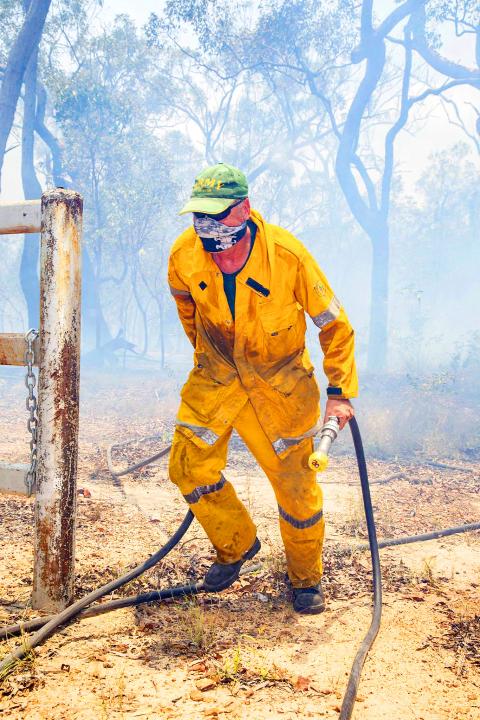
Photo: AP / Queensland Fire and Emergency Service
Greg Transell, an office manager in Sydney’s north, told Australian Broadcasting Corp that strong winds caused widespread disruption to the tower block office where he works.
“I started to go upstairs to see if there was any damage and next minute there was an almighty bang and it ripped panels off the roof in the warehouse,” Transell said.
Sydney got more than 100mm of rain in just a few hours, a level that the nation’s most populous city would normally get through the whole of November, the Australian Bureau of Meteorology said.
“That’s the sort of rainfall you’d expect to see once every 100 years,” bureau New South Wales state manager Ann Farrell told reporters.
The rain offered a welcomed respite to farmers who have suffered through a sustained drought in recent months, but it caused major disruptions to transportation.
Sydney Airport, the country’s busiest, said that 130 flights had been canceled or delayed after it was forced to close two of its three runways.
“The storm is pretty intense in and around the airport,” spokeswoman Cait Kyann said. “We are operating from a single runway, so that means that there are delays and likely some flights will be canceled.”
Ausgrid, the nation’s biggest electricity network, said the storm had cut power to 8,100 customers in Sydney and the Central Coast area to its north.
By late afternoon, 1,700 homes and businesses remained without power, Ausgrid said.
The storm struck only hours before the main morning peak hour, transforming some streets into fast-flowing rivers and parks into lakes. Several stranded motorists were plucked from rising floodwaters.
“We are asking all road users to reconsider the need to be on the roads throughout what will be a severe rain event,” New South Wales Assistant Police Commissioner Michael Corboy said.
In contrast, in Queensland, soaring temperatures near 40°C and strong winds exacerbated major bushfires.
Firefighters have been battling for nearly a week to contain 138 fires across the state, and 8,000 people were ordered to evacuate the city of Gracemere, about 600km north of the state capital, Brisbane.
“These are unprecedented conditions,” Queensland Premier Annastacia Palaszczuk said. “We have not seen the likes of this.”
The fire danger was rated catastrophic in areas of central Queensland, the first time the highest danger rating had been applied to the state, Palaszczuk said.
She said 34 schools had been closed in the most threatened regions and told families not to go out, to keep together and prepare to leave if needed.
Homes had been destroyed since Saturday in areas where the fire danger remained too high for teams to enter and assess damage, Queensland Fire and Emergency Services Commissioner Katarina Carroll said.
She expected that fewer than 10 homes had been lost so far.
“Thunderstorms are going through those areas as we speak. There will be no rain from thunderstorms — in fact, they are adding to the problem,” Carroll said.
Weather conditions are to moderate today, the bureau said.
Additional reporting by the Guardian and AP

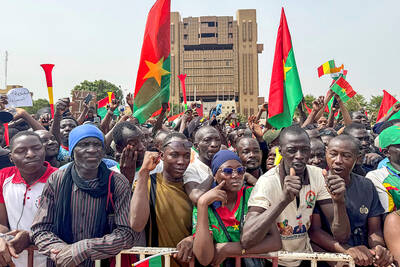
Kehinde Sanni spends his days smoothing out dents and repainting scratched bumpers in a modest autobody shop in Lagos. He has never left Nigeria, yet he speaks glowingly of Burkina Faso military leader Ibrahim Traore. “Nigeria needs someone like Ibrahim Traore of Burkina Faso. He is doing well for his country,” Sanni said. His admiration is shaped by a steady stream of viral videos, memes and social media posts — many misleading or outright false — portraying Traore as a fearless reformer who defied Western powers and reclaimed his country’s dignity. The Burkinabe strongman swept into power following a coup in September 2022
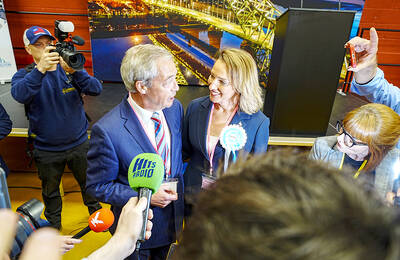
‘FRAGMENTING’: British politics have for a long time been dominated by the Labor Party and the Tories, but polls suggest that Reform now poses a significant challenge Hard-right upstarts Reform UK snatched a parliamentary seat from British Prime Minister Keir Starmer’s Labor Party yesterday in local elections that dealt a blow to the UK’s two establishment parties. Reform, led by anti-immigrant firebrand Nigel Farage, won the by-election in Runcorn and Helsby in northwest England by just six votes, as it picked up gains in other localities, including one mayoralty. The group’s strong showing continues momentum it built up at last year’s general election and appears to confirm a trend that the UK is entering an era of multi-party politics. “For the movement, for the party it’s a very, very big
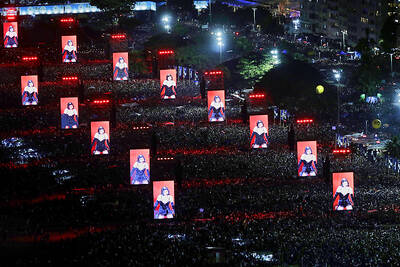
ENTERTAINMENT: Rio officials have a history of organizing massive concerts on Copacabana Beach, with Madonna’s show drawing about 1.6 million fans last year Lady Gaga on Saturday night gave a free concert in front of 2 million fans who poured onto Copacabana Beach in Rio de Janeiro for the biggest show of her career. “Tonight, we’re making history... Thank you for making history with me,” Lady Gaga told a screaming crowd. The Mother Monster, as she is known, started the show at about 10:10pm local time with her 2011 song Bloody Mary. Cries of joy rose from the tightly packed fans who sang and danced shoulder-to-shoulder on the vast stretch of sand. Concert organizers said 2.1 million people attended the show. Lady Gaga
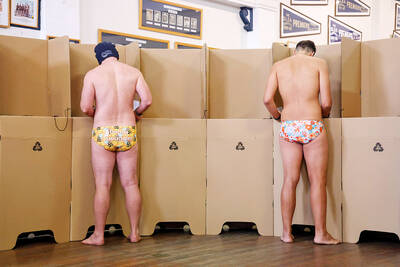
SUPPORT: The Australian prime minister promised to back Kyiv against Russia’s invasion, saying: ‘That’s my government’s position. It was yesterday. It still is’ Left-leaning Australian Prime Minister Anthony Albanese yesterday basked in his landslide election win, promising a “disciplined, orderly” government to confront cost-of-living pain and tariff turmoil. People clapped as the 62-year-old and his fiancee, Jodie Haydon, who visited his old inner Sydney haunt, Cafe Italia, surrounded by a crowd of jostling photographers and journalists. Albanese’s Labor Party is on course to win at least 83 seats in the 150-member parliament, partial results showed. Opposition leader Peter Dutton’s conservative Liberal-National coalition had just 38 seats, and other parties 12. Another 17 seats were still in doubt. “We will be a disciplined, orderly


 RSS
RSS