


A team of doctors who swallowed Lego bricks and timed how long they took to pass through their bowels have said the results of their research should reassure concerned parents.
In a paper published in the Journal of Paediatrics and Child Health, six researchers from Australia and the UK said they swallowed the head of a Lego figure — about 10mm by 10mm — in the “noble tradition of self-experimentation.”
Toy parts are the second-most common foreign object that children swallow and frequently cause anxiety among parents, but usually pass in a matter of days without pain or ill-effect.
For the special Christmas edition of the journal, which frequently features quirky studies, the team decided to put their own bodies on the line.
“[We] could not ask anything of our test subjects that we would not undertake themselves,” they wrote.
They developed their own metrics: the Stool Hardness and Transit (SHAT) score and the Found and Retrieved Time (FART) score.
The FART score — how many days it took the Lego piece to pass through the bowels — was between 1.1 days and three days, with an average of 1.7 days, the paper said.
Using the SHAT score, the researchers also found that the consistency of their stools did not change.
They said that they compared SHAT and FART scores to see if looser stools caused quicker retrieval, but found no correlation.
One of the report’s authors, Grace Leo, said that she hoped the report made people smile while also reassuring parents.
Parents should seek medical advice if children swallow things that are sharp, longer than 5cm, wider than 2.5cm, magnets, coins, button batteries or are experiencing pain, she said.
However, most small, smooth, plastic objects will pass easily, Leo said.
If parents are uncertain, they should seek medical attention, she added.
“I can’t remember if it was pre or post-breakfast,” Leo said. “But we all ingested our Lego between 7am and 9am in our own time zone, with a glass of water.”
“For most people, it was passed after one to three stools, but for poor [researcher Damien Roland], he didn’t find his, so we made him search every stool for two weeks,” she said. “I passed it on the first stool afterwards and was very relieved.”
None of the researchers experienced any symptoms or pain due to the Lego inside them, Leo said, but added that people should not replicate the experiment at home.
It is possible for children’s bowels to react differently, the report said, but added that there was “little evidence to support this.”
“If anything, it is likely that objects would pass faster in a more immature gut,” the researchers wrote.
“Hopefully there is more conversation and awareness of foreign bodies, and a reassurance for parents that, for small foreign bodies, they aren’t advised to search through the stool,” Leo said. “If it’s a small Lego head, you don’t need to go poking through their stool. That should save parents some heartache, unless that Lego head is dearly loved.”


Kehinde Sanni spends his days smoothing out dents and repainting scratched bumpers in a modest autobody shop in Lagos. He has never left Nigeria, yet he speaks glowingly of Burkina Faso military leader Ibrahim Traore. “Nigeria needs someone like Ibrahim Traore of Burkina Faso. He is doing well for his country,” Sanni said. His admiration is shaped by a steady stream of viral videos, memes and social media posts — many misleading or outright false — portraying Traore as a fearless reformer who defied Western powers and reclaimed his country’s dignity. The Burkinabe strongman swept into power following a coup in September 2022
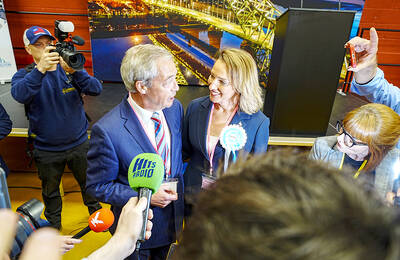
‘FRAGMENTING’: British politics have for a long time been dominated by the Labor Party and the Tories, but polls suggest that Reform now poses a significant challenge Hard-right upstarts Reform UK snatched a parliamentary seat from British Prime Minister Keir Starmer’s Labor Party yesterday in local elections that dealt a blow to the UK’s two establishment parties. Reform, led by anti-immigrant firebrand Nigel Farage, won the by-election in Runcorn and Helsby in northwest England by just six votes, as it picked up gains in other localities, including one mayoralty. The group’s strong showing continues momentum it built up at last year’s general election and appears to confirm a trend that the UK is entering an era of multi-party politics. “For the movement, for the party it’s a very, very big

ENTERTAINMENT: Rio officials have a history of organizing massive concerts on Copacabana Beach, with Madonna’s show drawing about 1.6 million fans last year Lady Gaga on Saturday night gave a free concert in front of 2 million fans who poured onto Copacabana Beach in Rio de Janeiro for the biggest show of her career. “Tonight, we’re making history... Thank you for making history with me,” Lady Gaga told a screaming crowd. The Mother Monster, as she is known, started the show at about 10:10pm local time with her 2011 song Bloody Mary. Cries of joy rose from the tightly packed fans who sang and danced shoulder-to-shoulder on the vast stretch of sand. Concert organizers said 2.1 million people attended the show. Lady Gaga
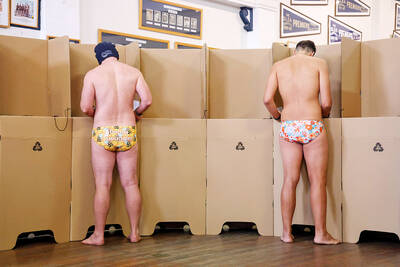
SUPPORT: The Australian prime minister promised to back Kyiv against Russia’s invasion, saying: ‘That’s my government’s position. It was yesterday. It still is’ Left-leaning Australian Prime Minister Anthony Albanese yesterday basked in his landslide election win, promising a “disciplined, orderly” government to confront cost-of-living pain and tariff turmoil. People clapped as the 62-year-old and his fiancee, Jodie Haydon, who visited his old inner Sydney haunt, Cafe Italia, surrounded by a crowd of jostling photographers and journalists. Albanese’s Labor Party is on course to win at least 83 seats in the 150-member parliament, partial results showed. Opposition leader Peter Dutton’s conservative Liberal-National coalition had just 38 seats, and other parties 12. Another 17 seats were still in doubt. “We will be a disciplined, orderly


 RSS
RSS