


From LGBT nightclubs to “gaycations” and more, a court ruling legalizing homosexuality in India is set to unlock one of the world’s largest “pink economies,” experts say.
The Indian Supreme Court’s historic decision last week to scrap a colonial-era ban on gay sex sparked joy as activists held rainbow-colored celebrations across the nation.
Now the community can expect to see businesses lining up to offer a range of tailored products, in fashion, health and other industries, providing a massive boost to Asia’s third-biggest economy.

Photo: AFP
“It can bring billions of dollars to the Indian economy if they can activate the spending of gay people in India,” said Keshav Suri, a hotelier and petitioner in the landmark case. “There is business to be done, real estate to be bought and sold, holidays and all the services that go with that.”
“The value of the pink economy and the social aspects of the LGBT community are too large now for us to ignore,” added Suri, executive director of the Lalit hotel group.
India is home to more than 55 million LGBT adults, according to Out Now Consulting, a marketing agency that helps businesses target gay and lesbian consumers.
Their nominal income is about US$113 billion annually, the firm estimates.
LGBT couples have fewer children than other groups and higher-than-average salaries, meaning plenty of disposable cash.
“They represent one of the world’s largest LGBT markets,” said Ian Johnson, founder of Australia-based Out Now Consulting.
He predicts that drinks brands and travel companies would be the first to target the LGBT community following the scrapping of Section 377, which was introduced 157 years ago.
LGBT bars, clubs and cafes would provide new employment and boost sales in the food and alcohol industries, while people would be able to attend vacations designed specifically for the gay market without fear of legal reprisal.
Nakshatra Bagwe, a Mumbai-based entrepreneur, runs The BackPack Travels, a company specializing in organizing trips for LGBT tourists.
He says it has been profitable since it was set up in October 2016, but he expects to see an increase in revenue following the law change.
“With legality and freedom on our side businesses will invest in the community and opportunities will increase in the coming years,” Bagwe said.
Inder Vhatwar, another businessman based in India’s financial capital, also hopes to profit from the ruling by judges who said members of the gay community deserve an apology for the treatment they have suffered.
Shortly after gay sex was briefly decriminalized before by the Delhi High Court in 2009, Vhatwar opened a store called D’Kloset in Mumbai’s trendy neighborhood of Bandra, where several Bollywood stars live.
He sold glitzy clothes, handbags and party masks, but after the ban was reinstated in 2013 Vhatwar was evicted by his landlord.
“I faced a lot of challenges due to Section 377 and had to shut down, but with this recent judgement I am planning to start the store again,” the 37-year-old said.
Gay sex has long been a taboo subject for many in socially conservative India, with religious groups in particular fiercely opposing any liberalization of sexual morality.
The World Bank said in a 2014 report that homophobic attitudes and a reluctance to hire LGBT people hampered India’s economic growth by up to 1.7 percent annually.
Research shows that LGBT-friendly policies in the workplace, such as equality training and non-discriminatory hiring practices, can boost profitability.
Activists hope the court ruling would help shift attitudes and boost the LGBT community’s economic engagement.
“The LGBT community is definitely an untapped market. The business potential is huge and set to grow,” said Parmesh Shahani, who heads up the cultural arm of India’s Godrej conglomerate.
“The verdict will catalyze change, and more companies will invest in products and services catering to the community. I hope the judgement creates more jobs and companies vie for LGBTQ talent,” he said.

‘CROSSING THE LINE’: China’s embassy in Seoul criticized US Forces Korea Commander General Xavier Brunson, asking if his ‘hostile’ remarks were authorized by Washington South Korea and the US are in talks over recent public remarks by the commander of US Forces Korea, Seoul’s presidential office said yesterday, after the comments drew sharp criticism from China. In a recent podcast interview, US Forces Korea Commander General Xavier Brunson described South Korea as “the dagger in the heart of Asia” from China’s east coast, prompting the Chinese embassy in Seoul to say that he had “truly crossed the line.” The interview came amid growing speculation that Washington might seek to expand the role of US Forces Korea in countering the growing regional influence of China, a key
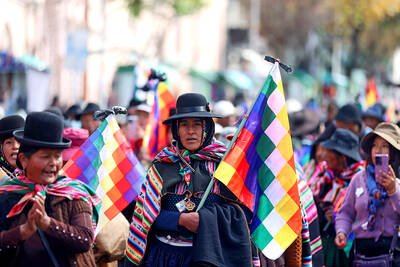
SEEKING ORDER: Rodrigo Paz said that ‘anyone who wants to destroy the nation will have to deal with this president and the full force of the constitution’ Bolivian President Rodrigo Paz on Wednesday said that the nation was at a “breaking point” after nearly a month of protests that have caused shortages of food, fuel and medicine. Paz, who took office six months ago amid the worst economic crisis there in four decades, is battling a groundswell of fury over his policies. The political capital, La Paz, has been besieged by low-income workers and members of the indigenous majority calling for his resignation. “The country needs order and is reaching breaking point,” the 58-year-old said at a public event in La Paz, renewing his appeal for dialogue. On Tuesday, the Bolivian

Forecasters in Europe yesterday warned of exceptional heat as record temperatures driven by a “heat dome” push temperatures well above seasonal norms across the continent. The surge follows a record-breaking Monday, with France logging its hottest day in the month of May on record, its weather agency said, and the UK also posting unprecedented highs. A so-called “heat dome” of warm air from northern Africa trapped under a high-pressure system over western Europe is behind the high temperatures not usually seen until high summer. Restrictions on outdoor work were imposed in parts of Italy, beaches in southwest France filled earlier than usual and

Australian researchers have trained lab-grown brain cells on a silicon computer chip to play the 1990s shooter game Doom and said they are just scratching the surface of what the neurons could be capable of doing. It is the science-fiction work of biotech boffins at Cortical Labs, who researched and developed the technology that harnesses the workings of the brain’s networking system. Each so-called “biological computer” contains about 200,000 living human brain cells, grown from stem cells that were harvested from blood donations. Having mastered the simple computer game Pong, where a paddle is moved up and down to send a ball


 RSS
RSS