


South Korea held its first ever drag parade this weekend, a small, but significant step for rights campaigners in a country that remains deeply conservative when it comes to gender and sexuality.
Dozens of drag queens and kings marched through Seoul’s Itaewon neighborhood on Saturday, which is best known for its nightlife and a nascent but vibrant gay scene.
Carrying rainbow flags, they cheered and strutted their best outfits, receiving shouts of support and the odd baffled look from those they passed.
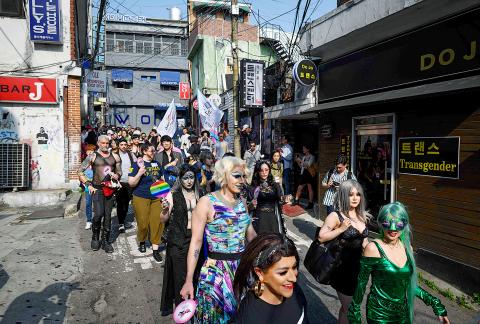
Photo: AFP
While homosexuality is not illegal in South Korea, same-sex marriage is not recognized and people cannot legally change their birth gender. The country is home to a large evangelical Christian community and LGBT people feel pervasive pressure to stay closeted.
“When it comes to South Korea, human rights guarantees for sexual minorities are insufficient,” said Yang Heezy, a drag queen and the organizer of the Seoul Drag Parade.
“Today’s drag parade and more queer culture festivals should take place to bring attention to sexual minorities and help those who are not from those minorities learn more,” he added, sporting a flame-red wig and floral dress.
The parade drew South Koreans, as well as foreigners.
One participant, who gave her drag queen name, Lola Bank, said that there was a feeling of exhilaration among marchers.
“The fact that we are able to be in public in drag is a huge milestone to queer acceptance in Korea,” Lola said, dragging on a cigarette. “I’ve always struggled with my masculinity and my femininity. And when I get in drag, I’m saying kind of like a ‘fuck you’ to society’s expectations of how I should behave as a male.”
Gay pride parades have been a fixture in South Korea for years, but have often been protested by religious groups, who have held rival anti-homosexuality rallies while trying to physically block marchers.
Even left-leaning South Korean President Moon Jae-in — a former human rights lawyer — said that he “opposed homosexuality” during a campaign debate last year.
Gay rights campaigners claim that some progress has been made over the past few years, with surveys showing increasing tolerance — particularly among young people — and growing participation at gay pride events.
Saturday’s small parade saw no counter-demonstration. Lee Hyang-soon, an elderly street vendor, smiled and waved to participants as they passed.
“It’s really cool. Seeing all the foreigners join in, it feels like Korea is becoming world famous,” she said. “I’m happy. It’s fabulous.”

SPEAKING OUT: After Siranudh Scott’s allegations surfaced, celebrities and public figures took to social media to share their own experiences of sexual misconduct and abuse A high-profile alleged sexual abuse case within a wealthy Thai beer brewing family has prompted a wave of painful accounts from survivors of unconnected abuse in the conservative nation. Siranudh Scott, a member of the billionaire Thai family that founded the ubiquitous Singha beer brand, posted an emotional video this month accusing his elder brother Sunit of repeatedly abusing him when he was a teenager. Sunit, who is in his 30s, later denied the allegations in a video posted online, but Singha parent Boonrawd dismissed him from his executive role with the company on Tuesday last week. “I felt I needed to speak

SEEKING ORDER: Rodrigo Paz said that ‘anyone who wants to destroy the nation will have to deal with this president and the full force of the constitution’ Bolivian President Rodrigo Paz on Wednesday said that the nation was at a “breaking point” after nearly a month of protests that have caused shortages of food, fuel and medicine. Paz, who took office six months ago amid the worst economic crisis there in four decades, is battling a groundswell of fury over his policies. The political capital, La Paz, has been besieged by low-income workers and members of the indigenous majority calling for his resignation. “The country needs order and is reaching breaking point,” the 58-year-old said at a public event in La Paz, renewing his appeal for dialogue. On Tuesday, the Bolivian

A Hong Kong astronaut is to join a Chinese space mission for the first time as part of a three-person crew launching today, as Beijing edges closer to its goal of landing people on the moon. The Tiangong space station — crewed by teams of three astronauts that are typically rotated every six months — is the crown jewel of China’s space program, boosted by billions in state investment in a bid to catch up with the US and Russia. The Shenzhou-23 mission is to blast off at 11:08pm from the Jiuquan Satellite Launch Center in northwestern China, carrying three astronauts to

UPGRADED ALERT: The risk inside DR Congo is now considered ‘very high,’ while neighboring countries face a ‘high’ threat as the outbreak continues, the WHO said Ebola is spreading faster than responders can track it in eastern Congo, where health workers managed to follow up with barely one in five identified contacts in a single day. Authorities in the Democratic Republic of the Congo (DR Congo) reported 83 confirmed infections, 746 suspected cases and 1,603 identified contacts as of Thursday, but health workers were able to follow up on only 342 contacts that day — about 21 percent of the total under monitoring — data released by the DR Congo Ministry of Public Health on Friday showed. The figures suggest the response is falling behind the outbreak itself,


 RSS
RSS