


Kept safe in a silk-lined box by its Belgian “custodian” lies a piece of the historic legacy of German composer Richard Wagner that was nearly lost forever.
The Lohengrin Cup, made of porcelain, was given to Wagner more than 150 years ago by Ludwig II, the “mad king” of Bavaria, whose passion for building fairytale castles was matched only by his love of Wagner’s operas.
It was believed lost after Allied bombing in World War II destroyed much of Bayreuth, the town where Wagner built the legendary theater that now hosts an annual music festival.
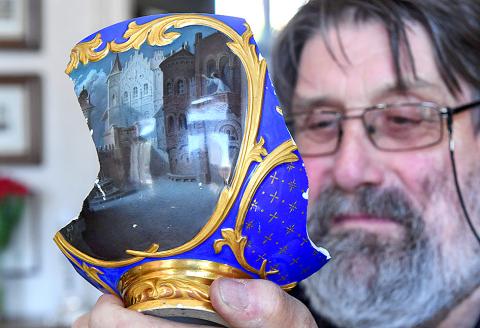
Photo: AFP
However, one fragment emerged after the war and was taken to the Belgian capital, Brussels, in 1949, where it has largely remained out of sight in the intervening years.
A group of Wagner devotees recently received a special viewing during a production in Brussels of the opera Lohengrin— the work that first bewitched Ludwig — and an Agence France-Presse reporter was given a rare glimpse.
“Ludwig was barely 18 years old when he started thinking about this vase, and he obsessed about it for six months. His diaries are full of it,” said Patrick Collon, the renowned organ maker and art expert who now owns the fragment.
“After Ludwig became king he sought out Wagner, who was hiding from his creditors, all over central Europe,” said Collon, 75.
“Ludwig found him a year later and gave him this vase in May 1865 for his 52nd birthday,” Collon said.
Saved from the ruins of the defeated Nazi Germany in 1945, the fragment at first looks insignificant, consisting of just the blue and gold base of the urn-like vase, and part of one rounded side.
However, it sheds an intriguing light on the extraordinary friendship between the young Ludwig and the older Wagner.
The eccentric Ludwig is best known for designing the fantastical Neuschwanstein near Munich, which served as the model for Disney’s Sleeping Beauty Castle.
A minor king under whom Bavaria lost its independence to Prussia, Ludwig has nevertheless gone down in history as a patron of the arts, especially of the equally erratic Wagner.
Ludwig was just 15 and infused by the old German legends when he first saw Wagner’s Lohengrin, based on the traditional story of the Swan Knight, and which later became the inspiration for Neuschwanstein Castle.
Two years later, Ludwig became obsessed by creating a porcelain vase featuring scenes from Lohengrin.
“It was Ludwig’s first creation. He didn’t make it himself, but he imagined it, he dreamed up the scenes that were painted on it by his drawing teacher,” the German landscape painter Leopold Rottmann, Collon said.
Rottmann’s watercolors of the receptacle — the only surviving evidence of what it looked like in full — show four scenes from the opera, and have a lid and handles in the shape of a swan.
The Brussels fragment shows a gilded swan, the tragic heroine, Elsa, on a balcony, and the two villains Telramund and Ortrud.
It is the only piece that survived the Allied bombing of Bayreuth on April 5, 1945.
“It was said that it had disappeared and that nothing was left of it, but in 1949, the Wagner brothers [Wagner’s grandsons Wolfgang and Wieland] were able to get a piece in a pretty box to a Belgian benefactor,” Collon said.
“At the end of her life, she gave it to a musician friend. When the friend died it was passed to me,” he said.
The benefactor — identified by Collon only as Juliette — contributed to the post-war reopening of the Bayreuth festival in 1951 and was nicknamed “Joan of Arc” by the Wagner brothers.
The Brussels fragment is an object of fascination for music lovers.
“A smart friend once said to me: ‘In the end, it’s moving because it’s broken,’” Collon said.
“This fragment has survived all the horrors of war,” he said.

An American scientist convicted of lying to US authorities about payments from China while he was at Harvard University has rebuilt his research lab in Shenzhen, China, to pursue technology the Chinese government has identified as a national priority: embedding electronics into the human brain. Charles Lieber, 67, is among the world’s leading researchers in brain-computer interfaces. The technology has shown promise in treating conditions such as amyotrophic lateral sclerosis and restoring movement in paralyzed people. It also has potential military applications: Scientists at the Chinese People’s Liberation Army have investigated brain interfaces as a way to engineer super soldiers by boosting
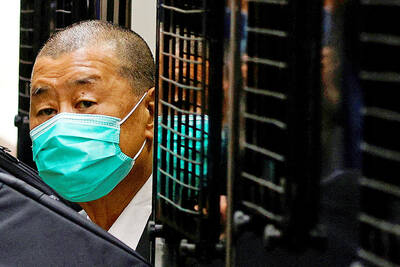
Jailed media entrepreneur Jimmy Lai (黎智英) has been awarded Deutsche Welle’s (DW) freedom of speech award for his contribution to Hong Kong’s pro-democracy movement. The German public broadcaster on Thursday said Lai would be presented in absentia with the 12th iteration of the award on June 23 at the DW Global Media Forum in Bonn. Deutsche Welle director-general Barbara Massing praised the 78-year-old founder of the now-shuttered news outlet Apple Daily for standing “unwaveringly for press freedom in Hong Kong at great personal risk.” “With Apple Daily, he gave journalists a platform for free reporting and a voice to the democracy movement in
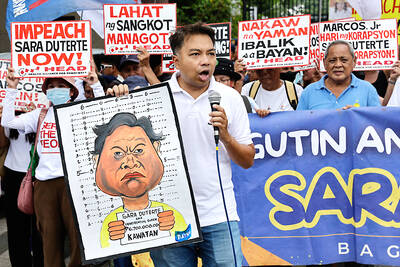
PHILIPPINE COMMITTEE: The head of the committee that made the decision said: ‘If there is nothing to hide, there is no reason to hide, there is no reason to obstruct’ A Philippine congressional committee on Wednesday ruled that there was “probable cause” to impeach Philippine Vice President Sara Duterte after hearing allegations of unexplained wealth, misuse of state funds and threats to have the president assassinated. The unanimous decision of the 53-member committee in the Philippine House of Representatives sends the two impeachment complaints to deliberations and voting by the entire lower chamber, which has more than 300 lawmakers. The complaints centered on Duterte’s alleged illegal use and mishandling of intelligence funds from the vice president’s office, and from her time as education secretary under Philippine President Ferdinand Marcos Jr. Duterte and the

Burmese President Min Aung Hlaing yesterday cut all prisoners’ sentences by one-sixth, a blanket measure that a source close to deposed leader Aung San Suu Kyi said would further shorten her detention. Aung San Suu Kyi has been sequestered since a 2021 military coup, but the senior member of her dissolved National League for Democracy (NLD) party said that while her term had been reduced, her remaining sentence is still unclear. “We also don’t know exactly how many years she has left,” the source told reporters, speaking on condition of anonymity for security reasons. The military toppled Aung San Suu Kyi’s elected government


 RSS
RSS