


The US military is shifting its stance in Syria, US Secretary of Defense James Mattis said on Friday, as the program to arm the Kurdish opposition comes to a close and is replaced by increased support for local police and security forces.
The Pentagon is “changing the composition of our forces” in Syria to reflect the collapse of the Islamic State group there and a renewed emphasis on finding a diplomatic path to peace, Mattis said.
Speaking to reporters on his airplane at the start of a five-day trip to the Middle East, Mattis said the shift in US forces would support the diplomatic process.
His comments came on the heels of the announcement last week that the US would stop actively providing arms to Syrian Kurds, known as the People’s Protection Units (YPG).
Officials have acknowledged that the US will likely begin taking back large military vehicles and heavy weapons from the Kurds, now that major combat operations to retake Raqqa, Syria, from the Islamic State group are over.
However, it was not clear whether the move to provide arms has completely stopped already, or is in the process of ending.
As part of the changing US military role, an artillery unit of about 400 US Marines was scheduled to leave Syria this week, taking their howitzers with them. Their exodus still leaves more than 1,000 US troops in the country.
Although the Pentagon would only publicly acknowledge about 500 US forces in Syria, there were at least 1,700 there throughout much of the year as the battle for Raqqa raged on.
“The YPG is armed, and as the coalition stops operations, then obviously you don’t need that, you need security forces, you need police forces,” Mattis said.
“That’s local forces, that’s people who make certain that ISIS doesn’t come back,” he said, using one of many acronyms used to describe the Islamic State.
The US program to arm the Kurds has been a sharply divisive issue with Turkey, which views them as terrorists because of their affiliation with outlawed Kurdish rebels who have waged a three decade-long insurgency in Turkey.
US commanders have consistently argued that the battle-hardened Kurds were the most effective fighting force available.
In a telephone call last week with Turkish President Recep Tayyip Erdogan, US President Donald Trump said he had “given clear instructions” that the Kurds will receive no more weapons, Turkish Minister of Foreign Affairs Mevlut Cavusoglu said.
The White House confirmed the move in a cryptic statement about the telephone call that said Trump had informed the Turkish government of “pending adjustments to the military support provided to our partners on the ground in Syria.”
US officials have been careful in their description of what exactly is happening, leaving open the possibility that some weapons, such as smaller arms, will remain with the Kurdish fighters in case the Islamic State tries to make a comeback.

PARLIAMENT CHAOS: Police forcibly removed Brazilian Deputy Glauber Braga after he called the legislation part of a ‘coup offensive’ and occupied the speaker’s chair Brazil’s lower house of Congress early yesterday approved a bill that could slash former Brazilian president Jair Bolsonaro’s prison sentence for plotting a coup, after efforts by a lawmaker to disrupt the proceedings sparked chaos in parliament. Bolsonaro has been serving a 27-year term since last month after his conviction for a scheme to stop Brazilian President Luiz Inacio Lula da Silva from taking office after the 2022 election. Lawmakers had been discussing a bill that would significantly reduce sentences for several crimes, including attempting a coup d’etat — opening up the prospect that Bolsonaro, 70, could have his sentence cut to

A powerful magnitude 7.6 earthquake shook Japan’s northeast region late on Monday, prompting tsunami warnings and orders for residents to evacuate. A tsunami as high as three metres (10 feet) could hit Japan’s northeastern coast after an earthquake with an estimated magnitude of 7.6 occurred offshore at 11:15 p.m. (1415 GMT), the Japan Meteorological Agency (JMA) said. Tsunami warnings were issued for the prefectures of Hokkaido, Aomori and Iwate, and a tsunami of 40cm had been observed at Aomori’s Mutsu Ogawara and Hokkaido’s Urakawa ports before midnight, JMA said. The epicentre of the quake was 80 km (50 miles) off the coast of
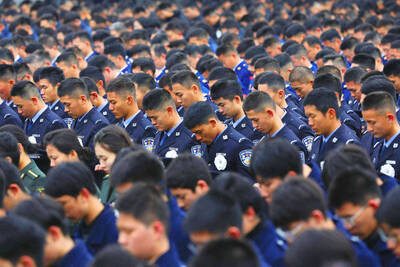
China yesterday held a low-key memorial ceremony for the 1937 Nanjing Massacre, with Chinese President Xi Jinping (習近平) not attending, despite a diplomatic crisis between Beijing and Tokyo over Taiwan. Beijing has raged at Tokyo since Japanese Prime Minister Sanae Takaichi last month said that a hypothetical Chinese attack on Taiwan could trigger a military response from Japan. China and Japan have long sparred over their painful history. China consistently reminds its people of the 1937 Nanjing Massacre, in which it says Japanese troops killed 300,000 people in what was then its capital. A post-World War II Allied tribunal put the death toll

A passerby could hear the cacophony from miles away in the Argentine capital, the unmistakable sound of 2,397 dogs barking — and breaking the unofficial world record for the largest-ever gathering of golden retrievers. Excitement pulsed through Bosques de Palermo, a sprawling park in Buenos Aires, as golden retriever-owners from all over Argentina transformed the park’s grassy expanse into a sea of bright yellow fur. Dog owners of all ages, their clothes covered in dog hair and stained with slobber, plopped down on picnic blankets with their beloved goldens to take in the surreal sight of so many other, exceptionally similar-looking ones.


 RSS
RSS