


The mysterious case of a billionaire who last week went missing from Hong Kong, reportedly abducted by Chinese security agents, has underscored the precarious lives of China’s ultra rich.
Local media said financier Xiao Jianhua (肖建華) was last seen at his apartment in the Four Seasons Hotel Hong Kong and is under investigation in connection with China’s 2015 stock crash.
There is no shortage of examples of other tycoons who have met a similar fate in a country that has the largest number of billionaires in the world — 594, according to the latest ranking by the magazine Hurun.
In China, company chiefs need the backing of the Chinese Communist Party to get rich.
It is a relationship that — when the political winds change — can leave them out to dry, experts said.
“Chinese businessmen know their country, and they all know that they must have the support of the authorities,” Hong Kong Baptist University professor Jean-Pierre Cabestan said. “Every day, local [Chinese] Communist Party officials receive gifts from company bosses ... who need protection.”
For example, without this support a businessman might have to pay more taxes, “because taxation is very arbitrary in China,” said Willy Lam (林和立), a political scientist at the Chinese University of Hong Kong. “If you don’t have official protection, it’s possible that your business might be wiped out, for whatever capricious reasons.”
There has been widespread speculation that Xiao’s disappearance was part of Chinese President Xi Jinping’s (習近平) ongoing anti-corruption drive, which some critics believe has been used to target his political opponents.
“There is always the risk of being dragged into the fall of a politician when he is prosecuted for corruption,” Cabestan said.
“If your protector is doing okay, then you make a lot of money,” Lam said, but added that if he is arrested, “this may suddenly become a big disadvantage. So it’s a double-edged sword.”
In addition to Xiao, who is believed to be close to Xi’s family, real-estate kingpin Guo Wengui (郭文貴), who had strong political connections, has fled abroad.
Billionaire Xu Ming (徐明), who was close to former top-ranking Chinese politician Bo Xilai (薄熙來) — a political rival of Xi — died in prison at the end of 2015.
Others, who had disappeared, resurfaced after claiming to have “cooperated with investigations.”
“In China, a joke says that if your name appears in the list of the 100 richest people in the country, then you should be careful, because many of these people have been arrested for tax evasion or economic crimes,” Lam said.
The phrase “to get rich is glorious” has been attributed to former Chinese leader Deng Xiaoping (鄧小平), but Lam pointed out another aspect of wealth: “It is dangerous to be rich in China, certainly.”
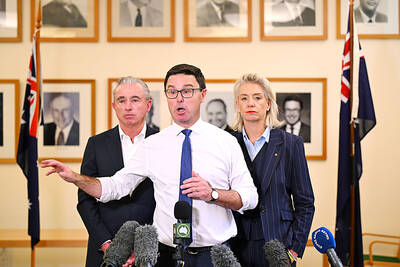
BACKLASH: The National Party quit its decades-long partnership with the Liberal Party after their election loss to center-left Labor, which won a historic third term Australia’s National Party has split from its conservative coalition partner of more than 60 years, the Liberal Party, citing policy differences over renewable energy and after a resounding loss at a national election this month. “Its time to have a break,” Nationals leader David Littleproud told reporters yesterday. The split shows the pressure on Australia’s conservative parties after Prime Minister Anthony Albanese’s center-left Labor party won a historic second term in the May 3 election, powered by a voter backlash against US President Donald Trump’s policies. Under the long-standing partnership in state and federal politics, the Liberal and National coalition had shared power

NO EXCUSES: Marcos said his administration was acting on voters’ demands, but an academic said the move was emotionally motivated after a poor midterm showing Philippine President Ferdinand Marcos Jr yesterday sought the resignation of all his Cabinet secretaries, in a move seen as an attempt to reset the political agenda and assert his authority over the second half of his single six-year term. The order came after the president’s allies failed to win a majority of Senate seats contested in the 12 polls on Monday last week, leaving Marcos facing a divided political and legislative landscape that could thwart his attempts to have an ally succeed him in 2028. “He’s talking to the people, trying to salvage whatever political capital he has left. I think it’s

CONTROVERSY: During the performance of Israel’s entrant Yuval Raphael’s song ‘New Day Will Rise,’ loud whistles were heard and two people tried to get on stage Austria’s JJ yesterday won the Eurovision Song Contest, with his operatic song Wasted Love triumphing at the world’s biggest live music television event. After votes from national juries around Europe and viewers from across the continent and beyond, JJ gave Austria its first victory since bearded drag performer Conchita Wurst’s 2014 triumph. After the nail-biting drama as the votes were revealed running into yesterday morning, Austria finished with 436 points, ahead of Israel — whose participation drew protests — on 357 and Estonia on 356. “Thank you to you, Europe, for making my dreams come true,” 24-year-old countertenor JJ, whose

Polish presidential candidates offered different visions of Poland and its relations with Ukraine in a televised debate ahead of next week’s run-off, which remains on a knife-edge. During a head-to-head debate lasting two hours, centrist Warsaw Mayor Rafal Trzaskowski, from Polish Prime Minister Donald Tusk’s governing pro-European coalition, faced the Eurosceptic historian Karol Nawrocki, backed by the right-wing populist Law and Justice party (PiS). The two candidates, who qualified for the second round after coming in the top two places in the first vote on Sunday last week, clashed over Poland’s relations with Ukraine, EU policy and the track records of their


 RSS
RSS