


As the US marks more than six years without an increase in the federal minimum wage of US$7.25 per hour, 14 US states and several cities are moving forward with their own increases, with most set to start taking effect on Friday.
California and Massachusetts are highest among the states, both increasing from US$9 to US$10 per hour, according to an analysis by the US National Conference of State Legislatures. At the low end is the state of Arkansas, where the minimum wage is increasing from US$7.5 to US$8. The smallest increase — US$0.05 — comes in the state of South Dakota, where the hourly minimum wage is now $8.55.
The increases come in the wake of a series of “living wage” protests across the country — including a November campaign in which thousands of protesters in 270 cities marched in support of a US$15 per hour minimum wage and union rights for fast-food workers. Food-service workers make up the largest group of minimum-wage earners, according to the US Bureau of Labor Statistics.
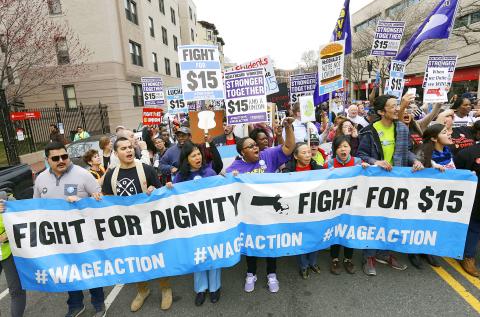
Photo: AP
With Friday’s increases, the new average minimum wage across the 14 affected states rises from US$8.5 an hour to a little more than US$9.
Several cities are going even higher. Seattle is setting a sliding hourly minimum between US$10.5 and US$13 on Jan. 1, and Los Angeles and San Francisco are enacting similar increases in July, en route to US$15 per hour phased in over six years.
Proponents of the move said a higher minimum wage helps to combat poverty, but opponents are concerned about the potential impact on employment and company profits.
Last year, a Democratic-backed congressional proposal to increase the federal minimum wage for the first time since 2009 to US$10.10 stalled, as have subsequent efforts by US President Barack Obama.
More recent proposals by some lawmakers call for a federal minimum wage of up to US$15 per hour.
Princeton University economics professor Alan Krueger said a federal minimum wage of up to US$12 per hour, phased in over five years or so, “would not have a noticeable effect on employment.”
Some employers might cut jobs in response to a minimum-wage increase, Krueger said, while others might find hikes allow them to fill job vacancies and reduce staff turnover, lifting employment but lowering profits.
In recent years, an increasing number of US states and municipalities have enacted their own wage-floor policies. Now, 29 states plus the District of Columbia and about two dozen cities and counties have their minimum wage at levels higher than the federal minimum.
Many are now in the midst of multiyear phase-in plans that would ultimately take them to between US$10 and US$15 per hour.
The 14 states where increases take effect on Friday are: Alaska, Arkansas, California, Colorado, Connecticut, Hawaii, Massachusetts, Michigan, Nebraska, New York, Rhode Island, South Dakota, Vermont and West Virginia.
The non-partisan US Congressional Budget Office estimated last year’s federal proposal would have raised the wages of 16.5 million US citizens and lifted 900,000 of them out of poverty but would have cost as many as 1 million jobs.
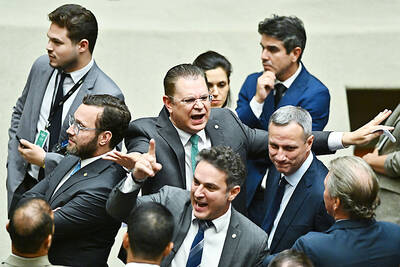
PARLIAMENT CHAOS: Police forcibly removed Brazilian Deputy Glauber Braga after he called the legislation part of a ‘coup offensive’ and occupied the speaker’s chair Brazil’s lower house of Congress early yesterday approved a bill that could slash former Brazilian president Jair Bolsonaro’s prison sentence for plotting a coup, after efforts by a lawmaker to disrupt the proceedings sparked chaos in parliament. Bolsonaro has been serving a 27-year term since last month after his conviction for a scheme to stop Brazilian President Luiz Inacio Lula da Silva from taking office after the 2022 election. Lawmakers had been discussing a bill that would significantly reduce sentences for several crimes, including attempting a coup d’etat — opening up the prospect that Bolsonaro, 70, could have his sentence cut to

A powerful magnitude 7.6 earthquake shook Japan’s northeast region late on Monday, prompting tsunami warnings and orders for residents to evacuate. A tsunami as high as three metres (10 feet) could hit Japan’s northeastern coast after an earthquake with an estimated magnitude of 7.6 occurred offshore at 11:15 p.m. (1415 GMT), the Japan Meteorological Agency (JMA) said. Tsunami warnings were issued for the prefectures of Hokkaido, Aomori and Iwate, and a tsunami of 40cm had been observed at Aomori’s Mutsu Ogawara and Hokkaido’s Urakawa ports before midnight, JMA said. The epicentre of the quake was 80 km (50 miles) off the coast of
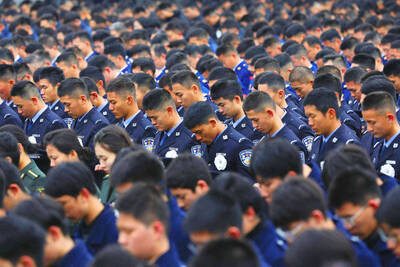
China yesterday held a low-key memorial ceremony for the 1937 Nanjing Massacre, with Chinese President Xi Jinping (習近平) not attending, despite a diplomatic crisis between Beijing and Tokyo over Taiwan. Beijing has raged at Tokyo since Japanese Prime Minister Sanae Takaichi last month said that a hypothetical Chinese attack on Taiwan could trigger a military response from Japan. China and Japan have long sparred over their painful history. China consistently reminds its people of the 1937 Nanjing Massacre, in which it says Japanese troops killed 300,000 people in what was then its capital. A post-World War II Allied tribunal put the death toll
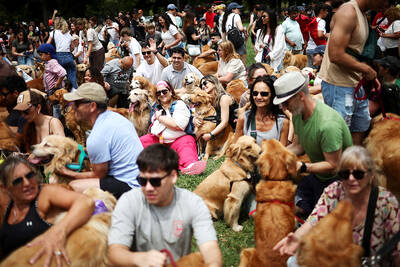
A passerby could hear the cacophony from miles away in the Argentine capital, the unmistakable sound of 2,397 dogs barking — and breaking the unofficial world record for the largest-ever gathering of golden retrievers. Excitement pulsed through Bosques de Palermo, a sprawling park in Buenos Aires, as golden retriever-owners from all over Argentina transformed the park’s grassy expanse into a sea of bright yellow fur. Dog owners of all ages, their clothes covered in dog hair and stained with slobber, plopped down on picnic blankets with their beloved goldens to take in the surreal sight of so many other, exceptionally similar-looking ones.


 RSS
RSS