


US President Barack Obama is to meet with US Attorney General Loretta Lynch on Monday to discuss what he can do to curb gun violence, sidestepping an entrenched US Congress.
In his first weekly radio address of the new year on Friday, Obama said he would talk to Lynch after a months-long examination of the measures he can take on his own to halt what he called “our epidemic of gun violence.”
Recalling the 2012 school shooting in Newtown, Connecticut, that killed 26 people — 20 of them children — and left many grimly hopeful it would lead to an overhaul of in the nation’s gun laws, the president accused lawmakers of bowing to the gun lobby and blocking change.
“All across America, survivors of gun violence and those who lost a child, a parent, a spouse to gun violence are forced to mark such awful anniversaries every single day,” Obama said. “Yet Congress still hasn’t done anything to prevent what happened to them from happening to other families.”
The speech was an explicit return to a theme that Obama has played down in the wake of terrorist attacks that killed 130 people on Nov. 13 in Paris and 14 people on Dec. 2 in San Bernardino, California, both of which were inspired by Muslim extremism.
While Obama’s initial response to the San Bernardino attacks emphasized its commonality with other mass shootings and the need for gun restrictions, Obama’s administration soon realized that this message was failing to reassure the US public that he was taking the threat from Muslim extremism and the Islamic State group seriously enough.
So through much of last month, Obama engaged in public events aimed at convincing the US public that his administration was doing everything it could to battle the Islamic State group. For some US citizens, being vigilant against Muslin extremism involves having more guns — not fewer — and sales of guns surged in the wake of the San Bernardino attack.
The administration sees such a response as counterproductive not only because the number of deaths from gun suicides and routine shootings is far greater than those from terrorist attacks, but also because the availability of weapons here makes such attacks far easier to conduct.
Rather than fight both the anxiety about Muslim extremism and the need for more gun restrictions at the same time, Obama focused on calming the nation.
Now, a month after the San Bernardino attacks, Obama has decided that he can return to his focus on gun measures.
“Because I get too many letters from parents, and teachers, and kids, to sit around and do nothing,” Obama said in his speech Friday.
A bipartisan effort in 2013 to bolster gun control measures after the Newtown shooting was halted in the US Senate, failing to garner the 60 votes needed to expand background checks and to ban assault weapons and high-capacity magazines.
Facing the reality that lawmakers are unlikely to strengthen the nation’s gun laws anytime soon, the administration has been looking at ways Obama can tighten gun sales unilaterally, focusing in particular on who could be considered a high-volume dealer for an executive action that could expand background checks.
However, White House officials have said there are many political and legal challenges to doing so, potentially opening up Obama to renewed criticism that he is abusing his authority.
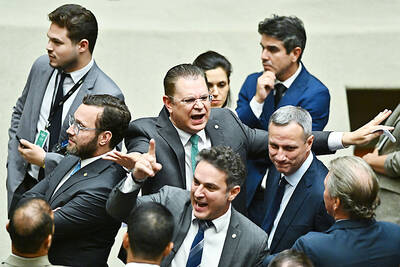
PARLIAMENT CHAOS: Police forcibly removed Brazilian Deputy Glauber Braga after he called the legislation part of a ‘coup offensive’ and occupied the speaker’s chair Brazil’s lower house of Congress early yesterday approved a bill that could slash former Brazilian president Jair Bolsonaro’s prison sentence for plotting a coup, after efforts by a lawmaker to disrupt the proceedings sparked chaos in parliament. Bolsonaro has been serving a 27-year term since last month after his conviction for a scheme to stop Brazilian President Luiz Inacio Lula da Silva from taking office after the 2022 election. Lawmakers had been discussing a bill that would significantly reduce sentences for several crimes, including attempting a coup d’etat — opening up the prospect that Bolsonaro, 70, could have his sentence cut to

A powerful magnitude 7.6 earthquake shook Japan’s northeast region late on Monday, prompting tsunami warnings and orders for residents to evacuate. A tsunami as high as three metres (10 feet) could hit Japan’s northeastern coast after an earthquake with an estimated magnitude of 7.6 occurred offshore at 11:15 p.m. (1415 GMT), the Japan Meteorological Agency (JMA) said. Tsunami warnings were issued for the prefectures of Hokkaido, Aomori and Iwate, and a tsunami of 40cm had been observed at Aomori’s Mutsu Ogawara and Hokkaido’s Urakawa ports before midnight, JMA said. The epicentre of the quake was 80 km (50 miles) off the coast of
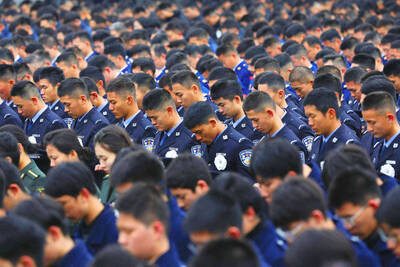
China yesterday held a low-key memorial ceremony for the 1937 Nanjing Massacre, with Chinese President Xi Jinping (習近平) not attending, despite a diplomatic crisis between Beijing and Tokyo over Taiwan. Beijing has raged at Tokyo since Japanese Prime Minister Sanae Takaichi last month said that a hypothetical Chinese attack on Taiwan could trigger a military response from Japan. China and Japan have long sparred over their painful history. China consistently reminds its people of the 1937 Nanjing Massacre, in which it says Japanese troops killed 300,000 people in what was then its capital. A post-World War II Allied tribunal put the death toll

A passerby could hear the cacophony from miles away in the Argentine capital, the unmistakable sound of 2,397 dogs barking — and breaking the unofficial world record for the largest-ever gathering of golden retrievers. Excitement pulsed through Bosques de Palermo, a sprawling park in Buenos Aires, as golden retriever-owners from all over Argentina transformed the park’s grassy expanse into a sea of bright yellow fur. Dog owners of all ages, their clothes covered in dog hair and stained with slobber, plopped down on picnic blankets with their beloved goldens to take in the surreal sight of so many other, exceptionally similar-looking ones.


 RSS
RSS