


Over the weekend, many millions of Chinese watched, gripped and outraged, a 104-minute video that begins with a slight woman in jeans and a white blouse walking onto a stage dimly lit in blue. The woman, Chai Jing (柴靜), shows the somber-looking audience a graph of brown-red peaks with occasional troughs.
“This was the PM2.5 curve for Beijing in January 2013, when there were 25 days of smog in that one month,” said Chai, a former Chinese television reporter, referring to a widely used gauge of air pollution.
At that time, she said, she did not pay much attention to the smog engulfing much of China and affecting 600 million people, even as she traveled for work from place to place where the air was acrid with fumes and dust.
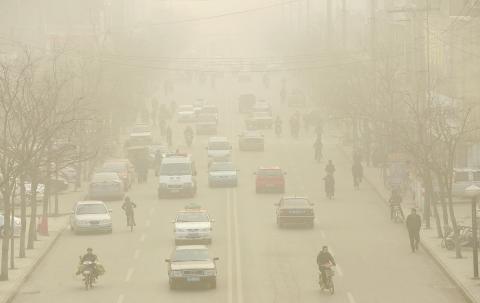
Photo: AFP
“But,” Chai said with a pause, “when I returned to Beijing, I learned that I was pregnant.”
Since its online debut on Saturday, Chai’s documentary, Under the Dome (霧霾調查:穹頂之下) has inspired an unusually passionate eruption of public and mass media discussion.
Chai recounts her journey of discovery, hunting for the sources of China’s bad air and inquiring why repeated government promises have done so little to clear it up, while coping with a daughter born with a tumor. Many messages were from Chinese parents identifying with Chai’s fears that pollution has imperiled their children’s health.
MASKED FEARS
“When I heard her heart beating, the only thing I wished for her was good health,” Chai said of her then-unborn daughter in the documentary.
“But she was diagnosed with a benign tumor and had to have surgery after birth,” she said.
“I’d never felt afraid of pollution before, and never wore a mask no matter where. But when you carry a life in you, what she breathes, eats and drinks are all your responsibility, and then you feel the fear, she said.
On Youku, a popular Chinese video-sharing site, Under the Dome had been played more than 14 million times by Sunday afternoon. The Paper, a Chinese news Web site, estimated that by Saturday night, the documentary had been opened more than 35 million times across various Web sites.
Many Chinese viewers praised Chai for forthrightly condemning the skein of industrial interests, energy conglomerates and bureaucratic hurdles that she says have obstructed stronger action against pollution. Despite online censorship, others took aim at China’s state media, lamenting that Chai was able to make her outcry against pollution only after leaving her job with the state-run China Central Television.
“Support Chai Jing or those like her who stand up like this to speak the truth,” said one of the comments — which exceeded 25,000 by Sunday afternoon — on Youku. “In this messed-up country that’s devoid of law, cold-hearted, numb and arrogant, they’re like an eye-grabbing sign that shocks the soul.”
The documentary is part science lecture, part investigative expose and part memoir, and Chai’s own story has become a focus of praise and criticism.
Chai and her husband were wealthy and privileged enough for her to have given birth in the US, according to a flurry of news reports last year, and some comments accused her of hypocrisy. Newspapers have quoted scientists who have challenged Chai’s suggestion that her daughter’s tumor was caused by smog.
‘NATURAL FOG’
However, online, most of the reaction welcomed her initiative in making the documentary with her own funding and putting it online. Indeed, some have wondered how Chai got away with it.
Under the Dome is critical of the government’s inability to make big inroads in cutting pollution. And under Chinese President Xi Jinping (習近平), restrictions on the news media and Internet in China have become tighter than ever. In years past, Chai said, the government insisted in public that the pollution was just natural fog.
So far at least, the government has not shut off the documentary, and some officials may welcome the chance to build greater support for cutting pollution. The Web site of People’s Daily was one of the first to post Under the Dome. And new Chinese Minister of Environmental Protection Chen Jining (陳吉寧) praised the video. He told Sina.com that he had watched it and sent a message to Chai.
“Chai Jing’s documentary calls for public environmental consciousness from the standpoint of public health,” Chen said. “It deserves admiration.”
Chai, 39, was born in Shanxi Province, a part of China abundant in coal and bathed in noxious pollution. She told the Web site of People’s Daily that she decided to set aside worries about making her daughter the subject of a video.
“If I had not had this kind of emotional impetus, I would have found it very difficult to spend such a long time completing this,” she told the Web site.

Through the noise of rushing papers and whirring belts at a print factory in Kyoto, two creators watch their photo essay come to life in broadsheet form — part of an effort to win new audiences in the age of artificial intelligence (AI). Despite the decline of the publishing industry, self-publication and handmade “zine” magazines are growing in popularity in Japan, reflecting the nation’s enduring love of paper in the digital era. While speaking to Agence France-Presse at the plant, his hands black with ink, one of the creators, Kazuma Obara, said: “I think [paper] is a medium that engages all five

‘CROSSING THE LINE’: China’s embassy in Seoul criticized US Forces Korea Commander General Xavier Brunson, asking if his ‘hostile’ remarks were authorized by Washington South Korea and the US are in talks over recent public remarks by the commander of US Forces Korea, Seoul’s presidential office said yesterday, after the comments drew sharp criticism from China. In a recent podcast interview, US Forces Korea Commander General Xavier Brunson described South Korea as “the dagger in the heart of Asia” from China’s east coast, prompting the Chinese embassy in Seoul to say that he had “truly crossed the line.” The interview came amid growing speculation that Washington might seek to expand the role of US Forces Korea in countering the growing regional influence of China, a key

Australian researchers have trained lab-grown brain cells on a silicon computer chip to play the 1990s shooter game Doom and said they are just scratching the surface of what the neurons could be capable of doing. It is the science-fiction work of biotech boffins at Cortical Labs, who researched and developed the technology that harnesses the workings of the brain’s networking system. Each so-called “biological computer” contains about 200,000 living human brain cells, grown from stem cells that were harvested from blood donations. Having mastered the simple computer game Pong, where a paddle is moved up and down to send a ball
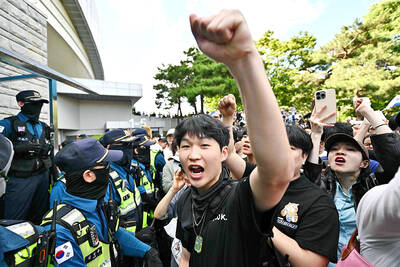
‘ABSURD MISTAKE’: The election commission said that there had been a failure to anticipate turnout after 14 polling stations ran short of ballot papers South Korean riot police yesterday cleared protesters from a Seoul polling station after a 35-hour blockade sparked by a shortage of ballot papers during local elections earlier this week. Wednesday’s election was the first nationwide vote since South Korean President Lee Jae-myung took office following the ouster of Yoon Suk-yeol over his short-lived martial law declaration. Lee’s ruling Democratic Party swept most races, but failed to flip the crucial Seoul mayoral seat. The South Korean National Election Commission apologized, blaming a failure to anticipate turnout after 14 polling stations in Seoul ran short of ballot papers. Some polling stations stayed open until 10pm to


 RSS
RSS