


Hundreds of teenage boys suffered brutal physical and sexual abuse at an Australian naval base, a task force said yesterday, as it slammed the Australian Defence Force for failing to protect them.
The Australian Defence Abuse Response Task force said the shocking and systemic treatment at HMAS Leeuwin between 1960 and 1984 was “much more serious and widespread” than previously acknowledged.
“The pattern of abuse at HMAS Leeuwin was such that Defence knew or ought to have known that abuse was occurring, yet failed to take appropriate action to stop it,” said retired judge Len Roberts-Smith, the task force head.
A national inquiry into abuse in the Australian military was set up by the government in 2012 after the service was rocked by claims of rape and sexual assault, a culture of coverups and a failure to punish perpetrators.
It received thousands of complaints and led to the Australian government making a parliamentary apology to victims.
The abuse at Western Australia’s Leeuwin navy base, which has since closed, was considered so serious that a separate report was instigated to deal with more than 200 complaints from junior recruits, many of whom were 15 or 16 at the time.
It heard that they suffered terrifying assaults, including rape and sodomy, often during humiliating initiation ceremonies at the instruction of senior sailors. Victims told of being stripped and scrubbed with brushes so hard it left them bleeding, and of being so badly beaten that bones were broken.
Others were held down while an object such as a mop handle was forced into their anus or a vacuum cleaner forcibly applied to their genitals.
“I was constantly living in fear that I would be bashed, raped or assaulted. I was constantly in a state of anxiety and this was not a nice way to be,” one recruit told the task force.
Many of them told the inquiry the experiences ruined their later lives and careers, with some blaming it for bouts of depression, broken relationships, and alcohol and substance abuse.
One former Leeuwin recruit said he was still traumatized after two men raped him on the same night at the base.
“I’ve lived with that for 46 years. I still live with it. I have terror every day. I can’t get it out of my mind. I hate nights. I can’t sleep,” he said. “I’m sure the other victims are still suffering as I am today.”
Some alleged abusers are still serving in the military.
Roberts-Smith said the Australian Defence Force let down the young recruits.
“It was responsible for ensuring that HMAS Leeuwin was an establishment at which the care and protection of these children was enabled and encouraged, rather than one where they were able to be abused,” he said. “However, on many occasions at HMAS Leeuwin, Defence failed in this responsibility.”
Navy head Vice Admiral Ray Griggs insisted that the military today was a vastly different organization.

POLITICAL PRISONERS VS DEPORTEES: Venezuela’s prosecutor’s office slammed the call by El Salvador’s leader, accusing him of crimes against humanity Salvadoran President Nayib Bukele on Sunday proposed carrying out a prisoner swap with Venezuela, suggesting he would exchange Venezuelan deportees from the US his government has kept imprisoned for what he called “political prisoners” in Venezuela. In a post on X, directed at Venezuelan President Nicolas Maduro, Bukele listed off a number of family members of high-level opposition figures in Venezuela, journalists and activists detained during the South American government’s electoral crackdown last year. “The only reason they are imprisoned is for having opposed you and your electoral fraud,” he wrote to Maduro. “However, I want to propose a humanitarian agreement that

ECONOMIC WORRIES: The ruling PAP faces voters amid concerns that the city-state faces the possibility of a recession and job losses amid Washington’s tariffs Singapore yesterday finalized contestants for its general election on Saturday next week, with the ruling People’s Action Party (PAP) fielding 32 new candidates in the biggest refresh of the party that has ruled the city-state since independence in 1965. The move follows a pledge by Singaporean Prime Minister Lawrence Wong (黃循財), who took office last year and assumed the PAP leadership, to “bring in new blood, new ideas and new energy” to steer the country of 6 million people. His latest shake-up beats that of predecessors Lee Hsien Loong (李顯龍) and Goh Chok Tong (吳作棟), who replaced 24 and 11 politicians respectively

Young women standing idly around a park in Tokyo’s west suggest that a giant statue of Godzilla is not the only attraction for a record number of foreign tourists. Their faces lit by the cold glow of their phones, the women lining Okubo Park are evidence that sex tourism has developed as a dark flipside to the bustling Kabukicho nightlife district. Increasing numbers of foreign men are flocking to the area after seeing videos on social media. One of the women said that the area near Kabukicho, where Godzilla rumbles and belches smoke atop a cinema, has become a “real
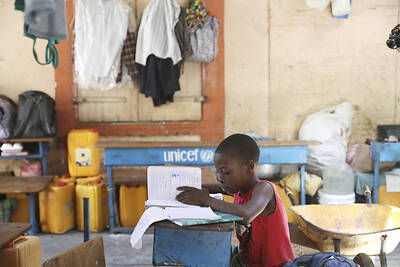
‘POINT OF NO RETURN’: The Caribbean nation needs increased international funding and support for a multinational force to help police tackle expanding gang violence The top UN official in Haiti on Monday sounded an alarm to the UN Security Council that escalating gang violence is liable to lead the Caribbean nation to “a point of no return.” Special Representative of the UN Secretary-General for Haiti Maria Isabel Salvador said that “Haiti could face total chaos” without increased funding and support for the operation of the Kenya-led multinational force helping Haiti’s police to tackle the gangs’ expanding violence into areas beyond the capital, Port-Au-Prince. Most recently, gangs seized the city of Mirebalais in central Haiti, and during the attack more than 500 prisoners were freed, she said.


 RSS
RSS