


US Secretary of Defense Chuck Hagel was expected to visit China’s sole aircraft carrier when he arrived in the country yesterday, a US official said, in an unprecedented opening by Beijing to a potent symbol of its military buildup.
The official believed Hagel would be the first official visitor from outside China to be allowed on board the Liaoning, although that could not be immediately confirmed.
The planned carrier visit, which was to come at the start of Hagel’s three-day trip to China, was quietly approved by Beijing at Washington’s request and had not been previously announced, the official said, speaking on condition of anonymity.
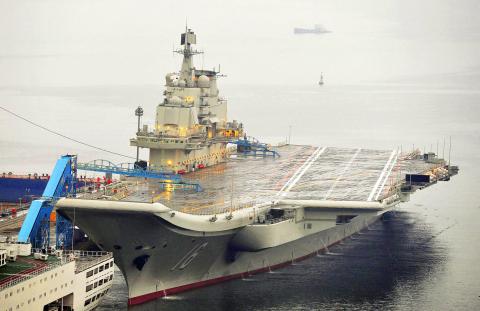
Photo: Reuters
The 60,000-tonne Liaoning, a Soviet-era ship bought from Ukraine in 1998 and refitted in a Chinese shipyard, is seen as a symbol of Beijing’s rapid naval modernization and ambition for greater global influence.
Hagel was to fly to China’s port city of Qingdao after a trip to Japan, and then head to a Chinese naval base.
While there, he was due to visit the Liaoning, the US official said.
Reporters traveling with Hagel were not expected to accompany him on the vessel.
The disclosure of the carrier visit came a day after Hagel said he would use his first trip to China as defense secretary to press Beijing to use its “great power” wisely and respect its neighbors, who have been put on edge by the country’s growing assertiveness in Asia’s disputed waters.
“Coercion, intimidation is a very deadly thing that leads only to conflict,” he said at a news conference on Sunday at the Japanese Ministry of Defense. “All nations, all people deserve respect.”
China claims 90 percent of the 3.5 million square kilometer South China Sea, which is believed to be rich in oil and gas. Taiwan, the Philippines, Vietnam, Malaysia and Brunei all claim parts of those waters.
Beijing has a separate dispute with Tokyo in the East China Sea over uninhabited islets that are administered by Japan. China’s decision in November last year to declare an air defense identification zone in the area that includes those islands sparked protests from the US, Japan and South Korea.
Hagel, in his talks in Japan over the weekend and last week at a gathering of Southeast Asian defense chiefs in Hawaii, has sought to reassure allies of the US security commitment to the region and has promised frank discussions in Beijing.
China, in turn, has repeatedly urged the US not to take sides in any of these disputes, and has watched warily as Washington moves to strengthen its military alliances in the region, especially with Tokyo and Manila.
Indeed, at a time when Washington has stepped up its military presence in the region as part of a strategic “pivot” toward Asia, China is building new submarines, surface ships and anti-ship ballistic missiles, and has tested emerging technology aimed at destroying missiles in mid-air.
The Liaoning is the first step in what Chinese state media and some military experts believe will be China’s deployment of several locally built carriers by 2020.
While Chinese President Xi Jinping (習近平) recently urged China’s military leadership to work faster to get the carrier combat-ready, some Chinese analysts and parts of the state media appear keen to dampen expectations about the Liaoning, which went on its first training mission into the South China Sea late last year.
The Liaoning would serve as a training platform rather than a fighting weapon, some Chinese experts have said.
Considerable doubt also remains over when it will be fully operational. Earlier estimates of two or three years had grown rubbery, with some hints internally that it could stretch to a decade, some experts say.
Nevertheless, as China’s military grows, the US and Chinese navies are expected to increasingly bump up against each other in hot spots in the region.
They hope to build up a mutual understanding that can help avert confrontations in the future and Hagel’s visit to China marks another step in that direction.

A Chinese scientist was arrested while arriving in the US at Detroit airport, the second case in days involving the alleged smuggling of biological material, authorities said on Monday. The scientist is accused of shipping biological material months ago to staff at a laboratory at the University of Michigan. The FBI, in a court filing, described it as material related to certain worms and requires a government permit. “The guidelines for importing biological materials into the US for research purposes are stringent, but clear, and actions like this undermine the legitimate work of other visiting scholars,” said John Nowak, who leads field

Brazil, the world’s largest Roman Catholic country, saw its Catholic population decline further in 2022, while evangelical Christians and those with no religion continued to rise, census data released on Friday by the Brazilian Institute of Geography and Statistics (IBGE) showed. The census indicated that Brazil had 100.2 million Roman Catholics in 2022, accounting for 56.7 percent of the population, down from 65.1 percent or 105.4 million recorded in the 2010 census. Meanwhile, the share of evangelical Christians rose to 26.9 percent last year, up from 21.6 percent in 2010, adding 12 million followers to reach 47.4 million — the highest figure

Swedish campaigner Greta Thunberg was deported from Israel yesterday, the Israeli Ministry of Foreign Affairs said, the day after the Israeli navy prevented her and a group of fellow pro-Palestinian activists from sailing to Gaza. Thunberg, 22, was put on a flight to France, the ministry said, adding that she would travel on to Sweden from there. Three other people who had been aboard the charity vessel also agreed to immediate repatriation. Eight other crew members are contesting their deportation order, Israeli rights group Adalah, which advised them, said in a statement. They are being held at a detention center ahead of a
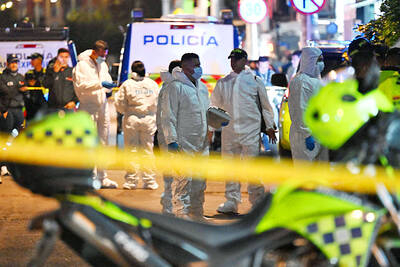
‘THE RED LINE’: Colombian President Gustavo Petro promised a thorough probe into the attack on the senator, who had announced his presidential bid in March Colombian Senator Miguel Uribe Turbay, a possible candidate in the country’s presidential election next year, was shot and wounded at a campaign rally in Bogota on Saturday, authorities said. His conservative Democratic Center party released a statement calling it “an unacceptable act of violence.” The attack took place in a park in the Fontibon neighborhood when armed assailants shot him from behind, said the right-wing Democratic Center, which was the party of former Colombian president Alvaro Uribe. The men are not related. Images circulating on social media showed Uribe Turbay, 39, covered in blood being held by several people. The Santa Fe Foundation


 RSS
RSS