


From the frozen Antarctic to the dry and remote Outback, millions of Australians will cast their ballots on Saturday in an election that poses logistical challenges in a continent-sized country.
Voting is compulsory and a record 14.71 million Australians are registered to make their mark at about 7,500 polling booths set up at schools, surf clubs, church halls and community centers.
However, finding somewhere to vote for either Australian Prime Minister Kevin Rudd’s Labor party, the conservative opposition of Australian Leader of the Opposition Tony Abbott or more than 50 other minor parties is not always easy.
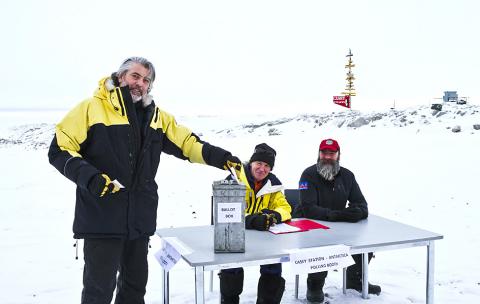
Photo: AFP / AUSTRALIAN ANTARCTIC DIVISION / MICHAEL SALINAS
With many people living in far-flung locations, 38 polling teams began criss-crossing the enormous country two weeks ahead of polling day to reach more than 400 isolated communities.
Residents of Warruwi, a Northern Territory Aboriginal community on South Goulburn Island, were among the first to cast their ballots.
Electoral Commissioner Ed Killesteyn said the teams expected to cover more than 3.4 million square kilometers by road, air and sea to reach pastoral properties, small towns, tourist resorts and mine sites.
“A large proportion of people who vote via the Australian Electoral Commission’s remote mobile polling service live in indigenous communities, with the majority in the Northern Territory,” he said. “There are about 220 electors on the roll in Warruwi. However there are many other smaller communities, such as Mulga Bore [40 voters] and Camel Camp [23 voters] that the AEC also has a responsibility to support this election.”
Anyone who fails to vote faces fines of up to US$170.
Even working and living in one of the most isolated places in the world — Antarctica — is no excuse, despite being 5,500km away from the nearest official polling booth in Tasmania.
The 53 scientists and support staff based at the Antarctic stations of Casey, Davis, Mawson and Macquarie Island must all vote, sending their ballots by ship or via a designated polling officer on site who will phone their decisions through.
Australian Antarctic Division station leader Allan Cooney said it was the first time he was voting in a federal election away from home, and the first time from the Antarctic.
While having only a “watching interest” in topical matters back home, he said voting was very important.
“Voting is a key component to the quality of life we enjoy as Australian citizens in a strong democratic country,” he said, adding that Antarctic staff would stay in touch with the election results online.
“I will be checking how things are going from time to time,” he said. “We don’t have live broadcast options here for television, but there is a delayed option.”
Soldiers serving in Afghanistan and other global hotspots also need to vote, with their ballots being sent back via diplomatic bags. One of the busiest polling stations is not even in Australia.
During the last election in 2010, more than 16,000 people — tourists and expatriates — cast their ballots at the Australian embassy in London, and another 7,700 in Hong Kong. Similar figures are expected this time.
In multicultural Australia, where thousands of people do not speak English well, an official guide to the election is being distributed to every household, translated into 26 languages including Arabic, Burmese, Dinka (a Sudanese dialect) and Assyrian.
It is part of a massive operation — that also involves 50,000 ballot boxes being produced, 100,000 pencils provided and 43 million ballot papers printed — to ensure everyone eligible votes. Despite the logistical difficulties, Australians overwhelmingly abide by their obligation to vote, with a more than 90 percent turnout in 2010 when Labor’s former Australian prime minister Julia Gillard beat Abbott after forming a coalition after neither major party scored an outright win.

Kouri Richins, a Utah mother who published a children’s book about grief after the death of her husband is to serve a life sentence for his murder without the possibility of parole, a judge ruled on Wednesday. Richins was convicted in March of aggravated murder for lacing a cocktail given to her husband, Eric Richins, with five times the lethal dose of fentanyl at their home near Park City in 2022. A jury also found her guilty of four other felonies, including insurance fraud, forgery and attempted murder for trying to poison her husband weeks earlier on Feb. 14, 2022, with a

DELA ROSA CASE: The whereabouts of the senator, who is wanted by the ICC, was unclear, while President Marcos faces a political test over the senate situation Philippine authorities yesterday were seeking confirmation of reports that a top politician wanted by the International Criminal Court (ICC) had fled, a day after gunfire rang out at the Philippine Senate where he had taken refuge fearing his arrest. Senator Ronald “Bato” dela Rosa, the former national police chief and top enforcer of former Philippine president Rodrigo Duterte’s “war on drugs,” has been under Senate protection and is wanted for crimes against humanity, the same charges Duterte is accused of. “Several sources confirmed that the senator, Senator Bato, is no longer in the Senate premises, but we are still getting confirmation,” Presidential

HELP DENIED? The US Department of State said that the Cuban leadership refuses to allow the US to provide aid to Cubans, ‘who are in desperate need of assistance’ US Secretary of State Marco Rubio on Wednesday said that Cuba’s leadership must change, as Washington renewed an offer of US$100 million in aid if the communist nation agrees to cooperate. Cuba has been suffering severe economic tumult led by an energy shortage that plunged 65 percent of the country into darkness on Tuesday. Cuba’s leaders have blamed US sanctions, but Rubio, a Cuban American and critic of the government established by Fidel Castro, said the system was to blame, including corruption by the military. “It’s a broken, nonfunctional economy, and it’s impossible to change it. I wish it were different,” he told

Myanmar yesterday published a parliamentary bill proposing the death sentence for those who detain or violently coerce people into working in online scam centers. Internet fraud factories have flourished in Myanmar, part of Southeast Asia’s scam economy, targeting Internet users worldwide with romance and cryptocurrency investment cons. The multibillion-dollar black market attracts many willing employees, but repatriated foreigners have also reported being trafficked to sites in Myanmar and tortured by scam center operators. The draft legislation would allow capital punishment for “violence, torture, unlawful arrest and detention, or cruel treatment against another person for the purpose of forcing them to commit online scams.” The


 RSS
RSS