


In a rare and remarkable interview posted on YouTube, the teenage grandson of the late North Korean leader Kim Jong-il has provided a glimpse into the secretive world of his country’s ruling dynasty.
During the interview conducted at the school in Bosnia where he studies, Kim Han-sol, nephew of North Korean leader Kim Jong-un, refers to his uncle as “a dictator” and speaks of his wish to “make things better” for the Korean people.
Sporting wide, black-frame glasses, two studs in his left ear and a fashionable haircut, Kim also talks of his close friendships with South Korean and US students and his hopes for the Korean Peninsula’s reunification.

Photo: AFP PHOTO / Cityportal / YLE / Mikko Kelloniemi
Born in Pyongyang in 1995, Kim described a lonely early childhood, spent mostly in the home of his mother’s family — isolated from the grandfather he never actually met and who died in December last year.
“I always wanted to meet him, because I just wanted to know what kind of person he is,” Kim said.
“I was actually waiting for him … until he passed away, hoping he would come find me, because I really didn’t know if he knew that I existed,” he said.
Kim, now 17, is the son of Kim Jong-il’s eldest son, Kim Jong-nam, who fell out of favor with his father following a botched attempt in 2001 to secretly enter Japan using a fake passport and visit Disneyland.
The family has since lived in virtual exile, mainly in Macau.
“My dad was not really interested in politics,” Kim said, when asked why his father was passed over for the dynastic succession in North Korea in favor of his younger brother.
“I don’t really know why he became a dictator,” Kim said of his uncle Kim Jong-un. “It was between him and my grandfather.”
The interview was conducted in English for a Finnish television channel by Elisabeth Rehn, a former UN under-secretary-general and special rapporteur for Human Rights in Bosnia-Hercegovina, and first broadcast on Monday.
“When I was growing up in North Korea, I wasn’t really aware of what was going on there,” Kim said.
“I’ve always dreamed that one day I would go back and make things better and make it easier for the people there,” he added.
Kim enrolled in the United World College in Mostar last year, arousing intense media interest, which he did his best to avoid.
He gave no indication as to why he had chosen to speak out now, or whether the interview had been sanctioned either by his own family or by Pyongyang.
Speaking of his overseas studies, both in Macau and Bosnia, Kim recalled how it was “kind of awkward” when he first met students from South Korea as well as the US.
“But then, little by little, we started understanding each other,” he said. “Now, we are really close friends and we travel together, and it’s such a wonderful feeling.”
“It’s really sad I can’t go to the other side [South Korea],” he added. “But we can, if we put in a little effort, step by step, come to a conclusion and unite.”
After finishing school, Kim said he envisioned himself getting involved in voluntary and humanitarian work aimed at “building world peace.”
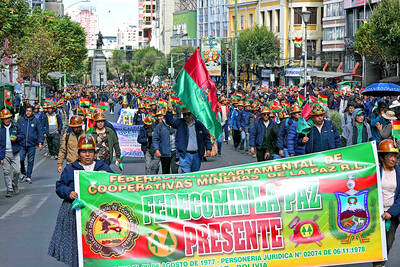
The Bolivian government on Friday struck a deal with protesting miners, but was still grappling with blockades and demonstrations by other workers across La Paz. Other groups are still blocking access roads into the city, which is also the seat of the government. Police on Thursday prevented the miners from entering the main square by using tear gas, while the demonstrators hurled stones and explosives with slingshots. Protests against the policies of Bolivian President Rodrigo Paz have convulsed the Andean nation since early this month, and roadblocks were choking routes into La Paz throughout Friday, the national road authority said. Miners demanded that Paz
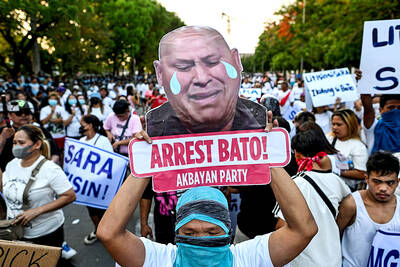
The Philippines said it has asked the country’s Supreme Court to allow it to arrest former Philippine president Rodrigo Duterte’s chief drug war enforcer to stand trial in an international tribunal. The International Criminal Court (ICC) last week unsealed an arrest warrant against Philippine Senator Ronald dela Rosa, accusing him along with Duterte and other “coperpetrators” of the “crime against humanity of murder.” Dela Rosa briefly sought refuge in the Philippine Senate last week while asking the Philippine Supreme Court to stop an ongoing attempt by government agents to arrest him. “By his own conduct, he has placed himself outside the protection of

A ship anchored off the United Arab Emirates (UAE) was seized and taken toward Iran and another — a cargo ship near Oman — sank after being attacked, authorities said on Thursday, as tensions escalated near the Strait of Hormuz. It was not immediately clear who was behind these incidents, but they happened as a senior Iranian official reiterated his country’s claim of control over the waterway and another said it had a right to seize oil tankers connected to the US. The turmoil in the strait has been a sticking point for weeks in talks between the US and Iran to
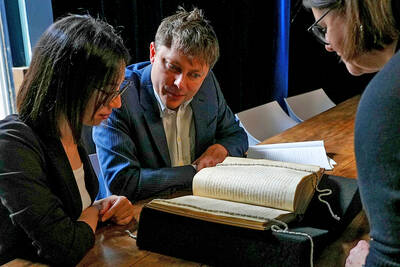
The researchers in Ireland looked at their computer screen, marveling at a medieval book tracked down in a Roman library. They flipped through its digitized pages and found their sought-after treasure: the oldest surviving English poem. “We were extremely surprised. We were speechless. We couldn’t believe our eyes when we first saw that,” said Elisabetta Magnanti, a visiting research fellow at Trinity College Dublin’s school of English. The poem was also within the main body of Latin text, she said, calling it “extraordinary.” Composed in Old English by a Northumbrian agricultural worker in the 7th century, Caedmon’s Hymn appears within some copies of


 RSS
RSS