


The UN General Assembly on Thursday overwhelmingly voted in favor of a resolution backing an Arab League plan that calls for Syrian President Bashar al-Assad to step down and strongly condemning human rights violations by his regime.
In addition, UN Secretary--General Ban Ki-moon accused the Syrian regime of committing “almost certain” crimes against humanity as activists reported fresh violence and the arrest of several prominent dissidents, including a US-born blogger.
The 193-member world body voted 137 to 12 on the Arab--sponsored resolution, with 17 abstentions, and though there are no vetoes in the General Assembly and its resolutions are non-binding, they do reflect world opinion on major issues. Russia and China, who recently vetoed a similar resolution in the Security Council, voted against the -measure along with North Korea, Iran, Venezuela, Cuba and others who heeded Syria’s appeal against the measure.
Thursday’s high “yes” vote was the strongest condemnation so far of al-Assad. The resolution called on the Syrian leader to hand over power to his vice president and immediately stop the bloody crackdown that has killed over 5,400 people.
“Today, the UN General Assembly sent a clear message to the people of Syria: the world is with you,” US Ambassador Susan Rice said in a statement.
Al-Assad “has never been more isolated. A rapid transition to democracy in Syria has garnered the resounding support of the international community. Change must now come,” she added.
In Vienna, the UN secretary--general demanded the Syrian regime stop using indiscriminate force against civilians caught up in fighting between government troops and al-Assad’s opponents.
“We see neighborhoods shelled indiscriminately,” Ban told reporters. “Hospitals used as torture centers. Children as young as ten years old jailed and abused. We see almost certain crimes against humanity.”
Syrian activists said government forces attacked Daraa on Thursday, carrying out arrests and shooting randomly in the city where the uprising against al-Assad erupted 11 months ago. They also reported intense clashes between army defectors and government troops in the central province of Hama.
The Britain-based Syrian Observatory for Human Rights said Syrian troops “committed a new massacre” near the northwestern town of Jisr al-Shughour, killing 19 people — 11 of them from the same family. The report was impossible to confirm.
The push into Daraa, located near the Jordanian border about 130km south of Damascus, -followed sieges of the rebellious cities of Homs and Hama and appears to be part of an effort by the regime to extinguish major pockets of dissent.
Also on Thursday, the Local Coordination Committees, an umbrella group of activists, reported the arrest of several activists, including Razan Ghazzawi, a US-born blogger and press freedom campaigner.
Ghazzawi, who was born in Miami, Florida, was arrested early in the uprising and charged with spreading false information, but she was released after about two weeks.
The committee said security forces also arrested leading human rights activist Mazen Darwish and others during a raid on their Damascus office. The reports could not be immediately confirmed.
The Observatory said security forces killed at least one civilian in Daraa, and that clashes between defectors and government troops there left at least three regime soldiers dead.
The deadliest fighting between troops and defectors took place in the village of Kfar Naboudeh in Hama Province where government forces killed 10 defectors and four civilians, according to the Observatory. The group said the defectors attacked an army checkpoint near the Hama town of Soran, killing four soldiers.
The Syrian revolt started in March with mostly peaceful protests against the al-Assad family dynasty, but the conflict has become far more violent and militarized in recent months as army defectors fight back against government forces.
On Wednesday, al-Assad ordered a Feb. 26 referendum on a new Constitution that would create a multiparty system in Syria, which has been ruled by the same family dynasty for 40 years. Such a change would have been unheard of a year ago, and al-Assad’s regime is touting the new Constitution as the centerpiece of reforms aimed at calming the upheaval.
However, after almost a year of bloodshed and with well over 5,400 dead in the regime’s crackdown on protesters and rebels, al-Assad’s opponents say the referendum and other promises of reform are not enough and that the country’s strongman must go.
Al-Assad’s call for a referendum also raises the question of how a nationwide vote could be held at a time when many areas see daily battles between Syrian troops and rebel soldiers.
Russia, a top Syrian ally, has presented al-Assad’s reform promises as an alternative way to resolve Syria’s bloodshed.
Chinese Vice Foreign Minister Zhai Jun (翟俊) was scheduled to visit Syria yesterday and today for talks on how to end the violence, Chinese Ministry of Foreign Affairs spokesman Liu Weimin (劉為民) said on Thursday. Zhai met a Syrian opposition delegation in Beijing last week.
“I believe the message of this visit is that China hopes for a peaceful and proper resolution of the Syrian situation and that the Chinese side will play a constructive role in the mediation,” Liu said.

HISTORIC: After the arrest of Kim Keon-hee on financial and political funding charges, the country has for the first time a former president and former first lady behind bars South Korean prosecutors yesterday raided the headquarters of the former party of jailed former South Korean president Yoon Suk-yeol to gather evidence in an election meddling case against his wife, a day after she was arrested on corruption and other charges. Former first lady Kim Keon-hee was arrested late on Tuesday on a range of charges including stock manipulation and corruption, prosecutors said. Her arrest came hours after the Seoul Central District Court reviewed prosecutors’ request for an arrest warrant against the 52-year-old. The court granted the warrant, citing the risk of tampering with evidence, after prosecutors submitted an 848-page opinion laying out
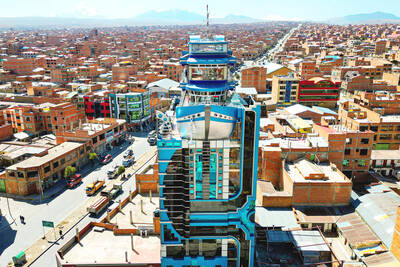
STAGNATION: Once a bastion of leftist politics, the Aymara stronghold of El Alto is showing signs of shifting right ahead of the presidential election A giant cruise ship dominates the skyline in the city of El Alto in landlocked Bolivia, a symbol of the transformation of an indigenous bastion keenly fought over in tomorrow’s presidential election. The “Titanic,” as the tallest building in the city is known, serves as the latest in a collection of uber-flamboyant neo-Andean “cholets” — a mix of chalet and “chola” or Indigenous woman — built by Bolivia’s Aymara bourgeoisie over the past two decades. Victor Choque Flores, a self-made 46-year-old businessman, forked out millions of US dollars for his “ship in a sea of bricks,” as he calls his futuristic 12-story

FORUM: The Solomon Islands’ move to bar Taiwan, the US and others from the Pacific Islands Forum has sparked criticism that Beijing’s influence was behind the decision Tuvaluan Prime Minister Feletei Teo said his country might pull out of the region’s top political meeting next month, after host nation Solomon Islands moved to block all external partners — including China, the US and Taiwan — from attending. The Pacific Islands Forum (PIF) leaders’ meeting is to be held in Honiara in September. On Thursday last week, Solomon Islands Prime Minister Jeremiah Manele told parliament that no dialogue partners would be invited to the annual gathering. Countries outside the Pacific, known as “dialogue partners,” have attended the forum since 1989, to work with Pacific leaders and contribute to discussions around

END OF AN ERA: The vote brings the curtain down on 20 years of socialist rule, which began in 2005 when Evo Morales, an indigenous coca farmer, was elected president A center-right senator and a right-wing former president are to advance to a run-off for Bolivia’s presidency after the first round of elections on Sunday, marking the end of two decades of leftist rule, preliminary official results showed. Bolivian Senator Rodrigo Paz was the surprise front-runner, with 32.15 percent of the vote cast in an election dominated by a deep economic crisis, results published by the electoral commission showed. He was followed by former Bolivian president Jorge “Tuto” Quiroga in second with 26.87 percent, according to results based on 92 percent of votes cast. Millionaire businessman Samuel Doria Medina, who had been tipped


 RSS
RSS