


US President Barack Obama will seek billions of dollars for jobs and infrastructure in his budget for next year, an appeal to voters that draws election-year battle lines over taxes and spending as Republicans slammed him for “debt, doubt and decline.”
Obama’s budget proposal, which he will submit to Congress tomorrow, will project a much smaller deficit next year compared with this year, White House officials said on Friday.
“The budget targets scarce federal resources to the areas critical to growing the economy and restoring middle class security,” the White House said in a statement, echoing Obama’s recent messages on the campaign trial.
The budget gives Obama one of his biggest platforms before the election to tell voters how he would govern in a second White House term, helping him cast Republicans as the party of the rich, while they paint him as a tax-and-spend liberal.
Congress is free to ignore his proposal and Republicans, seeking to defeat him on Nov. 6, declared it dead on arrival.
“This unserious budget is a recipe for debt, doubt and decline,” said Brendan Buck, spokesman for the top Republican lawmaker, Speaker of the US House of Representatives John Boehner.
“It would make our economy worse by imposing massive tax increases on small business and still pile up enormous debt that stirs greater economic uncertainty,” he said.
The budget will include a multi-year request for more than US$800 billion for job creation programs and spending on roads and other surface infrastructure, including more than US$300 billion that could be felt starting this year in tax breaks and other steps to spur hiring.
Obama’s request projects a deficit next year of US$901 billion, down from US$1.33 trillion this year, the officials said.
The numbers, both higher than the White House estimated in September, indicate a deficit equivalent to 5.5 percent of GDP next year, versus 8.5 percent this year.
In addition, recent indicators from the labor market have been better than expected and the White House has already announced that a predicted unemployment rate for this year in the budget of 8.9 percent was “stale” and should be lower.
The US jobless rate fell to 8.3 percent last month.
The president will repeat a call for millionaires to pay a minimum tax rate of 30 percent, named after billionaire investor Warren Buffett, and identify US$4 trillion in deficit-reducing steps over 10 years that echo plans he laid out in September.
More details on the Buffett Rule will come later in the month, together with details of Obama’s proposed minimum international tax on the foreign profits of US firms and his administration’s broad principles of corporate tax reform.
The budget will also propose raising US$1.5 trillion over a decade via higher taxes, with about half coming from allowing tax breaks for families earning more than US$250,000 a year to expire at the end of this year — a longstanding Obama goal.
Breaking down the job and infrastructure spending, the budget would earmark US$476 billion for roads and transportation upgrades over six years, and US$350 billion for job creation.
A senior administration official said that, as much as possible, the money directly aimed at jobs would be funneled into the economy this year to kickstart job creation.
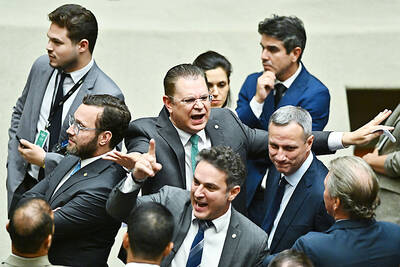
PARLIAMENT CHAOS: Police forcibly removed Brazilian Deputy Glauber Braga after he called the legislation part of a ‘coup offensive’ and occupied the speaker’s chair Brazil’s lower house of Congress early yesterday approved a bill that could slash former Brazilian president Jair Bolsonaro’s prison sentence for plotting a coup, after efforts by a lawmaker to disrupt the proceedings sparked chaos in parliament. Bolsonaro has been serving a 27-year term since last month after his conviction for a scheme to stop Brazilian President Luiz Inacio Lula da Silva from taking office after the 2022 election. Lawmakers had been discussing a bill that would significantly reduce sentences for several crimes, including attempting a coup d’etat — opening up the prospect that Bolsonaro, 70, could have his sentence cut to

A powerful magnitude 7.6 earthquake shook Japan’s northeast region late on Monday, prompting tsunami warnings and orders for residents to evacuate. A tsunami as high as three metres (10 feet) could hit Japan’s northeastern coast after an earthquake with an estimated magnitude of 7.6 occurred offshore at 11:15 p.m. (1415 GMT), the Japan Meteorological Agency (JMA) said. Tsunami warnings were issued for the prefectures of Hokkaido, Aomori and Iwate, and a tsunami of 40cm had been observed at Aomori’s Mutsu Ogawara and Hokkaido’s Urakawa ports before midnight, JMA said. The epicentre of the quake was 80 km (50 miles) off the coast of
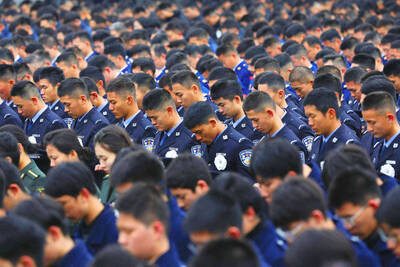
China yesterday held a low-key memorial ceremony for the 1937 Nanjing Massacre, with Chinese President Xi Jinping (習近平) not attending, despite a diplomatic crisis between Beijing and Tokyo over Taiwan. Beijing has raged at Tokyo since Japanese Prime Minister Sanae Takaichi last month said that a hypothetical Chinese attack on Taiwan could trigger a military response from Japan. China and Japan have long sparred over their painful history. China consistently reminds its people of the 1937 Nanjing Massacre, in which it says Japanese troops killed 300,000 people in what was then its capital. A post-World War II Allied tribunal put the death toll
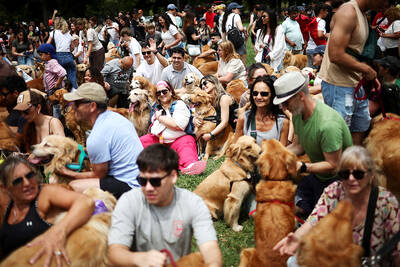
A passerby could hear the cacophony from miles away in the Argentine capital, the unmistakable sound of 2,397 dogs barking — and breaking the unofficial world record for the largest-ever gathering of golden retrievers. Excitement pulsed through Bosques de Palermo, a sprawling park in Buenos Aires, as golden retriever-owners from all over Argentina transformed the park’s grassy expanse into a sea of bright yellow fur. Dog owners of all ages, their clothes covered in dog hair and stained with slobber, plopped down on picnic blankets with their beloved goldens to take in the surreal sight of so many other, exceptionally similar-looking ones.


 RSS
RSS