


Back-to-back typhoons left at least 55 people dead and rescuers scrambling yesterday to deliver food and water to hundreds of villagers stuck on rooftops for four days because of flooding in the northern Philippines.
Typhoon Nalgae slammed ashore in northeastern Isabela province on Saturday, then barreled across Luzon’s mountainous north and agricultural plains that were still sodden from fierce rain and wind unleashed by a howler just days earlier.
Nalgae left at least three people dead on Saturday, while Typhoon Nesat killed 52 others in the same region before blowing out on Friday.
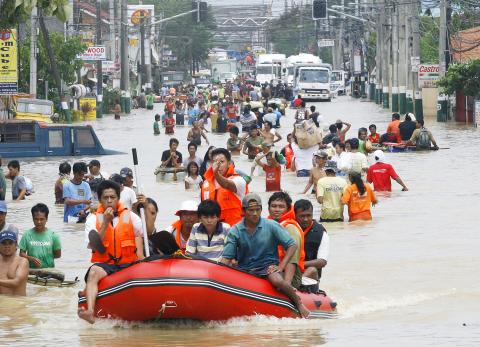
Photo: Reuters
Nalgae was whirling 200km over the South China Sea from the country’s northeast toward southern China early yesterday with sustained winds of 130kph and gusts of 160kph, according to the government weather agency.
Its ferocious wind set off a rockslide in northern Bontoc province on Saturday, causing boulders to roll down a mountainside and hit a passing van, where a passenger was pinned to death and another was injured, police said.
In northern Tarlac province’s Camiling town, an uncle sought safety with his two young nephews as flooding rose in their village on Saturday. However, one of the children was swept away by rampaging waters and drowned while his uncle and brother remained missing. A drunk man drowned in flooding in a nearby village, provincial disaster officer Marvin Guiang said.
Nalgae roared through a similar path across areas on Luzon saturated by Nesat, which trapped thousands on rooftops and sent huge waves that breached a seawall in Manila Bay. Nesat also pummeled southern China and was downgraded to a tropical storm just before churning into northern Vietnam on Friday afternoon, where flood warnings were issued and 20,000 people evacuated.
In the rice-growing province of Bulacan north of Manila, hundreds of residents in flooded Calumpit town remained trapped on rooftops in four villages for the fourth day, many of them desperately waving for help. Rescuers aboard rubber boats could not reach them because of narrow alleyways. Two air force helicopters would be deployed yesterday to drop water and food packs to the marooned villagers, officials said.
Calumpit Mayor James de Jesus pleaded for more help from the national government.
“The ones waving for help are the ones who need to be rescued first because they have elderly people and children with them,” de Jesus told ABS-CBN TV network. “We have a very big problem here ... we’re facing a long flooding.”
Benito Ramos, a retired army general who heads the Office Civil Defense, said floodwater was receding in many areas, but freshly dumped rains by Nalgae may flow down from the mountainous north to the central Luzon provinces of Bulacan and Pampanga, which act like a catch basin. Some officials said water released from nearby dams have exacerbated the flood.
Ramos said many rescuers have not slept for days, including himeself, but were elated to see help from many private groups and provinces unaffected by the typhoons.
“Their resiliency is being tested, but many people are still smiling and waving,” Ramos told reporters by telephone from Calumpit, where he was overseeing rescue work. “It’s grace under pressure.”

ROCKY RELATIONS: The figures on residents come as Chinese tourist numbers drop following Beijing’s warnings to avoid traveling to Japan The number of Chinese residents in Japan has continued to rise, even as ties between the two countries have become increasingly fractious, data released on Friday showed. As of the end of December last year, the number of Chinese residents had increased by 6.5 percent from the previous year to 930,428. Chinese people accounted for 22.6 percent of all foreign residents in Japan, making them by far the largest group, Japanese Ministry of Justice data showed. Beijing has criticized Tokyo in increasingly strident terms since Japanese Prime Minister Sanae Takaichi last year suggested that a military conflict around Taiwan could

A pro-Iran hacking group claimed to breach FBI Director Kash Patel’s personal e-mail inbox and posted some of the contents online. The e-mails provided by the hacking group include travel details, correspondence with leasing agents in Washington and global entry, and loyalty account numbers. The e-mail address the hackers claim to have compromised has been previously tied to Patel’s personal details, and the leaked e-mails contain photos of Patel and others, in addition to correspondence with family members and colleagues. “The FBI is aware of malicious actors targeting Director Patel’s personal email information,” the agency said in a statement on

RIVALRY: ‘We know that these are merely symbolic investigations initiated by China, which is in fact the world’s most profligate disrupter of supply chains,’ a US official said China has started a pair of investigations into US trade practices, retaliating against similar probes by US President Donald Trump’s administration as the superpowers stake out positions before an expected presidential summit in May. The move, announced by the Chinese Ministry of Commerce on Friday, is a direct mirror of steps Trump took to revive his tariff agenda after the US Supreme Court last month struck down some of his duties. “China expresses its strong dissatisfaction and firm opposition to these actions,” a ministry spokesperson said in a statement, referring to the so-called Section 301 investigations initiated on March 11.

When a hiker fell from a 55m waterfall in wild New Zealand bush, rescuers were forced to evacuate the badly hurt woman without her dog, which could not be found. After strangers raised thousands of dollars for a search, border collie Molly was flown to safety by a helicopter pilot who was determined to reunite the pet and the owner. A week earlier, an emergency rescue helicopter found the woman with bruises and lacerations after a fall at a rocky spot at the waterfall on the South Island’s West Coast. She was airlifted on March 24, but they were forced to


 RSS
RSS