


The killing of a Mexican woman purportedly in retaliation for her postings on an anti-crime Web site has left stunned chat users and employees at the newspaper where she worked wondering who can still be safe in the violent border city of Nuevo Laredo.
Press freedom groups condemned the killing of Maria Elizabeth Macias, whose decapitated body and head were found on Saturday next to a message citing posts she wrote on Nuevo Laredo en Vivo, a Web site used by Laredo residents to denounce crime and warn each other about drug cartel gunfights and roadblocks.
Some bloggers vowed to keep up the fight against powerful drug cartels, but warned users to trust no one.
“If we want to regain our peace and our freedom, we always have to fight on, I wouldn’t ask anybody to take up arms, clearly, but with our reports, we can do them damage,” said one poster logged on as “anon9113,” who quickly added a note of distrust. “Don’t become friends with anybody on here ... we have to be careful with something as simple as giving out personal information.”
Another poster agreed: “Exactly, this [Macias’ death] should not be in vain, we should make it an example.”
Others said that despite the risk, they would continue reporting. One user posted that he had seen four drug-gang lookouts in a compact car near a gas station, and gave part of the car’s license plate number.
Macias had previously been identified by an official in Tamaulipas State as Marisol Macias, who had worked as a newsroom manager for the Nuevo Laredo newspaper Primera Hora. However, an editor at Primera Hora said on Monday that Macias was the daily’s advertising supervisor. The editor would not give his name for security reasons.
The editor said the killing apparently was not related to Macias’ job at the daily, which, in the face of intimidation and threats by drug gangs, had stopped even reporting on drug violence two years ago.
“We were taken by surprise, because since about two years ago, we don’t even do crime reporting,” the editor said. “We don’t have a crime reporter.”
He said police have not talked to the paper, nor given it any information on the killing. The paper, according to weekend editions posted on its Web site, has not even reported on her death.
Nuevo Laredo, located across the border from Laredo, Texas, has been dominated for about the last two years by the violent Zetas drug cartel.
Mexico’s Human Rights Commission says eight journalists have been killed in the country this year and 74 since 2000.
With local newspapers forced to avoid crime reporting by threats in many border cities, Mexicans have increasingly turned to local online chat sites like Nuevo Laredo en Vivo to report and read about cartel activity. The site includes numbers to phone in tips to police and the military.
The message found next to Macias’ body on the side of a main thoroughfare on Saturday referred to the nickname she purportedly used on the site, “La Nena de Laredo,” or “Laredo Girl.” Her head was found placed on a stone piling nearby.

PARLIAMENT CHAOS: Police forcibly removed Brazilian Deputy Glauber Braga after he called the legislation part of a ‘coup offensive’ and occupied the speaker’s chair Brazil’s lower house of Congress early yesterday approved a bill that could slash former Brazilian president Jair Bolsonaro’s prison sentence for plotting a coup, after efforts by a lawmaker to disrupt the proceedings sparked chaos in parliament. Bolsonaro has been serving a 27-year term since last month after his conviction for a scheme to stop Brazilian President Luiz Inacio Lula da Silva from taking office after the 2022 election. Lawmakers had been discussing a bill that would significantly reduce sentences for several crimes, including attempting a coup d’etat — opening up the prospect that Bolsonaro, 70, could have his sentence cut to

A powerful magnitude 7.6 earthquake shook Japan’s northeast region late on Monday, prompting tsunami warnings and orders for residents to evacuate. A tsunami as high as three metres (10 feet) could hit Japan’s northeastern coast after an earthquake with an estimated magnitude of 7.6 occurred offshore at 11:15 p.m. (1415 GMT), the Japan Meteorological Agency (JMA) said. Tsunami warnings were issued for the prefectures of Hokkaido, Aomori and Iwate, and a tsunami of 40cm had been observed at Aomori’s Mutsu Ogawara and Hokkaido’s Urakawa ports before midnight, JMA said. The epicentre of the quake was 80 km (50 miles) off the coast of
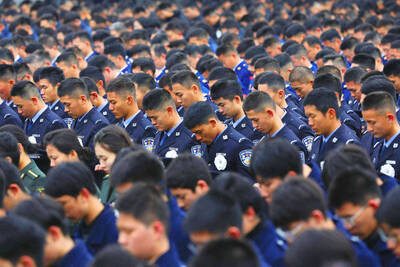
China yesterday held a low-key memorial ceremony for the 1937 Nanjing Massacre, with Chinese President Xi Jinping (習近平) not attending, despite a diplomatic crisis between Beijing and Tokyo over Taiwan. Beijing has raged at Tokyo since Japanese Prime Minister Sanae Takaichi last month said that a hypothetical Chinese attack on Taiwan could trigger a military response from Japan. China and Japan have long sparred over their painful history. China consistently reminds its people of the 1937 Nanjing Massacre, in which it says Japanese troops killed 300,000 people in what was then its capital. A post-World War II Allied tribunal put the death toll

A passerby could hear the cacophony from miles away in the Argentine capital, the unmistakable sound of 2,397 dogs barking — and breaking the unofficial world record for the largest-ever gathering of golden retrievers. Excitement pulsed through Bosques de Palermo, a sprawling park in Buenos Aires, as golden retriever-owners from all over Argentina transformed the park’s grassy expanse into a sea of bright yellow fur. Dog owners of all ages, their clothes covered in dog hair and stained with slobber, plopped down on picnic blankets with their beloved goldens to take in the surreal sight of so many other, exceptionally similar-looking ones.


 RSS
RSS