


Watching TV images of workers frantically dousing the reactors of Japan’s earthquake-wrecked nuclear power plant with water, one man realized he was uniquely placed to help out — he had on hand a truck-mounted pump bigger than any other in the land.
By Wednesday, a bright red Putzmeister pump normally used to pour concrete was towering 58m over the burnt-out remains of reactor No. 4 at the Fukushima Dai-ichi nuclear power plant, filling its spent-fuel pool with sea water at a rate of 160m3 an hour, but getting to that point in the chaotic days that followed the March 11 earthquake and tsunami was no easy matter for Hiroshi Suzuki, head of the Japan branch of a German firm that makes the behemoths.
For one thing the pump was on a ship off Tokyo in transit to a client when the disaster struck, knocking out the plant’s cooling systems.
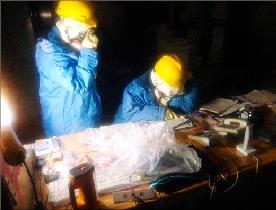
Photo: Reuters/Nuclear and Industrial Safety Agency via Kyodo
Then there was the problem of getting government permission to take it up to the nuclear facility 240km north of Tokyo as concern mounted that the plant could spew radioactive material into the atmosphere.
“I contacted the prime minister’s office with information about our equipment last Tuesday [March 15], but there was no response for about two days,” Suzuki said in a telephone interview. “They may have thought they could manage with their water trucks and fire trucks.”
Suzuki was eventually summoned to the prime minister’s office and given an emergency order allowing him to bring ashore the pump truck, which is so large it is illegal on Japanese roads in normal circumstances.
After the client was persuaded to part with the equipment, he and a colleague drove the pump north of the exclusion zone surrounding the unstable reactors, leaving Suzuki’s worried Australian wife, Juliane, and two teenage children in Tokyo.
There, he trained contractors for the plant’s operators to run the machine and stood by on tenterhooks until it finally cranked into action.
“Honestly speaking, I just did what was necessary, but I was relieved when I heard it was successful,” he said. “We’ve been told it went well today and yesterday, and radiation levels have fallen.”
The mission was a peculiarly personal one for Suzuki, who was born in nearby Sendai and has two relatives still unaccounted for after the March 11 disaster, which has left nearly 26,000 people dead or missing.
Coincidentally, the pump trucks were among those used to seal in the Chernobyl reactor after it exploded in Ukraine in 1986 and sightings of the truck led to media speculation that Japan was planning to do the same at the Fukushima Dai-ichi nuclear power plant.
Of course, Suzuki says, if the decision is ever made to go ahead and build a similar sarcophagus at Fukushima Dai-ichi, the Putzmeister pump can help with that too.
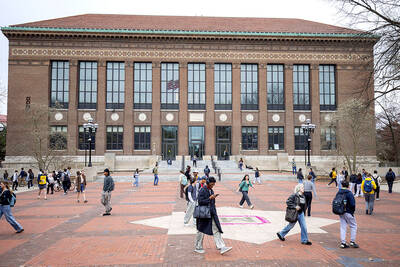
A Chinese scientist was arrested while arriving in the US at Detroit airport, the second case in days involving the alleged smuggling of biological material, authorities said on Monday. The scientist is accused of shipping biological material months ago to staff at a laboratory at the University of Michigan. The FBI, in a court filing, described it as material related to certain worms and requires a government permit. “The guidelines for importing biological materials into the US for research purposes are stringent, but clear, and actions like this undermine the legitimate work of other visiting scholars,” said John Nowak, who leads field

Brazil, the world’s largest Roman Catholic country, saw its Catholic population decline further in 2022, while evangelical Christians and those with no religion continued to rise, census data released on Friday by the Brazilian Institute of Geography and Statistics (IBGE) showed. The census indicated that Brazil had 100.2 million Roman Catholics in 2022, accounting for 56.7 percent of the population, down from 65.1 percent or 105.4 million recorded in the 2010 census. Meanwhile, the share of evangelical Christians rose to 26.9 percent last year, up from 21.6 percent in 2010, adding 12 million followers to reach 47.4 million — the highest figure

Swedish campaigner Greta Thunberg was deported from Israel yesterday, the Israeli Ministry of Foreign Affairs said, the day after the Israeli navy prevented her and a group of fellow pro-Palestinian activists from sailing to Gaza. Thunberg, 22, was put on a flight to France, the ministry said, adding that she would travel on to Sweden from there. Three other people who had been aboard the charity vessel also agreed to immediate repatriation. Eight other crew members are contesting their deportation order, Israeli rights group Adalah, which advised them, said in a statement. They are being held at a detention center ahead of a
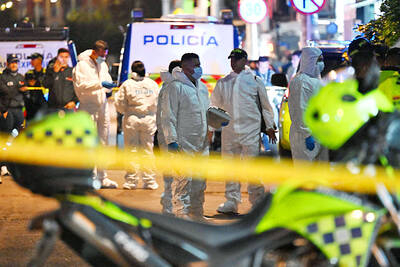
‘THE RED LINE’: Colombian President Gustavo Petro promised a thorough probe into the attack on the senator, who had announced his presidential bid in March Colombian Senator Miguel Uribe Turbay, a possible candidate in the country’s presidential election next year, was shot and wounded at a campaign rally in Bogota on Saturday, authorities said. His conservative Democratic Center party released a statement calling it “an unacceptable act of violence.” The attack took place in a park in the Fontibon neighborhood when armed assailants shot him from behind, said the right-wing Democratic Center, which was the party of former Colombian president Alvaro Uribe. The men are not related. Images circulating on social media showed Uribe Turbay, 39, covered in blood being held by several people. The Santa Fe Foundation


 RSS
RSS