


Jewish groups and others are up in arms over an attempt to outlaw male circumcision in San Francisco by putting the issue to a popular vote.
Self-described “intactivist” Lloyd Schofield has been collecting signatures for a voter initiative that would criminalize infant circumcision in the city.
After two months of collecting names, he claims to be more than half way toward getting the 7,168 signatures he needs by late next month to put the matter on the November ballot.
Schofield and a growing community of anti-circumcision activists say that infants should not be forced to participate in what is essentially culturally accepted genital mutilation.
They claim that the procedure can cause health risks and diminished sexual function and compare it to the clitoridectomies performed on girls in parts of Africa.
“This is a human rights issue,” he said. “What you’re doing is you’re taking an infant and removing the most sensitive part of their body.”
Jewish organizations have pledged to fight the measure should it be placed on the ballot. Anti-Defamation League director Daniel Sandman called Schofield’s effort discriminatory and misguided.
“This is hurtful and offensive to people in the community who consider this a coveted ritual,” he said.
Abby Porth of the Jewish Community Relations Council said Schofield was wasting city resources for an inappropriate political stunt that was unlikely to become law.
“This is one of the most fundamental practices to our tradition of over 3,000 years,” she said. “It’s symbolic of our covenant with God.”
Porth said the Jewish community would form a coalition against the initiative with medical professionals and Muslims, who also practice circumcision.
“It’s very similar to those of the Jewish faith,” said Omar Nawaz of the Bay Area-based Zaytuna College, one of the nation’s only Muslim colleges. “It’s a religious tradition and it’s important for us.”
Both pro- and anti-circumcision advocates make health claims, but the medical research does not firmly support either position.
The American Academy of Pediatrics holds that there are both benefits and risks to infant circumcision, and recommends that parents make the choice for themselves.
Several other health bodies are reviewing the evidence on circumcision with an eye to new policy recommendations.
Circumcision rates among US male infants have dropped in recent decades, but more than half of newborns are still circumcised, according to the Center for Disease Control and Prevention.
If the ban is approved, those caught cutting the foreskins of infants and other minors would face up to a year in jail and up to US$1,000 in fines.
The ban would certainly face legal challenges, and could be found in violation of the First Amendment right to Freedom of Religion.
However, it would not be subject to legislative amendment.
California’s unique voter initiative system allows residents to place virtually anything on the ballot as long as they secure the requisite signatures.

POLITICAL PRISONERS VS DEPORTEES: Venezuela’s prosecutor’s office slammed the call by El Salvador’s leader, accusing him of crimes against humanity Salvadoran President Nayib Bukele on Sunday proposed carrying out a prisoner swap with Venezuela, suggesting he would exchange Venezuelan deportees from the US his government has kept imprisoned for what he called “political prisoners” in Venezuela. In a post on X, directed at Venezuelan President Nicolas Maduro, Bukele listed off a number of family members of high-level opposition figures in Venezuela, journalists and activists detained during the South American government’s electoral crackdown last year. “The only reason they are imprisoned is for having opposed you and your electoral fraud,” he wrote to Maduro. “However, I want to propose a humanitarian agreement that

ECONOMIC WORRIES: The ruling PAP faces voters amid concerns that the city-state faces the possibility of a recession and job losses amid Washington’s tariffs Singapore yesterday finalized contestants for its general election on Saturday next week, with the ruling People’s Action Party (PAP) fielding 32 new candidates in the biggest refresh of the party that has ruled the city-state since independence in 1965. The move follows a pledge by Singaporean Prime Minister Lawrence Wong (黃循財), who took office last year and assumed the PAP leadership, to “bring in new blood, new ideas and new energy” to steer the country of 6 million people. His latest shake-up beats that of predecessors Lee Hsien Loong (李顯龍) and Goh Chok Tong (吳作棟), who replaced 24 and 11 politicians respectively

Young women standing idly around a park in Tokyo’s west suggest that a giant statue of Godzilla is not the only attraction for a record number of foreign tourists. Their faces lit by the cold glow of their phones, the women lining Okubo Park are evidence that sex tourism has developed as a dark flipside to the bustling Kabukicho nightlife district. Increasing numbers of foreign men are flocking to the area after seeing videos on social media. One of the women said that the area near Kabukicho, where Godzilla rumbles and belches smoke atop a cinema, has become a “real
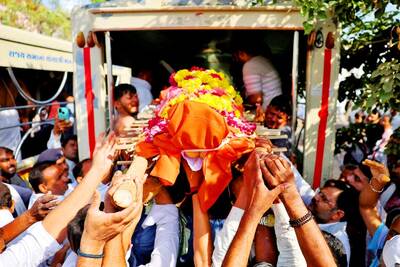
‘WATER WARFARE’: A Pakistani official called India’s suspension of a 65-year-old treaty on the sharing of waters from the Indus River ‘a cowardly, illegal move’ Pakistan yesterday canceled visas for Indian nationals, closed its airspace for all Indian-owned or operated airlines, and suspended all trade with India, including to and from any third country. The retaliatory measures follow India’s decision to suspend visas for Pakistani nationals in the aftermath of a deadly attack by shooters in Kashmir that killed 26 people, mostly tourists. The rare attack on civilians shocked and outraged India and prompted calls for action against their country’s archenemy, Pakistan. New Delhi did not publicly produce evidence connecting the attack to its neighbor, but said it had “cross-border” links to Pakistan. Pakistan denied any connection to


 RSS
RSS