


India’s embattled prime minister yesterday tried to patch things up with a key ally that said would quit his Cabinet, aiming to avert another crisis for a government shaken by a raft of corruption scandals.
The southern Dravida Munnetra Kazhagham (DMK) party, which gave the Congress party-led coalition a slim majority in parliament, said on Saturday it was pulling out its ministers because of a dispute over seats to be contested in state assembly elections next month.
Analysts, however, said the move was more likely linked to a massive telecoms graft scandal that has implicated the DMK and which has called into question Singh’s ability to govern Asia’s third largest economy.
Congress Secretary-General Ghulam Nabi Azad was flying to the southern city of Chennai to meet with leaders of the DMK to try and resolve the crisis, a party official said.
The government is not under immediate threat of collapse because the DMK ministers, who handle departments ranging from textiles to chemicals and fertilizers, have yet to officially tender their resignation and the party has said it would offer issue-based support.
However, if the DMK were to quit, the government would become more vulnerable to pressures from other coalition partners.
The ministers’ withdrawal from the Cabinet could complicate the government’s efforts to pass the 2011-2012 federal budget through parliament’s current session. The government would fall if its loses the budget vote.
The DMK’s move would also make it harder for the government to pass reform bills, including a uniform sales and services tax, a key piece of tax reform that will cut business costs and boost government revenues.
Regulatory concerns, combined with the global economic slowdown have hit foreign direct investment in India and contributed to making the Mumbai stock exchange the worst performing of the world’s major share markets.
Singh’s government is also under attack from the opposition over its inability to tackle rising prices, especially food inflation which, hitting 18 percent in December, is among the highest in Asia.
Singh must either depend on the DMK to support bills or seek other alliance partners.
“The DMK’s move to break the alliance is not about seat sharing. It is about the investigation into the 2G scandal,” said political commentator Cho Ramaswamy, referring to the sale of 2G mobile licenses.
The DMK, which said it was upset over a seat sharing plan in its stronghold southern state of Tamil Nadu, is at the center of the US$39 billion telecoms licensing scandal in which the former telecoms -minister A. Raja, a DMK member, faces possible charges.
Raja was sacked and is now in prison, but there is concern that the federal investigation into the scandal may touch on other top leaders of the DMK, which is led by strongman M. Karunanidhi and members of his family.
The scandal in which telecoms concessions were granted at rock bottom prices has already been widened out to include a probe into a TV channel linked to the DMK.
“The alliance is wounded. The Congress and the DMK have become a liability for themselves,” said Arun Jaitly, a leader of the main opposition Bharatiya Janata Party, which has steadily increased the pressure on Singh.
Singh has seen his unimpeachable reputation dashed following the scandal, said to be independent India’s biggest scam. Last week he suffered another setback when the Supreme Court rejected his appointment of a tainted civil servant as the head of the country’s main anti-graft agency.


Kehinde Sanni spends his days smoothing out dents and repainting scratched bumpers in a modest autobody shop in Lagos. He has never left Nigeria, yet he speaks glowingly of Burkina Faso military leader Ibrahim Traore. “Nigeria needs someone like Ibrahim Traore of Burkina Faso. He is doing well for his country,” Sanni said. His admiration is shaped by a steady stream of viral videos, memes and social media posts — many misleading or outright false — portraying Traore as a fearless reformer who defied Western powers and reclaimed his country’s dignity. The Burkinabe strongman swept into power following a coup in September 2022
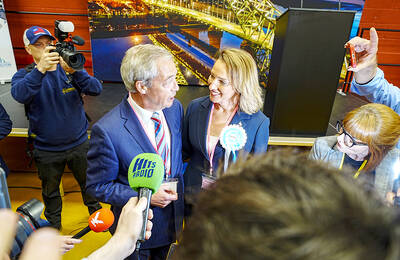
‘FRAGMENTING’: British politics have for a long time been dominated by the Labor Party and the Tories, but polls suggest that Reform now poses a significant challenge Hard-right upstarts Reform UK snatched a parliamentary seat from British Prime Minister Keir Starmer’s Labor Party yesterday in local elections that dealt a blow to the UK’s two establishment parties. Reform, led by anti-immigrant firebrand Nigel Farage, won the by-election in Runcorn and Helsby in northwest England by just six votes, as it picked up gains in other localities, including one mayoralty. The group’s strong showing continues momentum it built up at last year’s general election and appears to confirm a trend that the UK is entering an era of multi-party politics. “For the movement, for the party it’s a very, very big
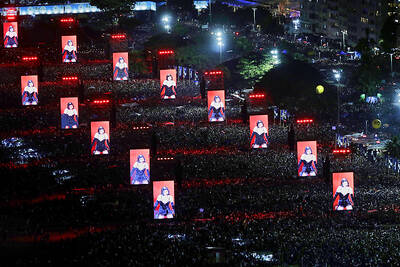
ENTERTAINMENT: Rio officials have a history of organizing massive concerts on Copacabana Beach, with Madonna’s show drawing about 1.6 million fans last year Lady Gaga on Saturday night gave a free concert in front of 2 million fans who poured onto Copacabana Beach in Rio de Janeiro for the biggest show of her career. “Tonight, we’re making history... Thank you for making history with me,” Lady Gaga told a screaming crowd. The Mother Monster, as she is known, started the show at about 10:10pm local time with her 2011 song Bloody Mary. Cries of joy rose from the tightly packed fans who sang and danced shoulder-to-shoulder on the vast stretch of sand. Concert organizers said 2.1 million people attended the show. Lady Gaga

SUPPORT: The Australian prime minister promised to back Kyiv against Russia’s invasion, saying: ‘That’s my government’s position. It was yesterday. It still is’ Left-leaning Australian Prime Minister Anthony Albanese yesterday basked in his landslide election win, promising a “disciplined, orderly” government to confront cost-of-living pain and tariff turmoil. People clapped as the 62-year-old and his fiancee, Jodie Haydon, who visited his old inner Sydney haunt, Cafe Italia, surrounded by a crowd of jostling photographers and journalists. Albanese’s Labor Party is on course to win at least 83 seats in the 150-member parliament, partial results showed. Opposition leader Peter Dutton’s conservative Liberal-National coalition had just 38 seats, and other parties 12. Another 17 seats were still in doubt. “We will be a disciplined, orderly


 RSS
RSS