


A new film from one of the bad boys of Chinese cinema, Jiang Wen (姜文) — a scathing satire on power, greed and corruption — has critics cheering and movie-goers lining up to make it a box office hit.
Let the Bullets Fly, directed by and starring Jiang, raked in 400 million yuan (US$60 million) in its first 11 days of release, putting it on course to smash the ticket sales record for a domestically-made film.
The success of the film comes at the end of a banner year for Chinese cinema, with total annual box office revenues expected to surpass 10 billion yuan for the first time, according to state media.

PHOTO: AFP
The fast-paced movie, which also stars Hong Kong star Chow Yun-fat (周潤發) and local favorite Ge You (葛優), has won acclaim from critics for its satirical treatment of the corruption and graft plaguing contemporary China.
It revolves around a bloody battle in a remote 1920s Chinese town to monopolize local riches between a bandit played by Jiang, who masquerades as the newly appointed county head, and a local warlord played by Chow.
The leading Southern Daily newspaper praised Jiang and said the film’s message would not be lost in a society increasingly divided by a gaping rich-poor income gap.
“Without political corruption in the upper classes ... the blatant plundering of the people by the corrupt gentry would never take place,” the paper said in an opinion piece on the film. “Without the weakness and stupidity of the lower classes, they [the corrupt gentry] would not be able to build their fortresses founded on social injustice.”
One review posted on a blog on the popular portal Netease said the film fully embodied a slogan made famous by Communist revolutionary leader Mao Zedong (毛澤東) — “political power comes from the barrel of a gun.”
Jiang had “exposed and satirized the weaknesses and shortcomings of Chinese society and its people,” it went on. “Dressed up in commercial wrappings, he has packaged a work greatly steeped in political meaning.”
Jiang, 47, reportedly had little if any trouble with China’s strict film censors in releasing the film — a welcome change from a decade ago, when his war-time black comedy Devils on the Doorstep was banned in China in 2000.
That film won the Grand Prix at the Cannes Film Festival, but was apparently barred from the domestic market for portraying the invading Japanese army as too sympathetic, and the Chinese peasantry as too simple-minded.
At the time, Jiang — also one of the country’s top actors — was reportedly prohibited from directing films in China for seven years. It was only in 2007 that his art house film The Sun Also Rises was released in his own country.
A critic on the movie Web site twitchfilm.com praised its broad appeal: “Murder, molestation, dismemberment and even ritual suicide are all handled with a surprising degree of levity that will induce laughter and wincing in equal measure.”
“The script does take a few broad satirical swipes at government corruption and unscrupulous behavior of civil servants, but nothing likely to cause a commotion in Beijing, unlike some of Jiang’s previous efforts,” the review said.
At the box office, Let The Bullets Fly has easily bested the offerings from other noted Chinese directors, such as Feng Xiaogang’s (馮小剛) If You are the One 2 and Chen Kaige’s (陳凱歌) Sacrifice, as the key New Year’s period gets under way.
Feng’s Aftershock, based on an earthquake that devastated a Chinese city more than 30 years ago, is the highest-grossing domestic film to date, grossing 532 million yuan after a three-week run earlier this year.
Its takings are so far however dwarfed by James Cameron’s Avatar, which became China’s all-time box office champion, grossing 1.3 billion yuan, state media said previously.

Through the noise of rushing papers and whirring belts at a print factory in Kyoto, two creators watch their photo essay come to life in broadsheet form — part of an effort to win new audiences in the age of artificial intelligence (AI). Despite the decline of the publishing industry, self-publication and handmade “zine” magazines are growing in popularity in Japan, reflecting the nation’s enduring love of paper in the digital era. While speaking to Agence France-Presse at the plant, his hands black with ink, one of the creators, Kazuma Obara, said: “I think [paper] is a medium that engages all five
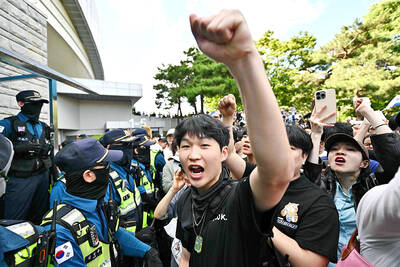
‘ABSURD MISTAKE’: The election commission said that there had been a failure to anticipate turnout after 14 polling stations ran short of ballot papers South Korean riot police yesterday cleared protesters from a Seoul polling station after a 35-hour blockade sparked by a shortage of ballot papers during local elections earlier this week. Wednesday’s election was the first nationwide vote since South Korean President Lee Jae-myung took office following the ouster of Yoon Suk-yeol over his short-lived martial law declaration. Lee’s ruling Democratic Party swept most races, but failed to flip the crucial Seoul mayoral seat. The South Korean National Election Commission apologized, blaming a failure to anticipate turnout after 14 polling stations in Seoul ran short of ballot papers. Some polling stations stayed open until 10pm to

Australian researchers have trained lab-grown brain cells on a silicon computer chip to play the 1990s shooter game Doom and said they are just scratching the surface of what the neurons could be capable of doing. It is the science-fiction work of biotech boffins at Cortical Labs, who researched and developed the technology that harnesses the workings of the brain’s networking system. Each so-called “biological computer” contains about 200,000 living human brain cells, grown from stem cells that were harvested from blood donations. Having mastered the simple computer game Pong, where a paddle is moved up and down to send a ball

France experienced its hottest spring on record, the French weather service said on Tuesday, after an exceptional early heat wave that also broke highs for the season in England and Wales. Meteo-France said the average nationwide temperature over March to May was 13.8°C — about 1.7°C above the norm, and surpassing records set in 2011 and 2020. “The warmest spring since records began in 1900,” it said in a bulletin. All three months were warmer than average, but the onset of an “unprecedented heatwave” late last month pushed the mercury to highs typically seen at the height of the summer. “Our country had never


 RSS
RSS