


Former Iraqi president Saddam Hussein was telling the truth, this time. The US just didn’t believe him.
So it took the most powerful military in the world 18 years to find the remains of the only US Navy pilot shot down in an aerial battle during the 1991 Gulf War.
Michael Scott Speicher’s bones lay 46cm deep in Iraqi sand, more or less right where a group of Iraqis had led a US search team in 1995.
The search for Speicher was frustrated by two wars, mysteriously switched remains, Iraqi duplicity and a final tip from a young nomad in Anbar Province.
US officials were often blinded by the same myopia that tainted prewar intelligence — the US conviction that Hussein’s government lied about everything. As it turned out, the Iraqis lied, but sometimes they told the truth.
For more than a decade, speculation swirled that the 33-year-old Speicher, a lieutenant commander when he went missing, had been captured alive. That was disproved by the team that found and confirmed his remains.
“He wasn’t captured or tortured,” said Thomas Brown, chief of the Intelligence Community POW/MIA (prisoner of war/missing in action) analytic cell at the Defense Intelligence Agency. Brown, who worked on Speicher’s case for 15 years, described in an exclusive interview how the threads leading to the pilot got so tangled.
Speicher was shot down by an Iraqi MiG 160km west of Baghdad on Jan. 17, 1991, the first day of the war to drive Saddam’s invading forces from Kuwait. Then-secretary of defense Dick Cheney announced the pilot’s death as the first casualty of the war, but no search and rescue effort was launched.
When the war ended in March, the US demanded the return of Speicher’s remains, but because of a data glitch, the US erroneously pinpointed his crash site south of Baghdad.
The Iraqis were puzzled. They knew an F-18 had been shot down west of the capital, but they followed the botched US coordinates and searched for Speicher’s plane in the south, finding nothing.
The search was soon complicated by the Iraqi discovery of a different crash site — of a downed Air Force A-10 fighter. The Iraqis brought the unidentified American A-10 pilot’s remains to a Basrah hospital for safekeeping, labeling them “Mickel,” a clumsy translation of what might have been the pilot’s belt buckle manufactured by McDonnell Douglas.
Just before those remains were to be handed over to the US, Shiites rebelling against Saddam seized the hospital, forcing Iraqi officials to make a hasty gamble.
If they didn’t turn over the pilot’s remains, they would be in violation of the UN resolution ending the war, and the war would not be officially over. So the Iraqis instead handed over to US authorities a 1.8kg piece of another cadaver and said it belonged to “Mickel.”
US officials already had accounted for the dead A-10 pilot, so the unidentified remains stumped them. Were they Speicher’s?
By May 1991, DNA tests ruled that out. Iraq was being duplicitous, but the US couldn’t figure out what was behind the switch. Rumors from Hussein’s inner circle about the “Mickel” remains began to morph into whispering that the Iraqis held a live US pilot. The rumors were picked up by US intelligence.
Two years later, in 1993, Speicher’s crash site was found by a party of Qatari falcon hunters. Brown believes the Iraqis had already identified the crash site, but failed to come forward out of fear they would be accused of covering it up. So instead, the Iraqis led the Qatari hunters to the site, Brown said, so they would “stumble” on the wreckage.
The hunters gave the US embassy in Qatar a piece of a plane containing a serial number that matched Speicher’s F-18.
US military officials began planning an operation to retrieve Speicher’s remains. The plan was dropped in 1995 when the Red Cross secured permission from Iraq for a humanitarian search team to excavate the crash site.
Shepherded by Iraqi officials, the search team was led by a local Bedouin boy to Speicher’s half-buried flight suit. Nearby were expended flares, part of an ejection seat and pieces of a life raft, but the searchers found no remains. They left suspicious, convinced that they had been set up even though Brown now says Saddam’s government was telling the truth about the site.
In January 2001, former US president Bill Clinton changed Speicher’s status from killed in action to missing, echoing the US belief he could be alive. An intelligence assessment said Speicher probably had survived the crash and Iraq was either holding him prisoner or hiding his remains.
In the summer of 2002, as the Bush administration prepared to invade Iraq, new intelligence intercepts suggested Speicher was being moved between dozens of secret sites inside Iraq.
Before the 2003 invasion, “we were positive we were getting him back,” said Buddy Harris, a Speicher friend who later married the pilot’s widow. “We were getting ready to go over and meet with him. We had the whole family prepped, with psychologists ready to help.”
At least three different times, based on US government information, Speicher’s relatives thought they were getting him back, Harris said.
Brown believes the Iraqi government was trying to convince former US president George W. Bush that Speicher was still alive to protect Saddam from being targeted when the invasion came.
If that was the motivation, it backfired. Bush used Speicher’s case as more evidence that Saddam had to be ousted. After Bush cited Speicher in his September 2002 speech at the UN, the rumors of Speicher’s movements abruptly stopped, Brown said.
After the US invasion, intelligence analysts searching for Speicher entered the Hakmiya jail in central Baghdad and dug up the grounds. They found remains, but none that matched Speicher’s DNA.
They did find a jail cell wall that appeared to be marked with the initials “M.S.S.” — and wondered if they had been scratched by the missing pilot.
The Army dismantled the wall section and sent it back to the US for testing. That same summer, a soldier discovered similar initials and what appeared to be a date — 9-15-94 — scratched into an I-beam in a parking garage in Tikrit. The FBI cut down the beam and sent it to the Smithsonian Institution for testing.
The markings, however, turned out to be more false leads. The museum determined the Tikrit initials were made with a special ink reserved for Iraqi religious groups — and a US prisoner would not likely have had access to such sacred ink. While other “M.S.S.” markings were found all over Iraq, the analysts were never able to tie them to Speicher.
The searchers continued to press every lead. For six years, soldiers and Marines deployed in Anbar were told to ask people there if they had heard anything about the missing US pilot.
The instructions finally paid off last July. A sheik told Marines of a Bedouin who remembered a burial 20 years earlier. The sheik couldn’t recall the exact location, but it was enough for the Marines. They returned to the old site that had frustrated the Red Cross searchers and with 100 men, bulldozers and back hoes, they turned over four football fields worth of desert, 1.2m deep.
The earth yielded another piece of a pilot’s flight suit and a jaw bone. The teeth matched the missing pilot’s dental records.
Michael Scott Speicher, who reached the rank of captain because he kept receiving promotions while his status was unknown, had been there all along, Brown said.
The US now says the case is closed, but Speicher’s family, from outside Jacksonville, Florida, is still unconvinced that he died in the crash.
Buddy Harris said the ending was too neat, meant to whitewash the Pentagon’s failure to launch a search and rescue mission in 1991.
“Too many people want to tie it into a nice little bow here,” Harris said. “Their motive wasn’t Scott Speicher, it was to get this thing done.”

DOUBLE-MURDER CASE: The officer told the dispatcher he would check the locations of the callers, but instead headed to a pizzeria, remaining there for about an hour A New Jersey officer has been charged with misconduct after prosecutors said he did not quickly respond to and properly investigate reports of a shooting that turned out to be a double murder, instead allegedly stopping at an ATM and pizzeria. Franklin Township Police Sergeant Kevin Bollaro was the on-duty officer on the evening of Aug. 1, when police received 911 calls reporting gunshots and screaming in Pittstown, about 96km from Manhattan in central New Jersey, Hunterdon County Prosecutor Renee Robeson’s office said. However, rather than responding immediately, prosecutors said GPS data and surveillance video showed Bollaro drove about 3km
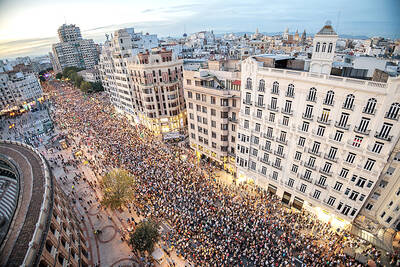
Tens of thousands of people on Saturday took to the streets of Spain’s eastern city of Valencia to mark the first anniversary of floods that killed 229 people and to denounce the handling of the disaster. Demonstrators, many carrying photos of the victims, called on regional government head Carlos Mazon to resign over what they said was the slow response to one of Europe’s deadliest natural disasters in decades. “People are still really angry,” said Rosa Cerros, a 42-year-old government worker who took part with her husband and two young daughters. “Why weren’t people evacuated? Its incomprehensible,” she said. Mazon’s
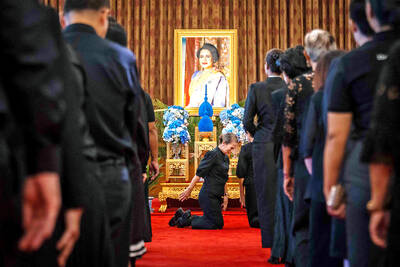
‘MOTHER’ OF THAILAND: In her glamorous heyday in the 1960s, former Thai queen Sirikit mingled with US presidents and superstars such as Elvis Presley The year-long funeral ceremony of former Thai queen Sirikit started yesterday, with grieving royalists set to salute the procession bringing her body to lie in state at Bangkok’s Grand Palace. Members of the royal family are venerated in Thailand, treated by many as semi-divine figures, and lavished with glowing media coverage and gold-adorned portraits hanging in public spaces and private homes nationwide. Sirikit, the mother of Thai King Vajiralongkorn and widow of the nation’s longest-reigning monarch, died late on Friday at the age of 93. Black-and-white tributes to the royal matriarch are being beamed onto towering digital advertizing billboards, on
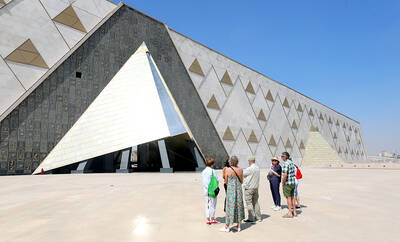
With much pomp and circumstance, Cairo is today to inaugurate the long-awaited Grand Egyptian Museum (GEM), widely presented as the crowning jewel on authorities’ efforts to overhaul the country’s vital tourism industry. With a panoramic view of the Giza pyramids plateau, the museum houses thousands of artifacts spanning more than 5,000 years of Egyptian antiquity at a whopping cost of more than US$1 billion. More than two decades in the making, the ultra-modern museum anticipates 5 million visitors annually, with never-before-seen relics on display. In the run-up to the grand opening, Egyptian media and official statements have hailed the “historic moment,” describing the


 RSS
RSS