


Survivors of Italy's devastating earthquake had little to celebrate as Easter Sunday dawned yesterday after many salvaged what they could from their abandoned homes.
On Saturday, rescue workers said no one remained in the missing column as hundreds of the newly homeless, clutching empty bags and suitcases, waited to be escorted to their ruined homes.
Many refugees from the devastated town of L'Aquila voiced fears of looting following several arrests since the quake on Monday that claimed at least 293 lives, as shown by the latest police toll.
Some 600 police officers were patrolling the walled city founded in the 13th century, the capital of the Abruzzo region with a population of some 70,000.
“I want to find our two cats and pick up some clothes,” said Riccardo Copersini as he waited in line. “Anything else would be extra.”
Also in the line was Vincenzo Rizi, an engineering professor at L’Aquila’s university.
“We all need to rebuild our lives,” he said simply.
Engineers meanwhile began assessing the damage to the estimated 10,000 buildings hit by Monday’s earthquake and the European Commission said construction experts will arrive in the region early next week.
“It's really a difficult situation. It will take a long time,” said Gennaro Tornatore, a fire service chief coordinating rescues. “We're trying to get the situation under control. We’ve got 125 firefighters working on it.”
Strong aftershocks continued to jolt the region, where some 40,000 people have lost their homes. Local administration chief Massimiliano Cordeschi said 18,000 people had registered for inspections of their homes so far.
Italy's space agency, comparing satellite radar images taken before and after the earthquake, said on Saturday that the earth in the region of L’Aquila had shifted by up to 15cm.
Italian Prime Minister Silvio Berlusconi was set to attend an Easter mass in L’Aquila yesterday and other masses were planned in the many tent camps set up in and around the city.
Easter Sunday, the most joyous day on the Christian calendar, celebrates the resurrection of Jesus Christ after his crucifixion.
At a mass funeral for the victims on Friday, Vatican Secretary of State Tarcisio Bertone told survivors that Easter Sunday would “once again be a rebirth from the rubble for a people who have already suffered so many times.”
But at one of the tent camps near L'Aquila, 70-year-old Anna Parisse said she was not looking forward to the holiday in the current situation.
“Unfortunately, we're going to have to celebrate Easter here. It's not going to be the same. I want to be at home with my family,” Parisse said.
She also voiced skepticism about Berlusconi's promises of aid, saying: “I don't trust him ... He just says whatever comes into his head.”
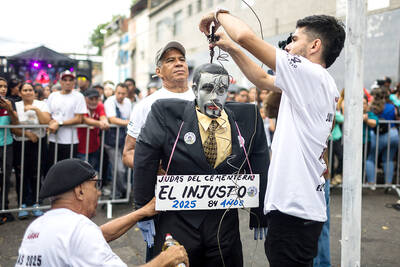
POLITICAL PRISONERS VS DEPORTEES: Venezuela’s prosecutor’s office slammed the call by El Salvador’s leader, accusing him of crimes against humanity Salvadoran President Nayib Bukele on Sunday proposed carrying out a prisoner swap with Venezuela, suggesting he would exchange Venezuelan deportees from the US his government has kept imprisoned for what he called “political prisoners” in Venezuela. In a post on X, directed at Venezuelan President Nicolas Maduro, Bukele listed off a number of family members of high-level opposition figures in Venezuela, journalists and activists detained during the South American government’s electoral crackdown last year. “The only reason they are imprisoned is for having opposed you and your electoral fraud,” he wrote to Maduro. “However, I want to propose a humanitarian agreement that

ECONOMIC WORRIES: The ruling PAP faces voters amid concerns that the city-state faces the possibility of a recession and job losses amid Washington’s tariffs Singapore yesterday finalized contestants for its general election on Saturday next week, with the ruling People’s Action Party (PAP) fielding 32 new candidates in the biggest refresh of the party that has ruled the city-state since independence in 1965. The move follows a pledge by Singaporean Prime Minister Lawrence Wong (黃循財), who took office last year and assumed the PAP leadership, to “bring in new blood, new ideas and new energy” to steer the country of 6 million people. His latest shake-up beats that of predecessors Lee Hsien Loong (李顯龍) and Goh Chok Tong (吳作棟), who replaced 24 and 11 politicians respectively

Young women standing idly around a park in Tokyo’s west suggest that a giant statue of Godzilla is not the only attraction for a record number of foreign tourists. Their faces lit by the cold glow of their phones, the women lining Okubo Park are evidence that sex tourism has developed as a dark flipside to the bustling Kabukicho nightlife district. Increasing numbers of foreign men are flocking to the area after seeing videos on social media. One of the women said that the area near Kabukicho, where Godzilla rumbles and belches smoke atop a cinema, has become a “real
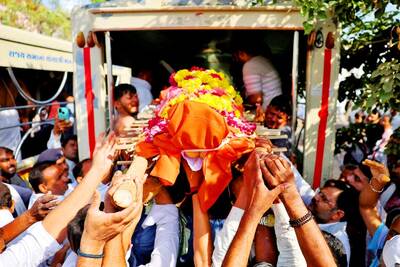
‘WATER WARFARE’: A Pakistani official called India’s suspension of a 65-year-old treaty on the sharing of waters from the Indus River ‘a cowardly, illegal move’ Pakistan yesterday canceled visas for Indian nationals, closed its airspace for all Indian-owned or operated airlines, and suspended all trade with India, including to and from any third country. The retaliatory measures follow India’s decision to suspend visas for Pakistani nationals in the aftermath of a deadly attack by shooters in Kashmir that killed 26 people, mostly tourists. The rare attack on civilians shocked and outraged India and prompted calls for action against their country’s archenemy, Pakistan. New Delhi did not publicly produce evidence connecting the attack to its neighbor, but said it had “cross-border” links to Pakistan. Pakistan denied any connection to


 RSS
RSS