


Chinese security forces on Friday stopped and detained dozens of protesters who tried to storm a university to confront a professor who said nearly all petitioners are mentally ill and should be put away.
Law professor Sun Dongdong’s (孫東東) comments, published in a March issue of China Newsweek magazine, triggered outrage among petitioners who routinely flock to Beijing by the thousands to air complaints after their local governments ignore them.
About 40 people gathered outside the elite Peking University gates on Friday morning, scattering leaflets and shouting for the professor to come out to talk to them. They tried to pass through the gates, but dozens of security forces stopped them. They were then put into buses and taken away.
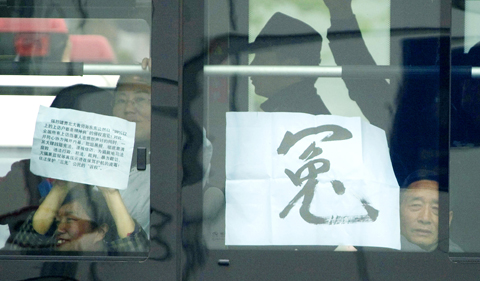
PHOTO: AP
The incident capped more than a week of demonstrations outside the university. So far, dozens of protesters have been sent away on buses or taken away by police, other protesters and state media said.
The situation has drawn fresh attention to the plight of petitioners — mostly from China’s vast and poor countryside — who have come to symbolize the country’s failure to build a justice system that ordinary Chinese consider fair.
More than a case of hurt feelings, petitioners and their supporters worry that Sun’s essay will be used to further lend a professional gloss to the practice of placing petitioners in mental institutions.
“There’s very good reason behind these worries,” said activist lawyer Li Heping (李和平), who has taken on many rights cases.
“Nowadays, there is an overflow of cases involving petitioners being forced into mental hospitals,” he said. “After being labeled as a mental health patient, one loses all rights.”
The system has its roots in China’s imperial past, when people petitioned the emperor. It survived after the Communists took power with “letters and visits” to offices at every level of government to handle grievances. The number of people flooding into the capital in recent years has ballooned, as awareness of legal rights and their infringement by local officials has grown.
But local officials have resorted to various methods outside of the law to stop them, including sending thugs or police that place them in illegal detention centers in Beijing or force them to return home, fearing the grievances will reflect badly on them.
Late last year, the state-run Beijing News newspaper reported on the plight of petitioners placed in mental institutions in eastern Shandong Province, with some forced to take psychiatric drugs and told they would not be released until they signed pledges to drop their complaints.
The government says it receives between 3 million and 4 million letters and visits from petitioners each year, but rights groups put the figure in the tens of millions.
Sun is an associate professor at the law department and head of the university’s forensics department, which also helps court authorities evaluate the mental health of defendants. A well-known adviser to the Ministry of Health, he is also involved in drafting China’s first mental health law, state media said.
He quickly issued a public apology, but his critics have dismissed it as insincere. His department said he was not available for an interview on Friday.


Kehinde Sanni spends his days smoothing out dents and repainting scratched bumpers in a modest autobody shop in Lagos. He has never left Nigeria, yet he speaks glowingly of Burkina Faso military leader Ibrahim Traore. “Nigeria needs someone like Ibrahim Traore of Burkina Faso. He is doing well for his country,” Sanni said. His admiration is shaped by a steady stream of viral videos, memes and social media posts — many misleading or outright false — portraying Traore as a fearless reformer who defied Western powers and reclaimed his country’s dignity. The Burkinabe strongman swept into power following a coup in September 2022

‘FRAGMENTING’: British politics have for a long time been dominated by the Labor Party and the Tories, but polls suggest that Reform now poses a significant challenge Hard-right upstarts Reform UK snatched a parliamentary seat from British Prime Minister Keir Starmer’s Labor Party yesterday in local elections that dealt a blow to the UK’s two establishment parties. Reform, led by anti-immigrant firebrand Nigel Farage, won the by-election in Runcorn and Helsby in northwest England by just six votes, as it picked up gains in other localities, including one mayoralty. The group’s strong showing continues momentum it built up at last year’s general election and appears to confirm a trend that the UK is entering an era of multi-party politics. “For the movement, for the party it’s a very, very big
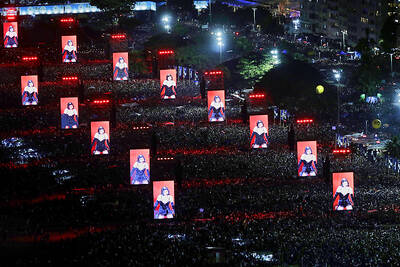
ENTERTAINMENT: Rio officials have a history of organizing massive concerts on Copacabana Beach, with Madonna’s show drawing about 1.6 million fans last year Lady Gaga on Saturday night gave a free concert in front of 2 million fans who poured onto Copacabana Beach in Rio de Janeiro for the biggest show of her career. “Tonight, we’re making history... Thank you for making history with me,” Lady Gaga told a screaming crowd. The Mother Monster, as she is known, started the show at about 10:10pm local time with her 2011 song Bloody Mary. Cries of joy rose from the tightly packed fans who sang and danced shoulder-to-shoulder on the vast stretch of sand. Concert organizers said 2.1 million people attended the show. Lady Gaga

SUPPORT: The Australian prime minister promised to back Kyiv against Russia’s invasion, saying: ‘That’s my government’s position. It was yesterday. It still is’ Left-leaning Australian Prime Minister Anthony Albanese yesterday basked in his landslide election win, promising a “disciplined, orderly” government to confront cost-of-living pain and tariff turmoil. People clapped as the 62-year-old and his fiancee, Jodie Haydon, who visited his old inner Sydney haunt, Cafe Italia, surrounded by a crowd of jostling photographers and journalists. Albanese’s Labor Party is on course to win at least 83 seats in the 150-member parliament, partial results showed. Opposition leader Peter Dutton’s conservative Liberal-National coalition had just 38 seats, and other parties 12. Another 17 seats were still in doubt. “We will be a disciplined, orderly


 RSS
RSS