


Moldovan President Vladimir Voronin called on Friday for a recount of an election, saying it would restore trust and calm after violent demonstrations by protesters alleging the vote was rigged.
Opposition parties said the president’s offer was meaningless and intended to distract attention from mass fraud on voters’ lists. The parties have demanded a new election in the country of 4 million wedged between Ukraine and Romania.
Voronin, Europe’s only ruling communist, asked the Constitutional Court to allow a recount of the April 5 vote, in which the communists finished far in front with nearly 50 percent of the vote.

PHOTO: AP
The court, dominated by his supporters, is likely to agree.
“I, as chairman of the party which gained undoubted victory in the fair and democratic contest, approach the Constitutional Court for a clear decision on the need for a full recount of the votes cast in the parliamentary election,” Voronin said.
“A full recount ... would be an important argument for the restoration of political stability, peace and mutual confidence in the Moldovan Republic,” he said in the request.
The president’s office later said Voronin had met US Ambassador Asif Chaudhry and promised to take steps to create dialogue between the authorities and the opposition.
In Washington, a US State Department spokesman told reporters the US welcomed the call for a recount. He said Chaudhry also met opposition leaders and that on Thursday the opposition was given four days to review voter rolls.
Thousands of demonstrators looted and set fire to the parliament and the president’s offices on Tuesday in the worst violence to sweep Moldova, Europe’s poorest country, in decades.
The president, speaking to reporters on Friday, again blamed opposition parties for the violence.
Voronin has accused EU member Romania of trying to stage a coup as part of plans to annex Moldova, with which it shares ethnic and linguistic ties. He expelled its ambassador and denied entry to Romanian journalists.
The Central Election Commission this week confirmed results showing Voronin’s party winning nearly half the vote — a ruling that implied there would be no recount.
The results gave the communists just short of 50 percent of the vote and 60 seats in the 101-member assembly — one short of the number needed to ensure victory for the party’s candidate when the assembly elects the president.
Eight out of nine court judges in the Constitutional Court were appointed under Voronin.
Opponents said the recount proposal was an attempt to mask fraud. They say thousands of dead people and Moldovans who work abroad were on voters’ lists and had votes cast in their names.
“This is a trick to draw attention from fraud on the voter lists,” said Serafim Urecheanu, leader of Our Moldova, one of three opposition parties to win seats in the election.
He said authorities were hindering checks of the lists although the Commission granted access to them this week.
After 10,000-strong demonstrations on Monday and Tuesday, only about 100 protesters stood outside the government building on Friday. Many held daffodils described as symbols of peace and spring. Dozens of riot police stood behind the building.
“I just came here because I felt so strongly about this,” said Vasile, a teacher. “The nation was deceived.”
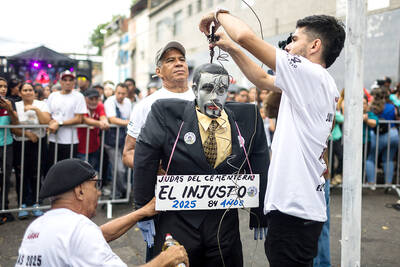
POLITICAL PRISONERS VS DEPORTEES: Venezuela’s prosecutor’s office slammed the call by El Salvador’s leader, accusing him of crimes against humanity Salvadoran President Nayib Bukele on Sunday proposed carrying out a prisoner swap with Venezuela, suggesting he would exchange Venezuelan deportees from the US his government has kept imprisoned for what he called “political prisoners” in Venezuela. In a post on X, directed at Venezuelan President Nicolas Maduro, Bukele listed off a number of family members of high-level opposition figures in Venezuela, journalists and activists detained during the South American government’s electoral crackdown last year. “The only reason they are imprisoned is for having opposed you and your electoral fraud,” he wrote to Maduro. “However, I want to propose a humanitarian agreement that
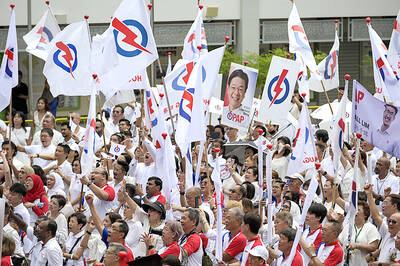
ECONOMIC WORRIES: The ruling PAP faces voters amid concerns that the city-state faces the possibility of a recession and job losses amid Washington’s tariffs Singapore yesterday finalized contestants for its general election on Saturday next week, with the ruling People’s Action Party (PAP) fielding 32 new candidates in the biggest refresh of the party that has ruled the city-state since independence in 1965. The move follows a pledge by Singaporean Prime Minister Lawrence Wong (黃循財), who took office last year and assumed the PAP leadership, to “bring in new blood, new ideas and new energy” to steer the country of 6 million people. His latest shake-up beats that of predecessors Lee Hsien Loong (李顯龍) and Goh Chok Tong (吳作棟), who replaced 24 and 11 politicians respectively

Young women standing idly around a park in Tokyo’s west suggest that a giant statue of Godzilla is not the only attraction for a record number of foreign tourists. Their faces lit by the cold glow of their phones, the women lining Okubo Park are evidence that sex tourism has developed as a dark flipside to the bustling Kabukicho nightlife district. Increasing numbers of foreign men are flocking to the area after seeing videos on social media. One of the women said that the area near Kabukicho, where Godzilla rumbles and belches smoke atop a cinema, has become a “real
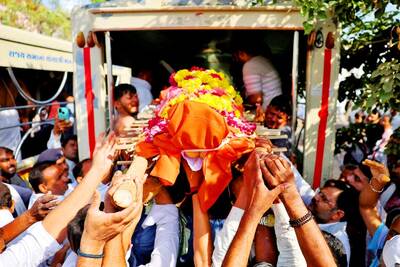
‘WATER WARFARE’: A Pakistani official called India’s suspension of a 65-year-old treaty on the sharing of waters from the Indus River ‘a cowardly, illegal move’ Pakistan yesterday canceled visas for Indian nationals, closed its airspace for all Indian-owned or operated airlines, and suspended all trade with India, including to and from any third country. The retaliatory measures follow India’s decision to suspend visas for Pakistani nationals in the aftermath of a deadly attack by shooters in Kashmir that killed 26 people, mostly tourists. The rare attack on civilians shocked and outraged India and prompted calls for action against their country’s archenemy, Pakistan. New Delhi did not publicly produce evidence connecting the attack to its neighbor, but said it had “cross-border” links to Pakistan. Pakistan denied any connection to


 RSS
RSS