


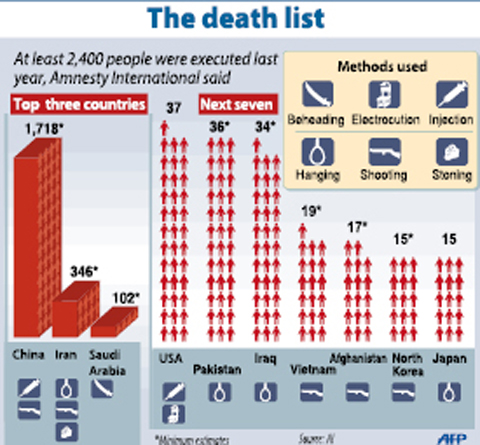
Almost 2,400 people were executed last year, including more than 1,700 in China alone, but the world moved closer toward abolishing the death penalty, Amnesty International said yesterday.
A total of 2,390 people were put to death in 25 countries last year and five states — China, Iran, Pakistan, Saudi Arabia and the US — accounted for 93 percent of the executions, the group said in an annual report.
But Amnesty saw positive signs in the UN’s adoption of a second resolution calling for a moratorium on abolishing the death penalty, saying it “consolidates three decades of steady progress towards complete abolition.”
The rights group noted that the UN General Assembly’s vote in December prompted the African Commission on Human and Peoples’ Rights to urge African states that retain the death penalty to move toward scrapping it.
Amnesty also noted that only 25 of the 59 countries that retain the death penalty actually carried out executions last year, although at least 8,864 people were sentenced to death.
This “indicates that there is increasing consolidation of majority international consensus that the death penalty cannot be reconciled with respect for human rights,” it said.
However, Amnesty said that despite the progress, “tough challenges remain,” especially in Asia, which carried out more executions than the rest of the world put together.
China alone executed at least 1,718 people, with Iran second with 346, followed by Saudi Arabia with at least 102 and the US with 37.
While the US still carried out executions “consistently,” the number of people put to death there last year was the lowest since 1995.
“There is increasing evidence that the USA itself is slowly turning away from the death penalty,” Amnesty said.
It also expressed particular concern about Iran, saying the Islamic republic “continued to execute prisoners who were under 18 at the time of the alleged offense, in flagrant violation of international law.”
Belarus meanwhile was the only country in Europe still to carry out the death sentence, executing four people last year.
Meanwhile, the number of executions worldwide increased significantly last year, with China responsible for almost three-quarters of them.
Last year’s figures show a marked increase from 2007, when the total stood at 1,252, Amnesty said.
Although there has been a trend in recent years for the abandonment of the death penalty, 25 countries executed people last year. Amongst the countries that have increased their rate of executions was Japan, which carried out 15, the highest number for more than 30 years. There were also at least 8,864 death sentences handed down in 52 different countries.


Kehinde Sanni spends his days smoothing out dents and repainting scratched bumpers in a modest autobody shop in Lagos. He has never left Nigeria, yet he speaks glowingly of Burkina Faso military leader Ibrahim Traore. “Nigeria needs someone like Ibrahim Traore of Burkina Faso. He is doing well for his country,” Sanni said. His admiration is shaped by a steady stream of viral videos, memes and social media posts — many misleading or outright false — portraying Traore as a fearless reformer who defied Western powers and reclaimed his country’s dignity. The Burkinabe strongman swept into power following a coup in September 2022

‘FRAGMENTING’: British politics have for a long time been dominated by the Labor Party and the Tories, but polls suggest that Reform now poses a significant challenge Hard-right upstarts Reform UK snatched a parliamentary seat from British Prime Minister Keir Starmer’s Labor Party yesterday in local elections that dealt a blow to the UK’s two establishment parties. Reform, led by anti-immigrant firebrand Nigel Farage, won the by-election in Runcorn and Helsby in northwest England by just six votes, as it picked up gains in other localities, including one mayoralty. The group’s strong showing continues momentum it built up at last year’s general election and appears to confirm a trend that the UK is entering an era of multi-party politics. “For the movement, for the party it’s a very, very big
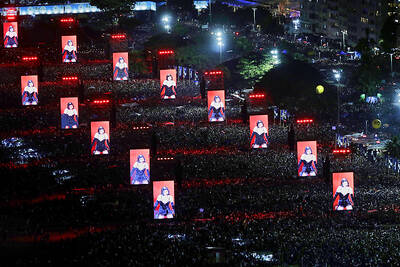
ENTERTAINMENT: Rio officials have a history of organizing massive concerts on Copacabana Beach, with Madonna’s show drawing about 1.6 million fans last year Lady Gaga on Saturday night gave a free concert in front of 2 million fans who poured onto Copacabana Beach in Rio de Janeiro for the biggest show of her career. “Tonight, we’re making history... Thank you for making history with me,” Lady Gaga told a screaming crowd. The Mother Monster, as she is known, started the show at about 10:10pm local time with her 2011 song Bloody Mary. Cries of joy rose from the tightly packed fans who sang and danced shoulder-to-shoulder on the vast stretch of sand. Concert organizers said 2.1 million people attended the show. Lady Gaga

SUPPORT: The Australian prime minister promised to back Kyiv against Russia’s invasion, saying: ‘That’s my government’s position. It was yesterday. It still is’ Left-leaning Australian Prime Minister Anthony Albanese yesterday basked in his landslide election win, promising a “disciplined, orderly” government to confront cost-of-living pain and tariff turmoil. People clapped as the 62-year-old and his fiancee, Jodie Haydon, who visited his old inner Sydney haunt, Cafe Italia, surrounded by a crowd of jostling photographers and journalists. Albanese’s Labor Party is on course to win at least 83 seats in the 150-member parliament, partial results showed. Opposition leader Peter Dutton’s conservative Liberal-National coalition had just 38 seats, and other parties 12. Another 17 seats were still in doubt. “We will be a disciplined, orderly


 RSS
RSS