


Recession or no, billionaire Charles Simonyi couldn’t pass up another shot at space, even if it meant shelling out US$35 million more.
Besides, it may one of the last times the Russian government allows tourists to hitch a ride to the International Space Station.
“It’s now or never,” said Simonyi, who has now spent US$60 million for a couple of space vacations.
The first was US$25 million.
A computer genius who helped build Microsoft, Simonyi will become the world’s first two-time space tourist when he leaves Earth behind on Thursday. He’ll be accompanied by two professional astronauts — a Russian and American — who will be going up for a six-month stint at the space station.
His own trip will last under two weeks, and it will be his last.
“I’m not getting any younger,” the 60-year-old said in a recent telephone interview. He’ll be one of the older men to fly in space, though nowhere near John Glenn’s record at age 77.
Besides, he’s promised his new wife, Lisa Persdotter, a 28-year-old Swedish socialite, that this will be his final spaceflight.
He told her about his plans when they got engaged and “she was very supportive, but, but to a limit, mainly. Just once,” Simonyi said with a chuckle.
He’s quick to point out this is his first marriage, and he’s taking one of their engagement rings with him into orbit.
The Hungarian-born Simonyi, who lives in suburban Seattle, is among six rich people who have bought tickets to space through Virginia-based Space Adventures.
NASA, the major stakeholder in the space station, may not love the idea of hosting tourists — “spaceflight participants” as it calls them. But the initial concerns back in 2001 have eased over the years with the addition of guidelines.
Space station program manager Mike Suffredini has spoken to Simonyi, just as he has with everyone going up, to make sure the visitor understands his limitations at the orbiting complex.
“It really has to do with their safety,” as well as the safety of the others and the space station itself, Suffredini said.
“They’re extremely restricted” in what they can do on the US side.
All this may soon be moot: Russian space officials have indicated that after this year, there will be no more seats available to tourists. That’s because the space station crew is about to double in size to six — hopefully by the end of May — and professional fliers will fill all the slots.
After he returned from his two-week space station trip in April 2007, Simonyi said Russian cosmonauts told him how different and rewarding it was to go back up a second time. With doors closing on future tourist flights, Simonyi did not want to miss out.
Because the training for his first flight was so recent, Simonyi got the abridged version, three months at cosmonaut headquarters in Star City, Russia, versus six to eight months before. He will return to Earth on April 7 in a Soyuz capsule.
“I look at it as a continuation of the first flight,” Simonyi said. “The reasons are the same. It’s to support space research, it’s to popularize civilian space flight and communicate the excitement of sciences and engineering to our kids.”
Simonyi’s own interest in space was kindled in childhood. He represented Hungary as a junior cosmonaut, when he was 13, and won a trip to Moscow to meet one of the first Soviet spacemen. His interest in computer programming eventually led him to the US; he’s been a US citizen for 27 years.
Simonyi — who has a doctorate in computer science and is a licensed pilot — led the development of Microsoft Word and Excel. He left Microsoft in 2002 and founded Intentional Software Corp as well as the Charles Simonyi Fund for Arts and Sciences.
“It’s a super-wide screen, and the Earth is fantastic blue,” he said of the view in space.
His wife of four months will be at the launching site in Kazakhstan, along with about a dozen other family and friends.
Microsoft Corp co-founder Bill Gates, who was an usher at Simonyi’s wedding, can’t make it.
It’s ironic, Simonyi said, that he left Hungary in 1966 as a teenager, frustrated by Soviet secrecy, and now Russia is allowing him to fulfill his dream — again.
“Who would have thought? The irony of this is amazing,” he said.

When a hiker fell from a 55m waterfall in wild New Zealand bush, rescuers were forced to evacuate the badly hurt woman without her dog, which could not be found. After strangers raised thousands of dollars for a search, border collie Molly was flown to safety by a helicopter pilot who was determined to reunite the pet and the owner. A week earlier, an emergency rescue helicopter found the woman with bruises and lacerations after a fall at a rocky spot at the waterfall on the South Island’s West Coast. She was airlifted on March 24, but they were forced to
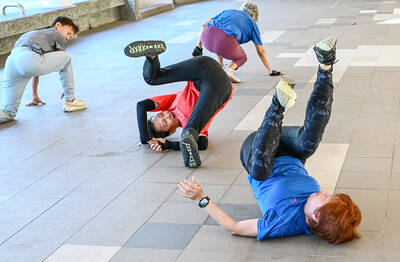
CONFIDENCE BOOSTER: ’After parkour ... you dare to do a lot of things that you think only young people can do,’ a 67-year-old parkour enthusiast said In a corner of suburban Singapore, Betty Boon vaults a guardrail, crawls underneath a slide, executes forward shoulder rolls and scales a steep slope, finishing the course to applause. “Good job,” the 69-year-old’s coach cheers. This is “geriatric parkour,” where about 20 retirees learned to tackle a series of relatively demanding exercises, building their agility and enjoying a sense of camaraderie. Boon, an upbeat grandmother, said learning parkour has aided her confidence and independence as she ages. “When you’re weak, you will be dependent on someone,” she said after sweating it out with her parkour classmates in suburban Toa Payoh,

Chinese dissident artist Gao Zhen (高兟), famous for making provocative satirical sculptures of former Chinese leader Mao Zedong (毛澤東), was tried on Monday over accusations of “defaming national heroes and martyrs,” his wife and a rights group said. Gao, 69, who was detained in 2024 during a visit from the US, faces a maximum three-year prison sentence, said his wife, Zhao Yaliang (趙雅良), and Shane Yi, a researcher at the Chinese Human Rights Defenders group which operates outside the nation. The closed-door, one-day trial took place at Sanhe City People’s Court in Hebei Province neighboring the capital, Beijing, and ended without a

‘TOXIC CLIMATE’: ‘I don’t really recognize Labour anymore... The idea that you can implement far-right ideas in order to stop the far right is nonsense,’ a protester said Tens of thousands of people on Saturday marched through central London to protest against the far right, weeks ahead of local elections and six months after Britain saw one of its largest far-right demonstrations. Organized by hundreds of civic groups, including trade unions, anti-racism campaigners and Muslim representative bodies, Saturday’s Together Alliance event was billed as the biggest in UK history to counter right-wing extremism. A separate pro-Palestinian march had also converged with the main rally. While organizers claimed 500,000 had turned out in total, the police gave a figure of about 50,000. Protesters carrying placards with slogans such as


 RSS
RSS