


A crude bomb exploded prematurely in the southern Philippines, wounding a seven-year-old girl, another passer-by and two suspected Muslim rebels who allegedly carried the device, officials said yesterday.
The suspects were on a motorcycle when the bomb, made from an 81mm mortar shell, accidentally went off late on Thursday in front of a restaurant in Shariff Aguak town in Maguindanao Province — scene of sporadic clashes between army troops and rebels, the military said.
The seven-year-old girl and a woman were wounded by shrapnel and taken to a hospital, said military spokesman Major Randolph Cabangbang. The two would-be bombers were also hurt and placed in police custody while an investigation continued, he said.
The province is a stronghold of Moro Islamic Liberation Front (MILF) rebels, who have been fighting for self-rule in the predominantly Roman Catholic nation’s south for decades.
Fresh violence erupted two months ago when the Supreme Court blocked the signing of a proposed accord on an expanded Muslim autonomous region, prompting three rebel commanders to go on a deadly rampage in several predominantly Christian communities.
Philippine President Gloria Macapagal Arroyo has ordered the arrest of the commanders and suspended Malaysian-brokered peace talks with the rebel group. More than 100 civilians have been killed and about 375,000 displaced in the fighting.
In the days before Thursday’s explosion, government troops had disarmed three other homemade bombs at a bus depot in Kabacan town in neighboring North Cotabato Province. Army spokesman Lieutenant Colonel Julieto Ando blamed the rebels for planting the bombs.
The rebels did not comment immediately but in the past have denied such accusations.
Residents in nearby Shariff Kabunsuan Province, meanwhile, were awakened early yesterday by a series of powerful explosions. The military said that a fire, possibly caused by a defective cannon shell, triggered explosives in an ammunition dump inside an army camp, but there were no casualties.
Military investigators ruled out sabotage in the blaze that destroyed the depot just before dawn, officials said.
The fire, which lasted nearly two hours, ignited mortar ammunition stored inside the facility and set off a series of blasts, triggering panic among the public wary of attacks from Muslim separatist rebels, officials said.
An initial investigation showed the fire might have been started by “exposure of white phosporous charges” that created sparks, military spokesman Lieutenant Colonel Ernesto Torres said in Manila.
“Sabotage is not apparent,” he said.
“The investigation is still ongoing,” he said, adding that the facility was heavily secured and is located in between two hills as a safety precaution in any event of accidental explosions.
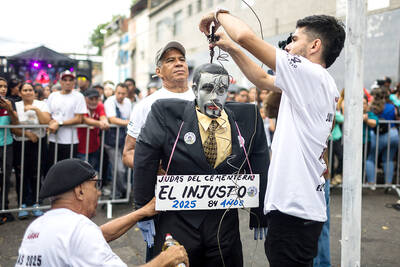
POLITICAL PRISONERS VS DEPORTEES: Venezuela’s prosecutor’s office slammed the call by El Salvador’s leader, accusing him of crimes against humanity Salvadoran President Nayib Bukele on Sunday proposed carrying out a prisoner swap with Venezuela, suggesting he would exchange Venezuelan deportees from the US his government has kept imprisoned for what he called “political prisoners” in Venezuela. In a post on X, directed at Venezuelan President Nicolas Maduro, Bukele listed off a number of family members of high-level opposition figures in Venezuela, journalists and activists detained during the South American government’s electoral crackdown last year. “The only reason they are imprisoned is for having opposed you and your electoral fraud,” he wrote to Maduro. “However, I want to propose a humanitarian agreement that

ECONOMIC WORRIES: The ruling PAP faces voters amid concerns that the city-state faces the possibility of a recession and job losses amid Washington’s tariffs Singapore yesterday finalized contestants for its general election on Saturday next week, with the ruling People’s Action Party (PAP) fielding 32 new candidates in the biggest refresh of the party that has ruled the city-state since independence in 1965. The move follows a pledge by Singaporean Prime Minister Lawrence Wong (黃循財), who took office last year and assumed the PAP leadership, to “bring in new blood, new ideas and new energy” to steer the country of 6 million people. His latest shake-up beats that of predecessors Lee Hsien Loong (李顯龍) and Goh Chok Tong (吳作棟), who replaced 24 and 11 politicians respectively

Young women standing idly around a park in Tokyo’s west suggest that a giant statue of Godzilla is not the only attraction for a record number of foreign tourists. Their faces lit by the cold glow of their phones, the women lining Okubo Park are evidence that sex tourism has developed as a dark flipside to the bustling Kabukicho nightlife district. Increasing numbers of foreign men are flocking to the area after seeing videos on social media. One of the women said that the area near Kabukicho, where Godzilla rumbles and belches smoke atop a cinema, has become a “real
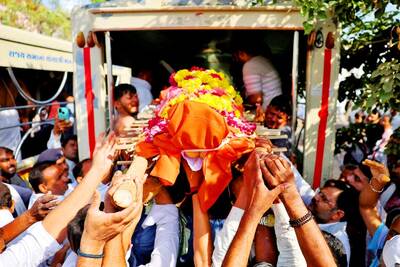
‘WATER WARFARE’: A Pakistani official called India’s suspension of a 65-year-old treaty on the sharing of waters from the Indus River ‘a cowardly, illegal move’ Pakistan yesterday canceled visas for Indian nationals, closed its airspace for all Indian-owned or operated airlines, and suspended all trade with India, including to and from any third country. The retaliatory measures follow India’s decision to suspend visas for Pakistani nationals in the aftermath of a deadly attack by shooters in Kashmir that killed 26 people, mostly tourists. The rare attack on civilians shocked and outraged India and prompted calls for action against their country’s archenemy, Pakistan. New Delhi did not publicly produce evidence connecting the attack to its neighbor, but said it had “cross-border” links to Pakistan. Pakistan denied any connection to


 RSS
RSS