


British Prime Minister Gordon Brown arrived in Baghdad yesterday for talks with his Iraqi counterpart and other leaders in a bid to push economic rebuilding in the violence-wracked country.
An Iraqi government statement said Brown was expected to discuss bilateral relations with the Iraqi leaders and also “study the future of the British presence in Basra” in the south.
This is Brown’s third visit to Iraq since he took over from former British prime minister Tony Blair on June 27 last year.
His visit comes a day after Washington and Baghdad agreed to set a “time-horizon” for the withdrawal of US troops as part of a security pact between the two countries.
Brown is expected to use his trip to push for reconstruction and investment in the Iraqi economy, particularly in the second city of Basra, where Britain’s 4,000 troops in Iraq are based.
The 57-year-old, who spent 10 years as finance minister under Blair, wants to help kick-start the economy in Basra and boost the southern oil city’s status as an economic hub for the wider region.
Senior British commanders on the ground believe conditions are right for a surge in economic development, with a rise in prosperity likely to help cement stability in the south.
Brown is also expected to express his support for the local elections slated for Oct. 1, with Britain stressing reconciliation and keen to see provincial councils become more representative.
He is also likely to discuss the role of Britain’s forces, based at Basra air station outside the city, which are on “overwatch” duties — training local troops but retaining the capacity to intervene if required by Iraqi forces.
In his last major statement on Iraq in October, Brown said Britain’s strategy in Iraq was firstly to ensure political harmony, then security and then “work for an economy in Iraq where people have a stake in the future.”
Major General Barney White-Spunner, Britain’s top commander in Iraq, said on Monday that Basra’s greatest need now was economic investment to develop its potential.
“Basra has got the oil, gas, port, people, airport and now it has security,” he said. “We now need economic development.”
Since 2003, Britain has pledged a total commitment of £744 million (US$1.49 billion) toward reconstruction in Iraq.
In Basra and the surrounding area, British reconstruction efforts so far have focused on institution-building, to ramp up the capacity of local authorities to plan for, access and spend funds.
Britain had intended to reduce troop numbers to 2,500 earlier this year, though conditions have not yet permitted this to happen.
Jock Stirrup, Britain’s head of armed forces, said on Thursday he expected troop numbers to drop in the first half next year.
White-Spunner said militias still remained a threat in Basra, despite a March offensive against them by Iraqi forces that killed hundreds of people.
Brown last visited Iraq on Dec. 9 to announce the Dec. 16 handover of security control of Basra Province.
British troops have transferred security control to local forces in all four provinces that were under their supervision.
A total of 176 British troops have died in Iraq since the 2003 US-led invasion, two this year.
At least 136 were killed by hostile action. British troop numbers involved in the Iraq operation peaked at 46,000 in March and April 2003 for the invasion.
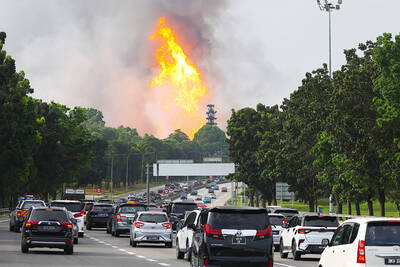
A fire caused by a burst gas pipe yesterday spread to several homes and sent a fireball soaring into the sky outside Malaysia’s largest city, injuring more than 100 people. The towering inferno near a gas station in Putra Heights outside Kuala Lumpur was visible for kilometers and lasted for several hours. It happened during a public holiday as Muslims, who are the majority in Malaysia, celebrate the second day of Eid al-Fitr. National oil company Petronas said the fire started at one of its gas pipelines at 8:10am and the affected pipeline was later isolated. Disaster management officials said shutting the
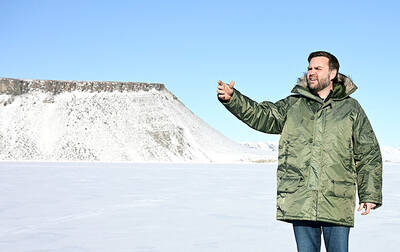
US Vice President J.D. Vance on Friday accused Denmark of not having done enough to protect Greenland, when he visited the strategically placed and resource-rich Danish territory coveted by US President Donald Trump. Vance made his comment during a trip to the Pituffik Space Base in northwestern Greenland, a visit viewed by Copenhagen and Nuuk as a provocation. “Our message to Denmark is very simple: You have not done a good job by the people of Greenland,” Vance told a news conference. “You have under-invested in the people of Greenland, and you have under-invested in the security architecture of this
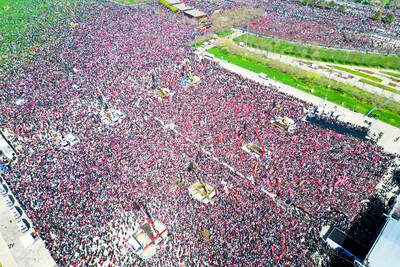
UNREST: The authorities in Turkey arrested 13 Turkish journalists in five days, deported a BBC correspondent and on Thursday arrested a reporter from Sweden Waving flags and chanting slogans, many hundreds of thousands of anti-government demonstrators on Saturday rallied in Istanbul, Turkey, in defence of democracy after the arrest of Istanbul Mayor Ekrem Imamoglu which sparked Turkey’s worst street unrest in more than a decade. Under a cloudless blue sky, vast crowds gathered in Maltepe on the Asian side of Turkey’s biggest city on the eve of the Eid al-Fitr celebration which started yesterday, marking the end of Ramadan. Ozgur Ozel, chairman of the main opposition Republican People’s Party (CHP), which organized the rally, said there were 2.2 million people in the crowd, but
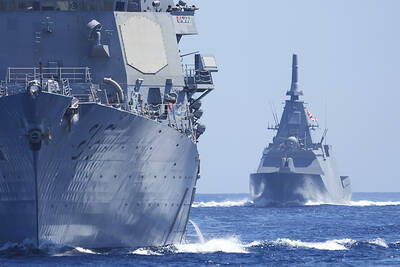
JOINT EFFORTS: The three countries have been strengthening an alliance and pressing efforts to bolster deterrence against Beijing’s assertiveness in the South China Sea The US, Japan and the Philippines on Friday staged joint naval drills to boost crisis readiness off a disputed South China Sea shoal as a Chinese military ship kept watch from a distance. The Chinese frigate attempted to get closer to the waters, where the warships and aircraft from the three allied countries were undertaking maneuvers off the Scarborough Shoal — also known as Huangyan Island (黃岩島) and claimed by Taiwan and China — in an unsettling moment but it was warned by a Philippine frigate by radio and kept away. “There was a time when they attempted to maneuver


 RSS
RSS