


As Lithuania’s post-Soviet generation comes of age, a local theater troupe is making sure the evils of the communist past are not forgotten.
It is offering a three-hour refresher course — as KGB prisoners.
“These few hours should provide a quintessential Soviet-era experience,” said Ruta Vanagaite, producer of the interactive show that runs in a former bunker in Naujasode, 25km from the capital Vilnius.
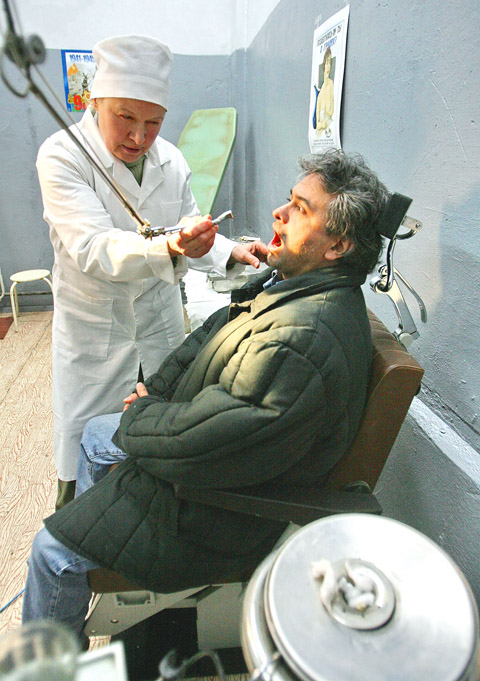
PHOTO: AFP
“By the end visitors should feel how, under a totalitarian regime, they are nothing,” she said. “They should realize how much progress there’s been over the past 17 years.”
Before heading 4m underground, participants begin a journey back in time by swigging a cup of ersatz coffee and donning a fufaika, the quilted cotton jacket worn by prisoners in the Soviet gulag.
From then on, the curious tourist is treated as a simple “comrade-prisoner” — obliged to respond to barked questions and commands from a half-dozen actors with a simple yes or no.
After saluting the Soviet flag, participants are made to perform physical exercises, such as squatting, running and rolling in a blanket while wearing a gas mask.
The ryhthm is dictated by an actor in KGB uniform, who screeches orders in Russian as his German shepherd dog strains on its leash.
The Orwellian show is set in 1984, and takes place in a bunker that until 1991 housed emergency radio and TV transmitters which were meant to be used if a NATO attack knocked out other Soviet facilities.
Lithuania, which was occupied by the Soviet Union during World War II, declared independence in 1990 and won international recognition a year later as the Soviet bloc crumbled.
In the early years, Soviet rule was notoriously brutal.
Some 360,000 Lithuanians were jailed, killed or deported to the gulags of Siberia and central Asia in the 1940s and 1950s.
In later decades, lower-level repression became the norm, although in a last gasp the Soviet regime cracked down on the Lithuanian independence movement in January 1991, killing 14 civilians.
Today’s Lithuania is a democratic, free-market nation with previously unimaginable opportunities for a new generation in its population of 3.4 million — notably since EU membership in 2004 opened the road for tens of thousands to work abroad.
For Lithuania’s teenagers, 20 and 30-somethings, the Soviet era is a non-existent or distant memory, while a swathe of older people who missed out on the benefits of change are nostalgic for the relative economic security.
“Half the population of this country misses the Soviet period and around half a million young Lithuanians never lived through it,” Vanagaite said.
In the bunker, visitors are forced to sit through Soviet-style May Day speeches, littered with praise for global communism and homages to steelworkers and the people of Cuba.
They are also treated to a medical check-up, where a doctor threatens to use a vintage dental drill on them.
The most unpleasant part of the show, however, is still to come.
The entire group of about 30 visitors is made to face the wall with their hands up, then a male participant is picked out.
In a booming voice, an actor playing a KGB interrogator browbeats the hapless individual into confessing that he has stolen from the factory where he works — an act of “anti-Soviet sabotage.”
Trying not to crack under pressure, or even attempting outright resistance, is a bad idea: The bunker has its own solitary confinement cell.
The tension only falls towards the end, as the “released” visitors are allowed to visit a Soviet-style store and leave with a toilet roll that is a soft as sandpaper.
Students make up a large percentage of the bunker’s visitors, although they are given a toned-down version of the show.
Adults have to sign a disclaimer which informs them that they risk verbal abuse and will have to perform physical exercise.
After the show, visitors are treated to an ultra-Soviet supper of tinned beef and a glass of vodka.
“I was curious to get taken back to this period, but for me it was really just a show, because I’ve drawn a line under the past,” said Lina, an accountant who was in her early teens when Lithuania won its independence.
Jolanta, a teacher in her forties, added: “Young people must come here to feel even a little bit of what we went through.”

Malaysia yesterday installed a motorcycle-riding billionaire sultan as its new king in lavish ceremonies for a post seen as a ballast in times of political crises. The coronation ceremony for Malaysia’s King Sultan Ibrahim, 65, at the National Palace in Kuala Lumpur followed his oath-taking in January as the country’s 17th monarch. Malaysia is a constitutional monarchy, with a unique arrangement that sees the throne change hands every five years between the rulers of nine Malaysian states headed by centuries-old Islamic royalty. While chiefly ceremonial, the position of king has in the past few years played an increasingly important role. Royal intervention was

X-37B COMPARISON: China’s spaceplane is most likely testing technology, much like US’ vehicle, said Victoria Samson, an official at the Secure World Foundation China’s shadowy, uncrewed reusable spacecraft, which launches atop a rocket booster and lands at a secretive military airfield, is most likely testing technology, but could also be used for manipulating or retrieving satellites, experts said. The spacecraft, on its third mission, was last month observed releasing an object, moving several kilometers away and then maneuvering back to within a few hundred meters of it. “It’s obvious that it has a military application, including, for example, closely inspecting objects of the enemy or disabling them, but it also has non-military applications,” said Marco Langbroek, a lecturer in optical space situational awareness at Delft

The Philippine Air Force must ramp up pilot training if it is to buy 20 or more multirole fighter jets as it modernizes and expands joint operations with its navy, a commander said yesterday. A day earlier US National Security Adviser Jake Sullivan said that the US “will do what is necessary” to see that the Philippines is able to resupply a ship on the Second Thomas Shoal (Renai Shoal, 仁愛暗沙) that Manila uses to reinforce its claims to the atoll. Sullivan said the US would prefer that the Philippines conducts the resupplies of the small crew on the warship Sierra Madre,

AIRLINES RECOVERING: Two-thirds of the flights canceled on Saturday due to the faulty CrowdStrike update that hit 8.5 million devices worldwide occurred in the US As the world continues to recover from massive business and travel disruptions caused by a faulty software update from cybersecurity firm CrowdStrike, malicious actors are trying to exploit the situation for their own gain. Government cybersecurity agencies across the globe and CrowdStrike CEO George Kurtz are warning businesses and individuals around the world about new phishing schemes that involve malicious actors posing as CrowdStrike employees or other tech specialists offering to assist those recovering from the outage. “We know that adversaries and bad actors will try to exploit events like this,” Kurtz said in a statement. “I encourage everyone to remain vigilant


 RSS
RSS