


French voters have sent a warning to President Nicolas Sarkozy and his conservative government, favoring leftists in the first round of local elections that were seen as a test for his presidency and his reform agenda.
Pollsters' projections showed the Socialists and their allies in the lead in key cities from Sunday's first round -- but overall, the left's lead was slim, and the decisive runoffs a week away remained an open battleground.
With more than 76 percent of ballots counted, candidates from Sarkozy's UMP party and its allies had 45.5 percent of the nationwide vote, official results from the interior ministry showed. The Socialists and their allies had 47 percent.
That could put the long struggling leftists on track for gains in the runoff voting on Sunday, reversing defeats in the last municipal voting in 2001. Voters are choosing mayors and other local leaders in more than 36,000 towns and cities nationwide.
While most voters chose based on local matters like maternity wards or garbage service, Sarkozy's dynamic persona loomed large over the elections. The president himself sought to infuse them with national import.
Analysts warned that the bid could backfire on the increasingly unpopular president, and that the overall outcome could affect Sarkozy's appetite for reforms to the euro zone's No. 2 economy.
French Prime Minister Francois Fillon insisted that would not be the case.
"We will hold our course on reforms," he said on Sunday night, urging voters not to confuse local issues with national ones.
Segolene Royal, the Socialist who lost in the presidential race against Sarkozy last spring, said France was punishing Sarkozy for the rising cost of living and meager rise in pensions among other issues.
Patrick Devedjian, chief of Sarkozy's party, acknowledged that the initial results were "not good."
Sarkozy's once-soaring popularity ratings have withered in recent weeks amid increasing frustration with what critics call his ostentatious and impetuous presidential style.
He won the presidency on pledges to make France more competitive by easing rigid labor laws and lowering taxes, but has pushed through mostly minor reforms. Meanwhile, inflation is up and consumer confidence down.
The Socialist-led left had the advantage going into Sunday's first-round elections.
Initial results showed that Paris City Hall looked set to stay in the hands of Socialist Mayor Bertrand Delanoe, who has tried to cut car traffic and pollution and is angling for a presidential bid in 2012.
Leftists also hung onto power in Lyon and were on track to oust conservatives in Strasbourg and Reims in the east and Rouen and Caen in the west, according to partial results and polling agency projections by the Ipsos and TNS-Sofres polling agencies.
The conservatives held their own in several cities, keeping Bordeaux and running neck-and-neck with Socialists in Marseille and Toulouse.
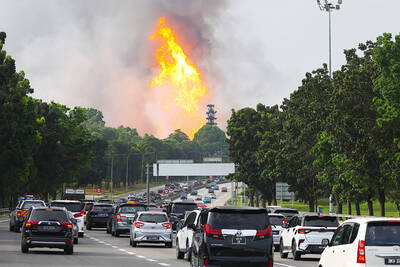
A fire caused by a burst gas pipe yesterday spread to several homes and sent a fireball soaring into the sky outside Malaysia’s largest city, injuring more than 100 people. The towering inferno near a gas station in Putra Heights outside Kuala Lumpur was visible for kilometers and lasted for several hours. It happened during a public holiday as Muslims, who are the majority in Malaysia, celebrate the second day of Eid al-Fitr. National oil company Petronas said the fire started at one of its gas pipelines at 8:10am and the affected pipeline was later isolated. Disaster management officials said shutting the
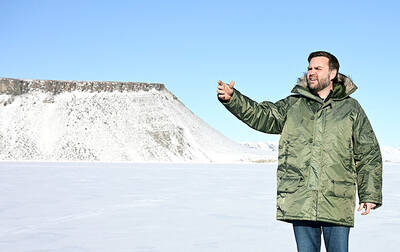
US Vice President J.D. Vance on Friday accused Denmark of not having done enough to protect Greenland, when he visited the strategically placed and resource-rich Danish territory coveted by US President Donald Trump. Vance made his comment during a trip to the Pituffik Space Base in northwestern Greenland, a visit viewed by Copenhagen and Nuuk as a provocation. “Our message to Denmark is very simple: You have not done a good job by the people of Greenland,” Vance told a news conference. “You have under-invested in the people of Greenland, and you have under-invested in the security architecture of this

Japan unveiled a plan on Thursday to evacuate around 120,000 residents and tourists from its southern islets near Taiwan within six days in the event of an “emergency”. The plan was put together as “the security situation surrounding our nation grows severe” and with an “emergency” in mind, the government’s crisis management office said. Exactly what that emergency might be was left unspecified in the plan but it envisages the evacuation of around 120,000 people in five Japanese islets close to Taiwan. China claims Taiwan as part of its territory and has stepped up military pressure in recent years, including
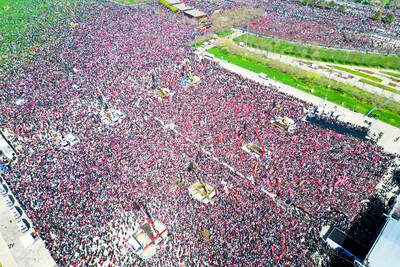
UNREST: The authorities in Turkey arrested 13 Turkish journalists in five days, deported a BBC correspondent and on Thursday arrested a reporter from Sweden Waving flags and chanting slogans, many hundreds of thousands of anti-government demonstrators on Saturday rallied in Istanbul, Turkey, in defence of democracy after the arrest of Istanbul Mayor Ekrem Imamoglu which sparked Turkey’s worst street unrest in more than a decade. Under a cloudless blue sky, vast crowds gathered in Maltepe on the Asian side of Turkey’s biggest city on the eve of the Eid al-Fitr celebration which started yesterday, marking the end of Ramadan. Ozgur Ozel, chairman of the main opposition Republican People’s Party (CHP), which organized the rally, said there were 2.2 million people in the crowd, but


 RSS
RSS